
Torsion bei WEA-Betontürmen
Projektdaten
| Titel | Title Torsionstragmodell zusammengesetzter Halbschalensegmente aus Beton auf Basis der Stabtheorie | Torsion model of assembled half-shell segments made of concrete based on the beam theory Förderer | Funding Deutsche Forschungsgemeinschaft (DFG) Zeitraum | Period 03/2025 – 02/2028 Projektleiter | Project leader Prof. Dr.-Ing. Steffen Marx Bearbeiter | Contributor Max Götze Florian Fürll (ehemalig | former) |
Kurzfassung
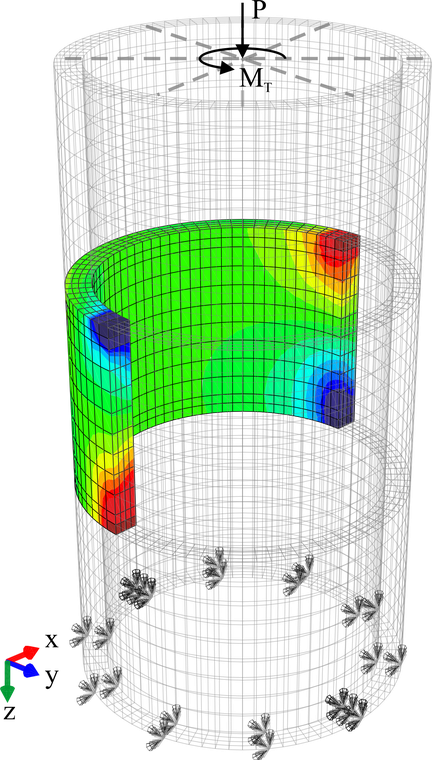
Spannungskonzentrationen (rot + blau) an den Segmentecken einer Halbschale im vereinfachten FE-Modell
Modulare Tragkonstruktionen sind eine wesentliche Voraussetzung für effizientes, ressourcenschonendes und zukunftsorientiertes Bauen mit Beton. Fertigteilkonzepte ermöglichen witterungsunabhängige Bauabläufe, verkürzte Bauzeiten und bessere Arbeitsbedingungen. Die kontrollierten Herstellungsbedingungen im Fertigteilwerk erlauben erheblich höhere Betonfestigkeiten und somit einen deutlich reduzierten Materialaufwand. Die modulare Bauweise fördert zudem das Recycling sowie die Wiederverwertung ganzer Bauteile im Rahmen einer Kreislaufwirtschaft.
Ein wesentlicher Aspekt moderner Fertigteilkonzepte ist die sichere und gleichzeitig lösbare Verbindung der modularen Elemente. Neben formschlüssigen Verbindungen wie Schubverzahnungen, die bei Segmentbrücken zum Einsatz kommen, spielt insbesondere die reibungsbasierte Kraftübertragung über trockene, geschliffene Fugen mithilfe externer Vorspannung bei Türmen von Windenergieanlagen eine große Rolle. Für die sichere Bemessung modularer Tragstrukturen ist eine eingehende Kenntnis des Lastabtrags in der Konstruktion erforderlich. Neben den heute üblichen FE-Berechnungen sind daher begleitende Ingenieuransätze gefragt, die das komplexe mechanische Tragverhalten vereinfachen und so das Verständnis des Kraftflusses in der modularen Struktur fördern.
Das Ziel des Forschungsvorhabens ist die Entwicklung eines analytischen Berechnungsansatzes für das Torsionstragverhalten von Halbschalensegmenten. Mithilfe dieses Ansatzes soll die Tragfähigkeit trockener Horizontalfugen in mehrfach segmentierten Betontürmen unter kombinierter Beanspruchung realitätsnah beschrieben werden. Dieser soll im Rahmen des Vorhabens durch umfangreiche experimentelle Versuche im Maßstab 1:5 sowie durch numerische Simulationen validiert werden. Erste Tastversuche zeigen, dass die Fugentragfähigkeit in Systemen mit Halbschalen unter der Wirkung von Vorspannung und Torsion um bis zu 35 % geringer ausfällt als in solchen mit Kreisringen. Um dies zu bestätigen, sind aktuell großformatige Versuche an einer Turmkonstruktion mit bis zu fünf Segmentebenen geplant.