
Entwurfsmethodik für ein lebensdauerübergreifendes Bauwerksmonitoring
Inhaltsverzeichnis
Projektdaten
| Titel | Title Entwurfsmethodik für ein lebensdauerübergreifendes Bauwerksmonitoring bei unbekanntem Schadensprozess | Design methodology for cross-life structural health monitoring with unknown damage process Förderer | Funding Deutsche Forschungsgemeinschaft (DFG) / SPP 2388 Zeitraum | Period 08/2022 – 02/2026 (Phase | period 1) 12/2025 – 11/2028 (Phase | period 2) Projektleiter | Project manager Prof. Dr.-Ing. Steffen Marx Team | Team Cedric Eisermann, Chongjie Kang |
Kurzfassung Förderphase 2

Viel hilft viel? Sensorik zur Überwachung einer Spannbetonbrücke
Das übergeordnete Ziel des Forschungsvorhabens besteht in der Entwicklung einer Entwurfsmethodik, mit der ein Sensorkonzept für den neuen Anwendungsbereich „lebensdauerübergreifende Monitoringsysteme“ zuverlässig entworfen werden kann. In der ersten Förderphase (2022 bis 2026) wurden Methoden erforscht, um für Bauwerke ohne bekannte Vorschäden wahrscheinliche Schadenszenarien zu prognostizieren sowie physikalische Parameter zu deren Überwachung zu bestimmen. Dabei wurde erkannt, dass physikalische Größen ohne Bezug zum erfassenden Sensor und zu den daraus abgeleiteten Schadensmerkmalen keine verwertbaren Informationen über den strukturellen Zustand eines Bauwerks liefern. Zudem wurde festgestellt, dass die gesamte Entscheidungsfindungskette im SHM unvermeidbare Unsicherheiten beinhaltet, welche die Zuverlässigkeit der Schadensidentifizierung beeinflussen. Vor diesem Hintergrund wird in Phase 2 (2026 bis 2029) eine ganzheitliche, probabilistisch fundierte Betrachtung des Entwurfsprozesses verfolgt. Das Projektziel in Phase 2 ist die Entwicklung einer Entwurfsmethodik, welche die Unsicherheiten des Schadenidentifikationsprozesses systematisch berücksichtigt und die optimale Auslegung von Sensornetzen ermöglicht.
Förderphase 1
Bericht aus dem Jahrbuch 2024/25
Analogieschlüsse zur Schadensprognose an Brücken
Die messdatenbasierte Zustandsbewertung von Brücken, auch als Structural Health Monitoring (SHM) bekannt, hat in den letzten Jahren erheblich an Bedeutung gewonnen. Der aktuelle Entwicklungsstand zeigt jedoch Defizite: Monitoringsysteme werden überwiegend auf Basis von Expertenwissen entworfen und häufig reaktiv als Antwort auf bereits aufgetretene Schäden ausgelegt. Das Projekt schließt diese Forschungslücke, indem Grundlagenforschung zur Konzeption von Monitoringsystemen betrieben wird, die neuralgische Bauwerkspunkte von Spannbetonbrücken bereits vor Schadenseintritt überwachen können.
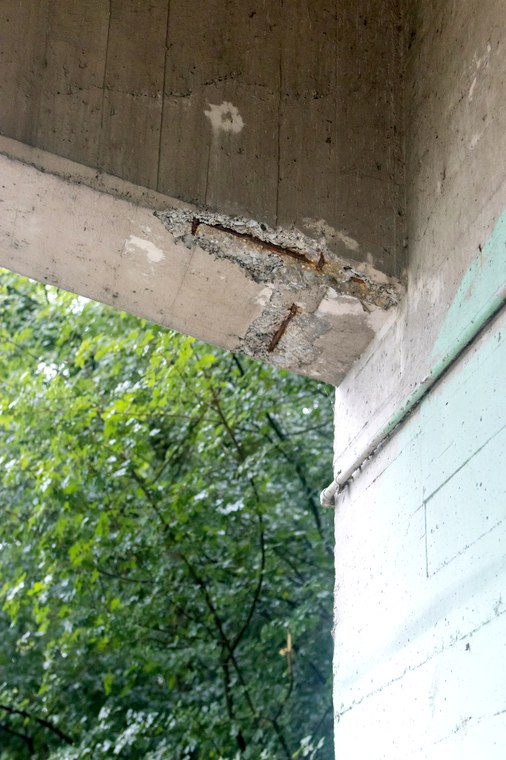
Betonabplatzungen als typischer Schaden an einer Massivbrücke
In der ersten Projektphase lag der Fokus auf der Identifizierung von Bauwerkspunkten mit hohem Schädigungspotenzial und der Ermittlung relevanter physikalischer Größen für deren Überwachung. In diesem Zusammenhang wurden zwei Ansätze untersucht: einerseits ein clusterbezogener Ansatz, der Schäden des konkreten Untersuchungsobjekts über die systematische Auswertung ähnlicher Brückenbauwerke prognostiziert, und andererseits ein objektbezogener Ansatz, der neuralgische Bauwerkspunkte von Brücken durch die Analyse bauwerksspezifischer Daten wie Bestandsunterlagen, bauwerksdiagnostische Untersuchungen und Nachrechnungen identifiziert. Darüber hinaus wurden physikalische Parameter zur Überwachung bestandstypischer Schadensmechanismen von Massivbrücken zusammengetragen. Dabei zeigte sich, dass physikalische Größen ohne Bezug zum erfassenden Sensor und zu den daraus abgeleiteten Schadensmerkmalen keine verwertbaren Informationen über den strukturellen Zustand eines Bauwerks liefern. Zudem wurde festgestellt, dass die gesamte Entscheidungsfindungskette im SHM unvermeidbare Unsicherheiten beinhaltet, welche die Zuverlässigkeit der Schadensidentifizierung beeinflussen.
Bericht aus dem Jahrbuch 2023
Monitoringkonzepte für Brücken ohne Schäden

Die historische Nibelungenbrücke Worms – das Validierungsbauwerk des SPP 2388
Das Ziel des Projektes im Schwerpunktprogramm 2388 (SPP 2388) ist die Entwicklung einer Entwurfmethodik, mit der Monitoringkonzepte für Brücken mit zunächst unkanntem Schadensmechanismus ausgelegt werden können. In der ersten Förderphase liegt der Forschungsschwerpunkt auf der physikalischen Struktur und den physikalischen Größen, die zur Identifizierung potenzieller Schäden überwacht werden müssen. Das Arbeitsprogramm beinhaltet zwei interagierende Ansätze: einen cluster- und einen objektbezogenen Ansatz.
Im Rahmen des clusterbezogenen Ansatzes wird untersucht, ob und wie anhand der filterbaren Merkmale in Bauwerksmanagementsystemen Vergleichscluster für Spannbetonbrücken gebildet werden können. Hierzu wird die Gesamtheit an filterbaren Merkmalen zunächst literaturbasiert auf eine abgegrenzte Anzahl schädigungsrelevanter Merkmale reduziert. Darauf aufbauend wird der Spannbetonbrückenbestand mithilfe unüberwachten Lernens geclustert. Für die Bauwerke eines Clusters werden auf Grundlage von Bauwerksbüchern und Prüfberichten charakteristische Schadensprozesse identifiziert sowie physikalische Größen zu deren Überwachung festgelegt. Da die Validierung der im SPP 2388 entwickelten Methoden an der Nibelungenbrücke erfolgt, werden in diesem Bearbeitungsschritt vor allem Freivorbaubrücken analysiert. Eine für den deutschen Brückenbestand repräsentative Stichprobe an Spannbeton- sowie Freivorbaubrücken wurde bereits identifiziert.
Der objektbezogene Ansatz beruht auf der Analyse des spezifischen Bauwerkes. Dazu werden typische Bewertungsmethoden für Bestandsbauwerke, die Bauwerksprüfung und die Nachrechnung, in den Kontext einer zukünftigen, messtechnischen Überwachung gesetzt. Für die Nibelungenbrücke erfolgte bereits eine umfangreiche Bauwerksdiagnose anhand der vorhandenen Prüfberichte, wobei die Bewehrungs- und Spanngliedkorrosion sowie die Querkraftragfähigkeit als maßgebende Schwachstellen identifiziert wurden. Zudem wurde ein numerisches Modell der Nibelungenbrücke entwickelt. Die ersten Berechnungen zeigen eine gute Übereinstimmung zwischen den Simulationsergebnissen und den Messdaten der am Bauwerk applizierten Sensoren.
Bericht aus dem Jahrbuch 2022
Brückenmonitoring der Zukunft – prädiktiv statt reaktiv
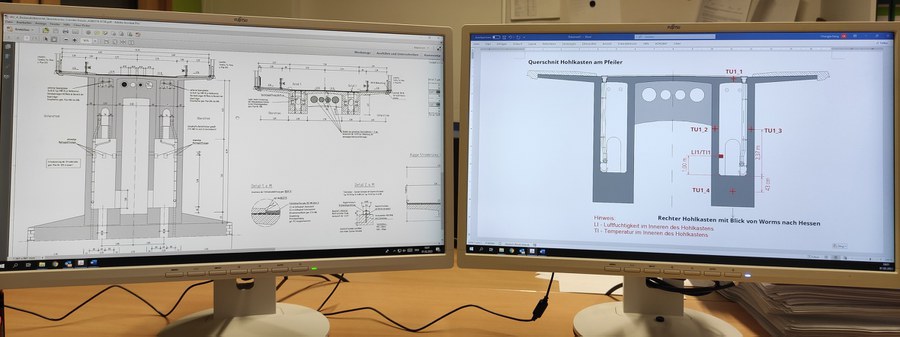
Planung des Sensornetzes für die Nibelungenbrücke in Worms
Thema des Dresdner Teilprojekts des Schwerpunktprogramms (SPP) 2388 „Hundert plus“ ist die Erarbeitung einer Entwurfsmethodik für lebensdauerübergreifende Brückenmonitoringsysteme, beginnend bei der Errichtung und Inbetriebnahme des Bauwerks, also zu einem Zeitpunkt, an dem normalerweise keine Schäden vorhanden sind.
Die aktuelle Instandhaltungsstrategie von Brücken ist durch turnusmäßige Vor-Ort-Inspektionen charakterisiert. Die Bauwerke werden alle drei Jahre hinsichtlich Schäden untersucht und diese werden dokumentiert. Dieser analoge Prozess ist personalintensiv und Bauwerksanomalien können nur zeitdiskret erfasst werden. Alle Schäden, die die Sicherheit der Brücke gefährden und zwischen zwei Inspektionen auftreten, können nicht rechtzeitig berücksichtigt werden. Eine kontinuierliche Überwachung in Form eines Brückenmonitorings würde hier Abhilfe schaffen. Das Projektziel besteht daher in der Entwicklung einer Methodik, mit der ein Sensorkonzept für lebensdauerübergreifende Monitoringsysteme ausgelegt werden kann.
In der ersten Förderphase liegt der Forschungsschwerpunkt auf dem Verhalten der physikalischen Struktur und den entsprechenden physikalischen Größen, die mit Sensoren gemessen werden können. Das Arbeitsprogramm sieht zwei interagierende Ansätze vor. Zum einen werden mit einem clusterbezogenen Ansatz bestehende Brücken hinsichtlich ihrer kritischsten Schäden systematisch ausgewertet. Zum anderen wird ein objektbezogener Ansatz verfolgt, mit dem ein konkretes Bauwerk hinsichtlich der zu überwachenden physikalischen Größen analysiert wird. Dabei werden sowohl physikalisch basierte Finite-Elemente-Modelle als auch Machine-Learning-Methoden nutzende, datenbasierte Modelle bezüglich ihrer Eignung für die Entwicklung von Sensorkonzepten untersucht. Beide Ansätze münden in der Entwurfsmethode für ein Sensornetzwerk, das an der Nibelungenbrücke im rheinland-pfälzischen Worms validiert wird.
In Kooperation mit dem Zentralprojekt des SPP 2388 „Hundert plus“ wurden erste Sensorapplikationsorte für die Nibelungenbrücke festgelegt. Ein initiales Structural-Health-Monitoring wurde über die TU Dresden ausgeschrieben und extern vergeben. Das Sensorkonzept wird innerhalb des Teilprojektes sukzessive weiterentwickelt und verbessert.