
Oct 02, 2026
Global Centres Symposium 2026: What counts as knowledge - and what makes it matter?
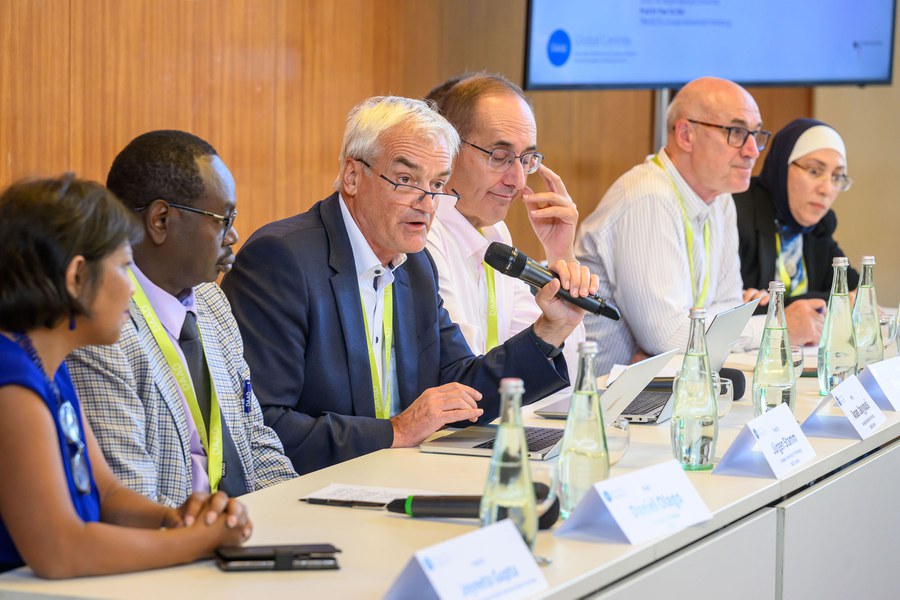
ABCD-Centre Project Leader Prof. Jürgen Stamm on the keynote panel.
How does knowledge actually translate into action? Who decides which evidence matters? And what happens when climate, water, health, ecosystems, and social realities cannot be neatly categorized into disciplinary boxes?
These questions shaped the 2026DAAD Global Centers Symposium in Berlin, where the four Global Centers for Climate and Environment came together under the theme “Bridging the Gap: Knowledge, Policy, and Practice for Climate Resilience and Sustainable Development.” programme_climate_digital. For the Global Water and Climate Adaptation Center (ABCD-Center), coordinated by TU Dresden, the symposium was more than just a project meeting. It offered an opportunity to critically examine some of the fundamental assumptions underlying academic work at the science-policy interface.
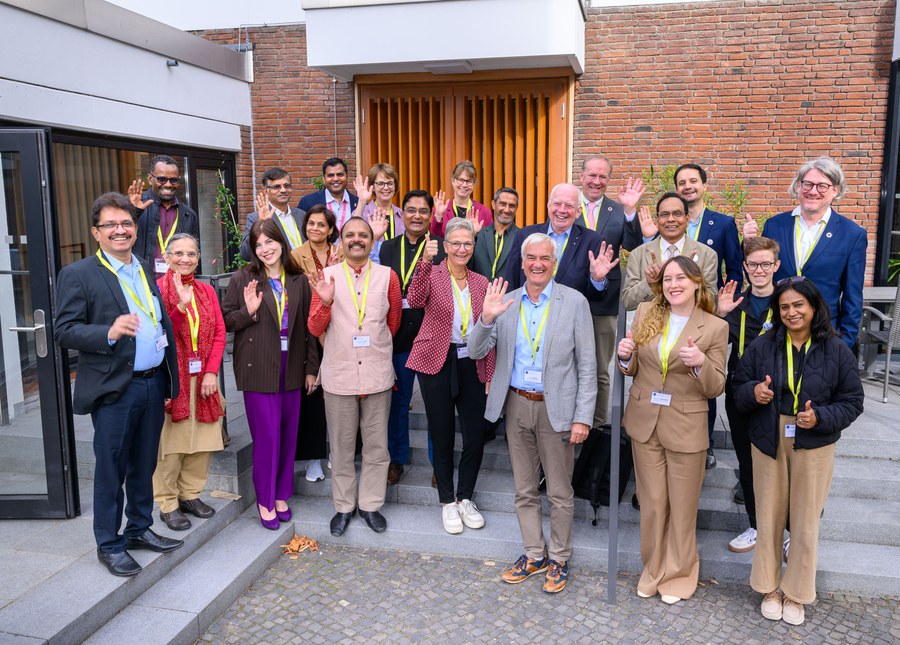
The ABCD-Centre Team with partners and colleagues at the 3rd DAAD Global Centres Symposium in Berlin.
Not all knowledge looks the same
This became particularly clear in the workshop “Traditional Ecological Knowledge.” The focus was on how different knowledge systems can contribute to climate resilience, water security, and a just transition. The discussion addressed not only how local and indigenous knowledge can be given greater consideration, but also which forms of knowledge are considered legitimate in the first place, what institutional and epistemic barriers exist, and how collaboration can be structured without merely translating or extracting knowledge into existing academic categories. programme_climate_digital. The central message: Climate adaptation cannot rely solely on technical expertise. It requires the ability to connect different forms of knowledge with one another.
Who Decides What Counts?
This was precisely the focus of the plenary session “Who Decides What Counts? Knowledge, Power & Co-Decision in Science-to-Policy Transfer.” The focus was on how political and institutional framework conditions influence which knowledge is incorporated into decisions, whose perspectives are heard, and where participation ends at consultation rather than enabling genuine co-decision-making. This is particularly relevant for universities: scientifically sound evidence is indispensable—but it is no guarantee of societal impact. Knowledge only becomes relevant for action when it can be connected to diverse interests, values, institutional capacities, and lived experiences.
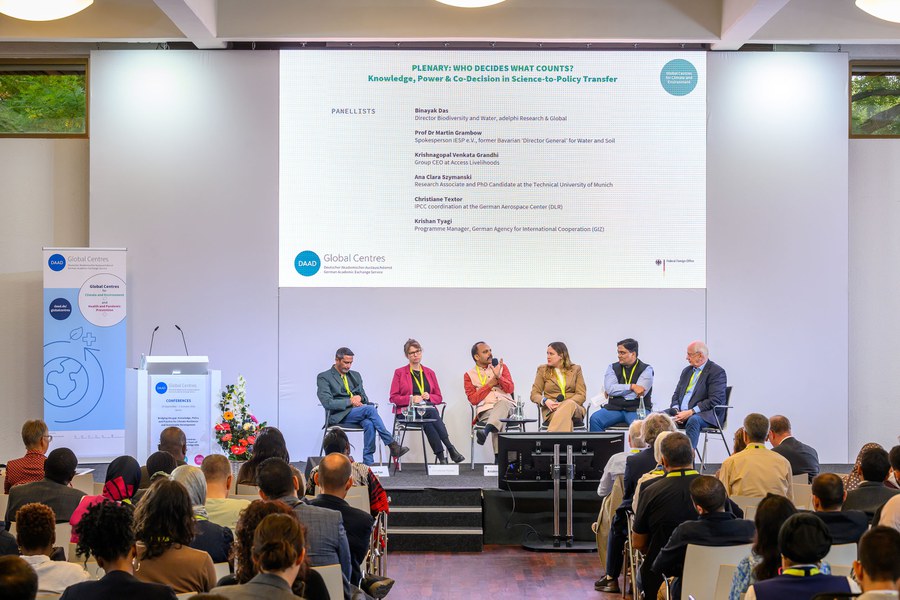
ABCD-Centre Session "Who decides what counts? Knowledge, Power & Co-Decision in Science-to-Policy Transfer"
Climate, water, and health do not adhere to disciplinary boundaries
The panel discussion “Climate, Water, and Health Nexus” also demonstrated just how deeply these issues are intertwined . By linking SDG 3 (Good Health and Well-being), SDG 6 (Clean Water and Sanitation), and SDG 13 (Climate Action), the discussion focused on the interactions between climate risks, water systems, infrastructure, health, and social vulnerability. For the ABCD-Centre, this nexus perspective is central: water security is not an isolated technical issue, but rather part of a complex web of ecological, social, and institutional interdependencies.
Less Choreography, More Dialogue
On the final day, the workshop “From Knowledge to Action: Universities Bridging Water Security and Climate Adaptation” turned its attention directly to the role of universities. The format was adapted on-site to accommodate a smaller group than originally anticipated. What might initially have sounded like a limitation turned out to be an advantage: fewer formal transitions, more direct discussion, and more room to actually test assumptions. One conclusion ran through many of the contributions: knowledge transfer is not a one-way street. Knowledge is questioned, interpreted, supplemented, and sometimes even controversially debated—and can undergo fundamental changes through exchange between disciplines, institutions, and societal stakeholders.
A Humboldtian Perspective for the Next Phase
A quote often attributed to Alexander von Humboldt fits remarkably well with these discussions:
“The most dangerous worldview is that of people who have not looked at the world.”
For an international center like the ABCD-Centre, this is almost a guiding principle. Water security looks different in Dresden than it does in Chennai or Bangkok. Climate adaptation therefore requires a willingness to step outside one’s own disciplinary, institutional, and geographical perspective. For the coming years, this also presents an opportunity for the Global Centers as a whole: to operate less as a collection of separate, side-by-side projects and more as a networked international transformation laboratory where research, teaching, and policy advice are brought together more systematically—across the boundaries of climate, water, health, ecosystems, and energy.
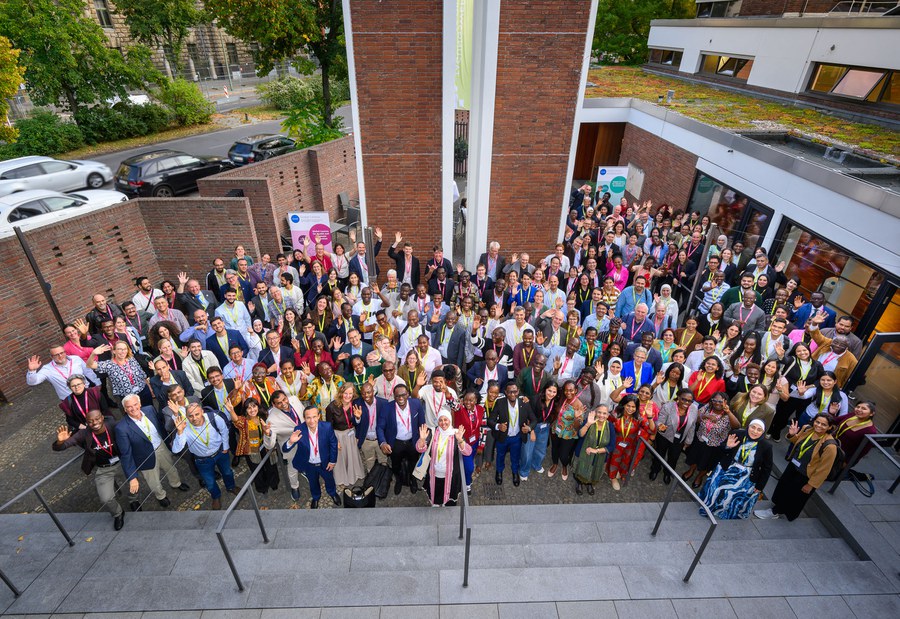
Group photo of the symposium participants
This would also mean viewing universities even more strongly not merely as places of knowledge production, but as spaces where complexity can be discussed, assumptions can be questioned, and different forms of expertise can come together.
Contact:
ABCD-Centre Coordinator
NameMs Sarah Elser M.Sc.
Send encrypted email via the SecureMail portal (for TUD external users only).
Chair of Hydraulic Engineering Secretariat
Visiting address:
Beyer-Bau, Raum 141 George-Bähr-Str. 1
01069 Dresden