
Nov 11, 2026
Movement behavior links environmental pollution to microplastic accumulation in wild mammals
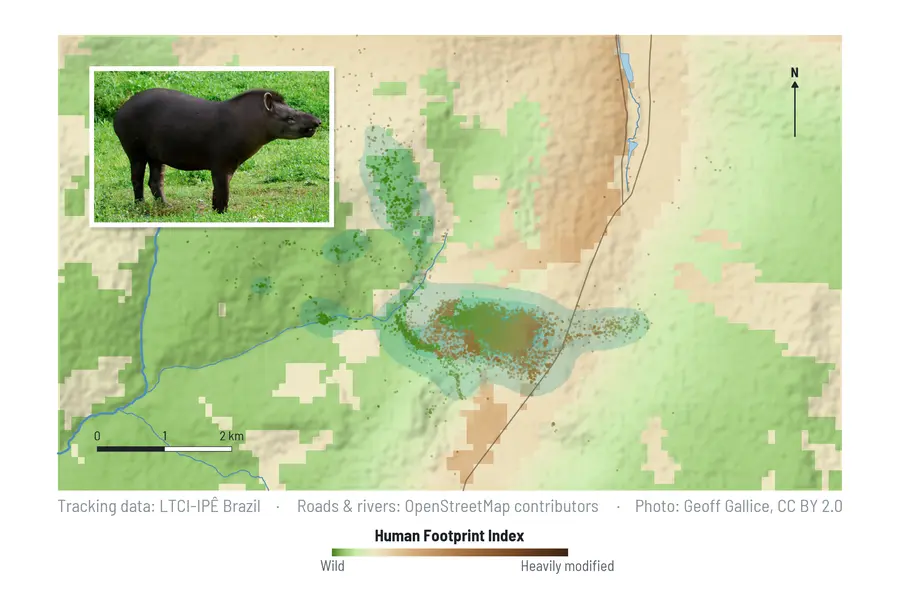
Microplastics are considered one of the most widespread environmental contaminants of our time—and have long since penetrated even seemingly pristine habitats. An international research team has now, for the first time, established a direct link between the movement patterns of wild mammals and their microplastic burden. The findings have been published in the journal Nature.
For the study, the researchers combined GPS tracking data from tapirs, giant anteaters, and giant armadillos in Brazil with novel laboratory analyses that allowed microplastic particles in the animals' blood to be quantified. This enabled the team to trace, for the first time, how individual animals' habitat use and movement behavior influence their contaminant load.
The result: The closer the animals lived to human infrastructure, the higher their exposure. Surprisingly, however, animals from largely undisturbed areas were also found to be contaminated. Apparently, microplastic particles enter the organism not only through direct contact with human-altered landscapes, but also via the food chain or through atmospheric deposition.
The study also highlights the potential of data-driven ecology: movement data from individual animals can be directly linked to environmental and land-use data, thereby providing new insights into contaminant pathways in the environment. Working precisely at the interface of data science and ecology is study co-author Prof. Justin Calabrese, holder of the Chair of Data Science in Ecology at TU Dresden (a joint appointment with the Helmholtz-Zentrum Dresden-Rossendorf (HZDR)).
He explains what makes the new study methodologically distinctive:
“The methods of movement ecology developed by my team and me allow us, for the first time, to link individual microplastic exposure to the actual habitats of wild animals. Our work thus lays the foundation for a mechanism-based understanding of how animals’ movement behavior influences their exposure to anthropogenic threats—even in relatively undisturbed habitats.”
Publication:
M.A.M.M. Ferraz, A.L.J. Desbiez, M.H. Alves, J.M. Calabrese, A.T. Cumerlato, F.C. Jacoby, N. Grechi, D. Kluyber, E.Y. Lin, M.P. Millazotto, G. Soresini, E.P. Medici, G. Mastromonaco, M.J. Noonan (2026): Human land use drives microplastic abundance in terrestrial wildlife. Nature, 2026. https://doi.org/10.1038/s41586-026-11285-x
Contact:
Prof. Dr. Justin Calabrese | Chair of Ecological Data Science at TU Dresden | Head of the Earth System Research Division at the Center for Advanced Systems Understanding (CASUS), HZDR
Phone: +49 3581 375 23 71 | Email: