
ValiGrün - Validierung des Klimaanpassungspotenzials und zur Optimierung der Funktionen blau-grüner Infrastrukturen im urbanen Raum

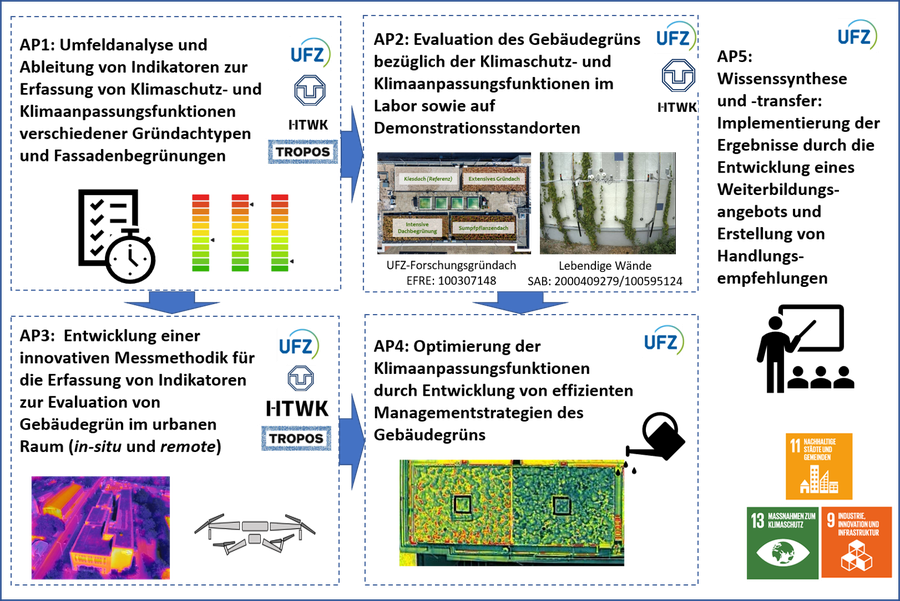
Blau-grüne Infrastrukturen wie Gebäudegrün gelten als zentrale Maßnahme zur Anpassung von Städten an den Klimawandel – etwa gegen Hitze, Trockenheit und Artenverlust. Doch oft bleiben die erwarteten Wirkungen wie Kühlung, Wasserspeicherung oder Förderung der Biodiversität aus. Das führt zu Unsicherheiten bei Kommunen, Investoren und Betreibern, da verlässliche Daten und Bewertungskriterien fehlen, um die tatsächliche Funktion dieser komplexen Systeme zu beurteilen. Hier setzt das Projekt ValiGrün an: Ziel ist es, die Klimawirkung von Gebäudegrün messbar zu machen. Dafür werden Indikatoren und Messverfahren zur Bewertung von Klimaschutz- und Anpassungsfunktionen verschiedener Gebäudetypen entwickelt. Diese kommen auf Demonstrationsflächen und im urbanen Raum zum Einsatz und werden mithilfe innovativer Sensorik validiert. Ein besonderer Fokus liegt auf der Entwicklung eines praxisnahen Konzepts zur intelligenten, klimaangepassten Bewässerungssteuerung. Auf dieser Grundlage entstehen Handlungsempfehlungen und ein anwendungsorientiertes Bewertungs-instrument, das Kommunen bei Planung, Förderung und Weiterentwicklung von Gebäudegrün unterstützt. Ein begleitendes Weiterbildungs- und Transferkonzept stellt sicher, dass die Ergebnisse in der Praxis ankommen und die gesellschaftliche Akzeptanz gestärkt wird.
Projektpartner
- Helmholtz-Zentrum für Umweltforschung (UFZ):
- Department Systemische Umweltbiotechnologie (Projektkoordinator)
- Department Monitoring- und Erkundungstechnologien
- Department Stadt- und Umweltsoziologie
- Hochschule für Technik, Wirtschaft und Kultur Leipzig (HTWK)
- Technische Universität Dresden
- Leibniz-Institut für Troposphärenforschung e.V. (TROPOS)