
Bachelor's and Master's Theses
Table of contents
The group welcomes students from the fields of environmental science, hydrosciences, Civil Engineering, mechanical engineering, physics, geosciences, computer science, and related disciplines. A good project does not require expertise in every single method; curiosity, reliability, and quantitative thinking are more important. The projects can be tailored to students who prefer experimental work, numerical modeling, programming, data analysis, or a combination of these approaches.
Students can develop practical and transferable skills in the areas of experimental protocol design, microscopy and image analysis, particle characterization, Python-based data analysis, setting up and post-processing CFD/FVM simulations, DEM-IBM simulations, creating scientific figures, and writing theses and reports.
Our core research areas
We investigate the transport, deposition, erosion, and flow of sediment-laden fluids and granular materials in aquatic environments. We combine laboratory experiments, continuum modeling using the finite-volume method, and particle-resolved simulations to link particle-level mechanisms to geophysical and engineering applications.
Why This Is Important
Particle-fluid systems play a central role in water quality, sediment management, river morphodynamics, soil stability, deep-sea mining, debris flows, and industrial processing. A physical understanding across multiple scales helps improve predictions, planning, and environmental impact assessments.
1. Laboratory Research
The experimental program combines standardized characterization with custom-built equipment. This enables students to work with both precisely defined measurement protocols and experimental setups they have developed themselves, which are specifically designed to address particular physical questions.
We characterize natural sediments, fine particles, and water samples using microscopy, particle counting or hydrometer analysis, carbon content measurements, turbidity-based methods, flow cytometry, and zeta potential analysis. The goal is to correlate particle properties, water chemistry, and biological or organic components with the macroscopic behavior of suspensions.
We develop experimental setups for inducing and visualizing shear zones in dry, wet, and submerged granular systems. By controlling cohesion, friction, particle shape, and fluid conditions, we investigate how localized deformations develop prior to failure. This research topic bridges the fields of granular physics, soil stability, natural hazards, and the industrial handling of particulate materials.
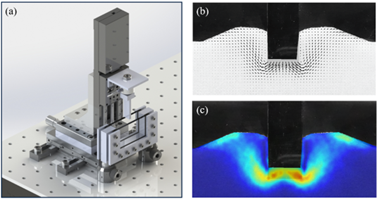
Soil stability and shear localization
Granular rheology provides a framework for quantifying the flow behavior of dense particle systems in the range of blockage. The group uses rheological concepts based on pressure and volume to measure stress response, effective friction, and granular viscosity. These projects allow for the investigation of the role of particle shape, roughness, cohesion, and the effects of interstitial fluid.
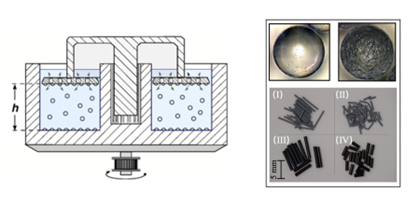
Rheology of granular materials and suspensions
In collaboration with partners from the fields of environmental science and engineering, we are investigating how salinity, pollutants, and hydrodynamic shear forces influence the aggregation and sedimentation of natural fine sediments. In our experiments, we combine measurements of total deposition, floc visualization, and particle characterization to assess sediment removal and transport processes in the environment. Selected example: Sailor
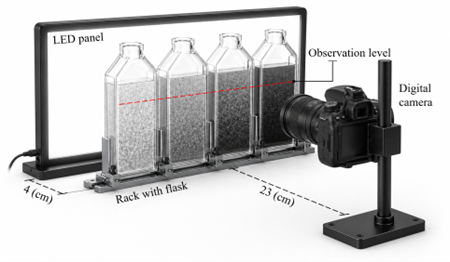
Flocculation and settling of fine sediments
2. Numerical Continuum Modeling: Finite Volume Method (FVM)
Finite-volume simulations are used when the relevant physical processes can be described at the continuum level. Instead of modeling every individual particle, these models solve averaged equations for flow motion, sediment transport, erosion, and deposition. This approach is particularly well-suited for large-scale or turbulent environmental flows.
Numerical experiments are used to investigate how currents interact with deep-sea sediments in environments relevant to the mining of manganese nodules. The goal is to quantify erosion thresholds, near-bottom transport, and the sensitivity of the seafloor response to hydrodynamic forces.
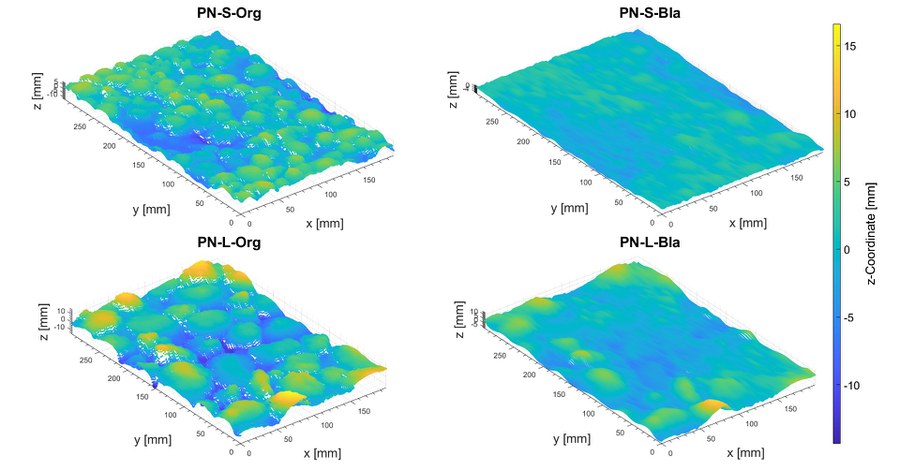
Deep-sea floor erodibility
We combine local three-dimensional simulations with larger-scale two-dimensional models to study sediment deposition, soil shear, erosion risk, and geomorphological changes. This multiscale strategy helps link local mechanisms to sediment management issues at the field scale.
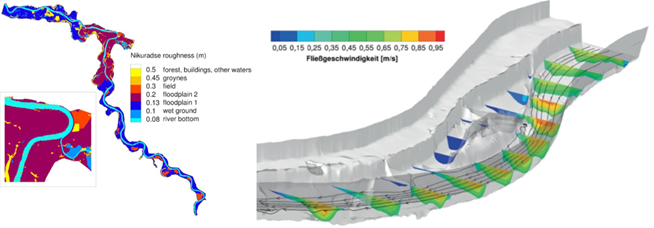
Local 3D and global 2D river modeling
Typical tasks include creating computational domains, selecting boundary conditions, conducting parameter studies, analyzing velocity and sediment fields, and comparing simulation results with laboratory or field observations. Selected example: ERASE
3. Particle-Resolved Simulations: Discrete Element Method – Immersed Boundary Method (DEM-IBM)
DEM-IBM simulations capture the motion and interaction of individual particles while simultaneously calculating the surrounding flow. The Discrete Element Method (DEM) describes the contacts between the particles, while the Immersed Boundary Method (IBM) couples particle motion with the flow. This makes this approach particularly well-suited for investigating mechanisms that are difficult to isolate experimentally.
Particle-resolved simulations make it possible to investigate how cohesion, aggregation, and hydrodynamic interactions influence the settling of fine sediments. These simulations complement laboratory observations by providing insights into particle trajectories, contact networks, and flow fields.
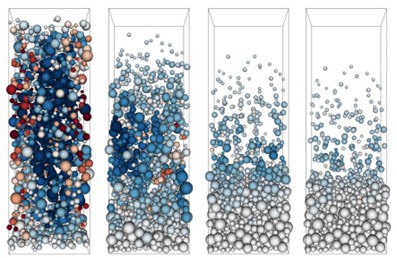
Fine-cohesive-porous sediment settling
Using simple shear and transport configurations, this study examines how suspensions behave in viscous and inertial regions. The focus is on the relationship between microscopic interactions and macroscopic quantities such as shear stress, normal stress, effective friction, and sediment mobility.
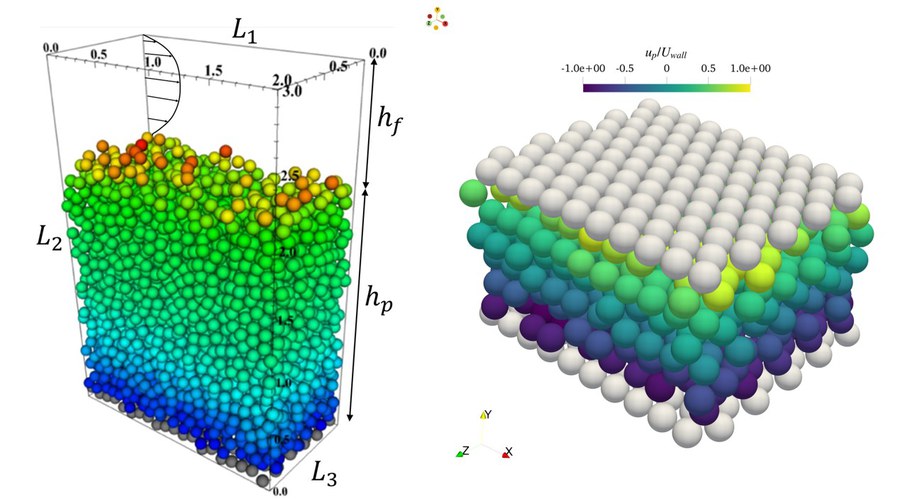
Suspension rheology and sediment transport
Typical tasks include preparing simulation cases, modifying particle or fluid parameters, determining rheological properties, visualizing particle-fluid interactions, and comparing particle-resolved results with continuum models or experiments.
Selected examples: Pro-Mud
Contact
We warmly welcome all students to contact us regarding a bachelor’s thesis, undergraduate research project, or master’s thesis. You can get an idea of our work by checking out our projects, and if you’re interested, you can contact one of our staff members directly via the Team page. If you have your own topic proposal, you can also contact Prof. Dr.-Ing. Vowinckel.