
SIAS-ÖV – Saxon Initiative: Automated Shuttles in Public Transportation – Technology Research for Highly Automated Cooperative Mobility Systems
Project Overview
|
Project duration: |
February 23, 2026 – June 30, 2028 |
|
Funded by: |
Free State of Saxony using ERDF/ESF funds |
|
Budget: |
€13.1 million |
|
Funding |
€9.5 million (€2.5 million contributed by TU Dresden) |

Motivation
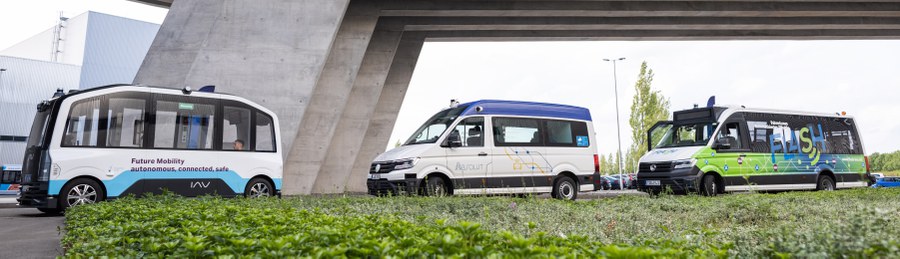
The SIAS-ÖV technology project aims to research automated public transit as a comprehensive technological system for the future of public transportation. Automated public transit using small, driverless shuttles can play a key role in addressing key challenges, such as the growing driver shortage, rising operating costs, and changing mobility needs. Integrated as a complement to existing public transport systems, they are capable of significantly improving citizens’ access to public mobility in the spirit of public service and inclusion, particularly in rural and suburban areas—regardless of vehicle ownership or a driver’s license.
At the same time, this presents an economic opportunity for Saxon companies with a unique position in Europe. Politically, the project is prioritized in both the Saxon coalition agreement and the federal coalition agreement and represents the first concrete measure under the joint Saxon declaration of intent “Saxon Initiative for Autonomous Driving in Local Public Transport – City. Country. Mobility”
https://www.medienservice.sachsen.de/medien/news/1096676
Project Objectives
The project “Saxon Initiative: Automated Shuttles in Public Transport” (SIAS-ÖV) focuses on technological research for highly automated cooperative mobility systems in local public transport. The central objectives can be summarized as follows:
Overarching objective:
- Securing and improving mobility options in public transport (especially in rural and suburban areas) in the face of cost pressures and driver shortages through highly automated, driverless mini/midibuses (shuttles)
- Contributing to society by promoting the inclusion of disadvantaged groups (children, seniors, people with limited mobility) and supporting essential public services
- Creating the conditions for establishing Saxony as a model region for automated mobility in Germany and Europe
Specific project objectives:
Research and development of a functional prototype (TRL 4) of an integrated, automated, and connected comprehensive mobility system, consisting of:
• Highly automated (SAE Level 4), driverless public transit vehicles
• Safe traffic infrastructure and resilient connectivity
• Integration of data, services, and interfaces (open, vendor-neutral data integration platform)
• Technical supervision and user software
• Sustainability and efficiency monitor for real-time assessment of ecological and economic efficiency
The project lays the groundwork for the start of operations and a comprehensive rollout.
Focus Areas of the Chair of Vehicle Mechatronics
Through the Chair of Vehicle Mechatronics, TU Dresden contributes the VW e-Crafter test vehicle as well as the Vehicle Technology Test Center (FVZ), which features a full-vehicle test bench, climate chamber, and vibration test bench.
Our tasks include, among other things:
- Research into the technical requirements for vehicles and subsystems
- Analysis and testing of sensor systems (sensing performance, robustness, service life)
- Virtual and real-world testing of vehicle subsystems (test bench operations)
- Research into algorithms for real-time evaluation of perception performance and adaptation strategies
- Model-based development and validation of minimal-risk maneuvers (MRM)
- Research into strategies for automated intersection crossing in public transportation
Contact
 © FZM
© FZM
Research Fellow
NameDr.-Ing. Stephan Rother
Send encrypted email via the SecureMail portal (for TUD external users only).
Project partners and their project focuses
|
Partner |
Project Focus |
|
Leipziger Verkehrsbetriebe (LVB) GmbH, Leipzig |
|
|
BitCtrl Systems GmbH, Leipzig link |
|
|
DEKRA Automobil GmbH, Dresden link |
|
|
glts cotech GmbH, Leipzig |
|
|
Fraunhofer Institute for Transportation and Infrastructure Systems IVI, Dresden |
Safe, connected intersections |
|
IAV GmbH, Chemnitz / Stollberg |
|
|
Yunex Traffic, Leipzig |
|