
Sep 25, 2026
Chair participation in AI4RAILS
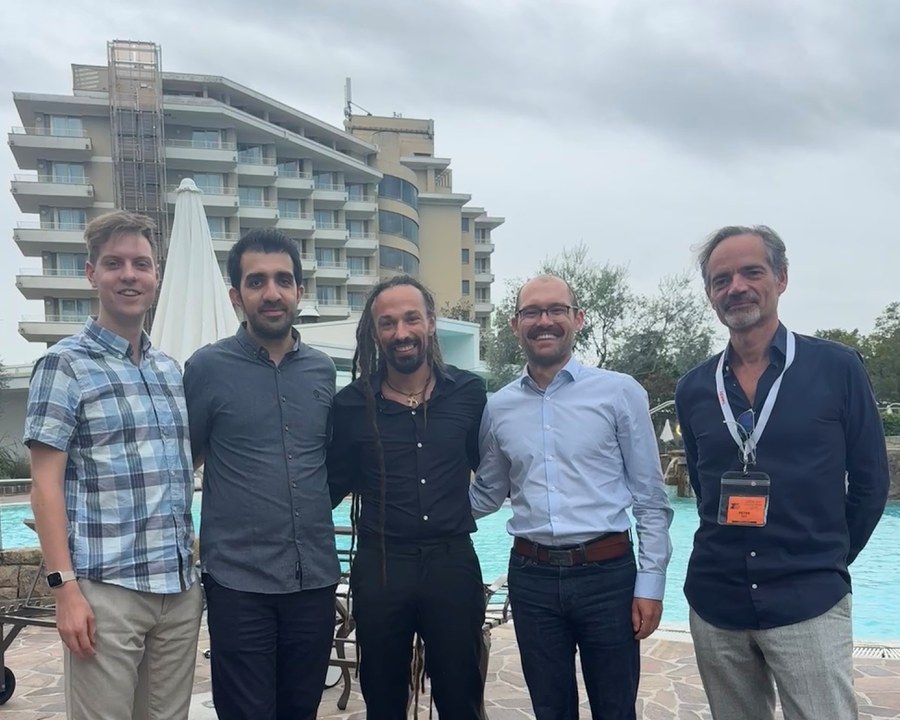
Chair participants at AI4RAILS
AI4RAILS
Time to recap the 22 interesting presentations in the 7th International Workshop on Artificial Intelligence for Railways (#AI4RAILS) co-located with the International Conference on Optimization and Decision Science (#ODS2026) in Galzignano Terme, Italy. The joint organization from Paola Pellegrini , Nikola Bešinović and Zhiyuan Lin was a great success, fostering applications of AI methods in railway specific research. All information can be found at https://www.airoconference.it/ods2026/ai4rails-workshop
🤖 LLMs can already produce high-quality heuristics rivaling human design (Kevin Tierney). However, there regulatory reasoning for tram operation is rather limited (Markus Lagler). Safety standards can be parsed efficiently with a RAG pipeline (Neda Mashhadi).
🎨 AI driven Image Segmentation can look from view of the driver cap to ensure safe autonomous operations, but explaining the decision shows bigger challenges (Steffen Seitz, Kilian Göller, Manuella Fotie).
🔍 Explainable forcasting is winning production deployment. Jasmijn De Clercq deployed SHAP-explained punctuality predictions at Belgian Infrabel. Jannes Glaubitz, Dr. David Rößler-von Saß used SHAP to interprete rail-crack prediction.
🕹️ Reinforcement Learning is promising in solving time-critical replanning tasks, like real-time traffic management (Ashkan Fouladi), timetable rescheduling (Zipei Zhang), and locomotive assignment (Oskar R.). The work by Falk Pospischil, Ariane Fazeny enforced feasibility via a ray-masking approach.
⚙️ Machine Learning can boost classical optimization. Sebastian Sehmisch used ML for reducing the search space, Cheng Bai applied per instance algorithm selection and Lukas Bodi predicted optimization results.
📊 Data-driven methods can leverage historical railway data. Mohammad Maghrour Zefreh used a Graph Attention Network as a "starter motor" to forecast future train supply, while Niloofar Minbashi applied k-medoids clustering to map rail-freight potential across European regions. Xuwen Jia estimated freight train breaking forces and driver input force, and Peter Sels created robust cyclic timetables.
Thank you to all participants! See you at the next edition, #AI4RAILS2028