
Sep 22, 2026
3rd Conference on AI in Finance brings together academia and practice in Dresden
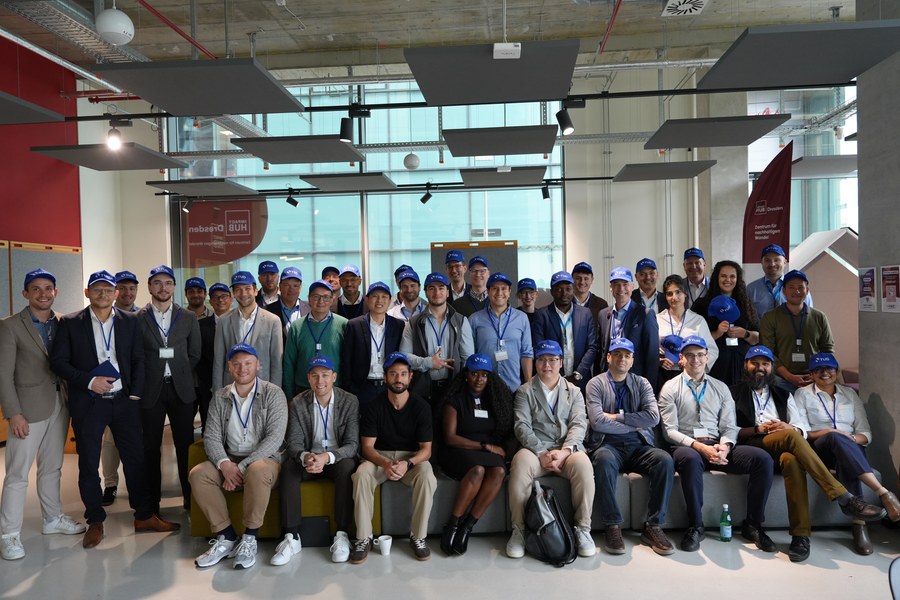
On September 17 and 18, 2026, Prof. Lars Hornuf and his Chair of Business Administration, esp. Finance and Financial Technology at TUD Dresden University of Technology hosted the 3rd Conference on AI in Finance. More than 50 participants from academia and industry discussed how artificial intelligence is changing financial decision-making. The conference continued the series that began in 2024.
Day 1: PhD and Postdoc Workshop
The first day took place at the TUD campus. Lars Hornuf opened with an introduction and mapped open research questions in the field. In the morning workshop, Dr. Matthias Mattusch showed participants how to download, install, and run large language models on local resources, and how to set up agentic AI systems. In the afternoon, the editors-in-chief Tony Klein (Chemnitz University of Technology, Finance Research Letters) and Vincenzo Capizzi (Università del Piemonte Orientale, Venture Capital and Journal of Financial Management, Markets and Institutions) explained how to publish in leading finance journals. Early-career researchers then received detailed feedback on their work. Contributions came from the Stockholm School of Economics, the University of Twente, and Tulane University, among others.
Day 2: Main Conference at Impact Hub Dresden
The main conference on September 18 emphasized the link between research and industry. It opened with the session "AI in Practice – Use Cases from Finance," in which seven presentations showed how AI is already being applied across the financial sector. Luca Frignani of exaloan demonstrated explainable machine learning for credit decisions at scale. Jan Book of Ostsächsische Sparkasse Dresden and Fabian Kretschmann of elevait then traced how AI supports corporate banking, from the loan application to advisory. Roland von Horn of Julius Bär described the AI-augmented workforce in private banking, and Nadjate Zebri of parcIT outlined the road to automation in controlling. Martin Faust of Valsight presented agentic decision support on driver-based planning models. Hauwa Umaru of SarynSpace introduced a regulatory signal for default risk in satellite-operator credit. Finally, Arman Khaledian of Zanista AI showed how to quantify financial news with embeddings and LLMs to build momentum and reversal strategies. A moderated Q&A with all speakers concluded the session.
Two paper sessions and two Fire Talk sessions then presented academic research. In the first paper session, Yirou Wang (City University of Hong Kong) examined how news narratives are priced into Treasury yields between macroeconomic announcements. Eghbal Rahimikia (University of Manchester) then revisited the performance of time series foundation models in finance. In the first Fire Talk session, Andrea Maurino (Università di Milano-Bicocca) discussed fiduciary alignment in AI-powered investment advice for retail investors. Daniele Previtali (University of Naples Parthenope) followed with an analysis of how banks’ innovation culture shapes their responses to FinTech disruption.
The second Fire Talk session turned to the reliability and governance of AI. Kolja Gauer (Otto von Guericke University Magdeburg) presented a game-theoretic analysis of liability design and insurability for generative AI-enabled decisions in European banking. William C. Johnson (University of Massachusetts Lowell) proposed a framework for assessing AI performance in terms of internal consistency and accuracy. The second paper session closed the academic program. Toghrul Aghbabali (University at Buffalo) showed that generative AI affects firm performance and share prices asymmetrically, depending on whether it augments or substitutes labor. Yifei Liao (Frankfurt School of Finance & Management) examined the role of AI in shaping investor disagreement. Yiqun Li (Boston University) introduced a new measure of firm-level currency exposure.
Keynote by Alejandro Lopez-Lira
A highlight of the program was the keynote by Alejandro Lopez-Lira (University of Florida, Warrington College of Business). His research on large language models, machine learning and asset pricing, including work on whether LLMs can forecast stock returns, closely matched the conference theme.
Networking
A sightseeing tour through Dresden’s Old Town, a drinks reception at the venue and coffee breaks gave participants room for informal exchange. The day ended with the conference dinner at Restaurant Moritz on the roof terrace of Hotel Suitess.
Participants engaged in lively discussions throughout both days, and contributions spanned many areas of the field. The 3rd Conference on AI in Finance once again offered a strong platform for dialogue between academic research and financial practice.