
18.12.2025
Präsentationen auf der ICIS 2025 in Nashville
Vom 14. bis 17. Dezember 2025 fand die diesjährige International Conference on Information Systems (ICIS) in Nashville, USA, statt. Die ICIS ist die führende internationale Konferenz im Bereich der Wirtschaftsinformatik und bringt jedes Jahr Tausende von Forschenden aus aller Welt zusammen, um ihre neuesten Erkenntnisse zu präsentieren und sich über aktuelle Entwicklungen in der IS-Forschung und -Praxis auszutauschen.
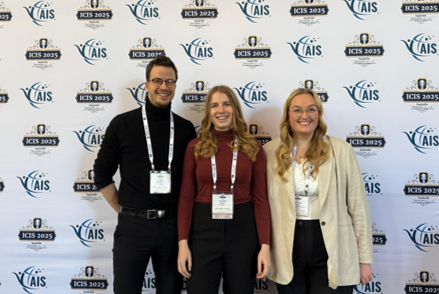
© Sonja Olbing


© Sonja Olbing
© Sonja Olbing
In diesem Jahr waren der Fakultät nicht nur Forscher:innen aus der Wirtschaftsinformatik sondern auch aus der BWL mit Paper-Präsentationen auf der ICIS vertreten. Sonja Olbing (Professur für BWL, insb. Organisation und Management) stelle die gemeinsam mit
Dr. Matthias Sinnemann (Universität Münster) verfasste Studie „Digital nomads: A self-determination perspective“ vor. Die Studie untersucht digitales Nomadentum als Form extremen Einsatzes von Informationssystemen. Auf Basis von mehr als 75.000 Beiträgen aus dem Subreddit r/digitalnomad werden mittels Topic Modeling, Sentiment-Analyse und Zeitreihenanalyse zentrale Themen und Emotionen identifiziert, die den Lebensstil digitaler Nomaden prägen. Unter Bezugnahme auf die Selbstbestimmungstheorie liefert die Forschung neue Erkenntnisse zur Rolle von Autonomie, Kompetenz und sozialer Eingebundenheit im Arbeits- und Lebensalltag von digitalen Nomaden und bietet dadurch wertvolle Implikationen für Wissenschaft und Praxis.
Theres Rüger und Janek Müksch (Professur für BWL, insb. Marketing) stellten in Nashville die in Zusammenarbeit mit Prof. Dr. Alfred Benedikt Brendel und Mariam Bellger verfasste Studie "More Than a Mascot? The Effect of Conversational Mascots on Donations for Nonprofit Organizations" vor. Die Studie untersucht, ob und wie Conversational Agents wie Chatbots dazu beitragen können, dass ein Internetnutzer auf einer Website für gemeinnützige Organisationen spendet. Der empirischen Studie liegt ein Online-Experiment zugrunde, bei dem den 156 Befragten jeweils eines von drei möglichen Treatments (maschinenähnlicher Chatbot, menschenähnlicher Chatbot und Marken Chatbot) präsentiert wurde. Die Ergebnisse zeigen, dass ein markenähnlicher Chatbot das Vertrauen in die gemeinnützige Organisation erhöht und das Spendenverhalten fördert und somit für NGOs ein geeignetes Instrument sein könnten, um das Spendenverhalten zu steigern.