
Feb 20, 2026
How Does Epigenetics Shape Brain Development? Prestigious Grant Supports New Research at the CRTD
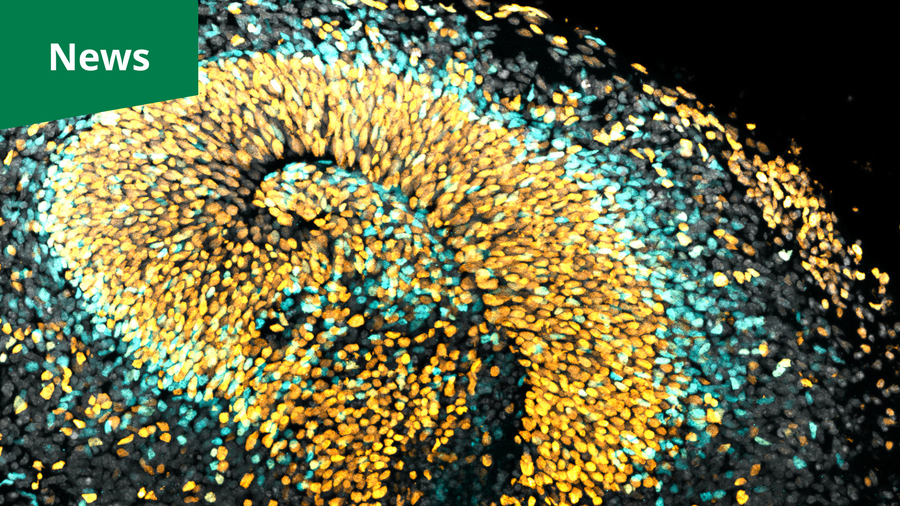
Microscopy picture of an eight-week-old gorilla brain organoid grown from gorilla stem cells. The Albert group uses these organoids to study evolutionary differences in brain development between humans and non-human primates.
Although brains develop in broadly similar ways across animal species, the timing of each stage of the process can vary significantly. In humans, the neocortex – the part of the brain responsible for higher cognitive functions – takes much longer to develop than in other species, forming more neurons and contributing to the larger size and complexity of the human brain. A new research project led by Prof. Mareike Albert at the Center for Regenerative Therapies Dresden (CRTD) will use cutting-edge technologies to investigate how epigenetic regulation influences the timing of brain development across species. The project is supported by a Rise Up! grant from the Boehringer Ingelheim Foundation.
Epigenetic modifications are chemical changes that regulate gene activity in cells without altering the DNA sequence. “Recent evidence suggests that specific epigenetic mechanisms contribute to the extended development of the human neocortex,” says Prof. Mareike Albert, Professor for Epigenomics of Neural Development at Faculty of Biology and a research group leader at the Center for Regenerative Therapies Dresden (CRTD) at TUD Dresden University of Technology. However, how these epigenetic mechanisms differ between humans and other primates remains largely unexplored.
Brain Organoids: A Window into Development
The Albert group specializes in studying brain development using brain organoids. These tiny, lab-grown 3D models of brain tissue are created from just a handful of stem cells derived from skin or blood cells, making the process minimally invasive.
“Organoids allow us to compare brain development across species in vitro using stem cells as a starting point,” explains Prof. Albert.
Differences in the timing of different developmental stages may also contribute to human neurodevelopmental disorders, such as Kabuki syndrome and Weaver syndrome, which are characterized by changes in brain size and intellectual disability. The new project will address whether developmental timing is altered in these disorders by comparing brain development in organoids derived from patient samples.
Cutting-Edge Technology
The project will heavily rely on Epi-CyTOF, a method developed for studying organoids by Dr. Claudia Peitzsch from the CRTD’s Mass Cytometry Facility in collaboration with Dr. Franziska Baenke and the Albert group. This technique can simultaneously detect dozens of epigenetic modifications across different cell types, saving time and offering unprecedented insights into how epigenetic regulation shapes brain development.
By combining organoids and Epi-CyTOF, the team aims to uncover the molecular processes that make human brain development unique – and what might go wrong in neurodevelopmental disorders. Their work has the potential to deepen our understanding of the human brain while demonstrating the power of new technologies to address complex scientific questions.
About the Rise up! Program
The Rise up! program is aimed at outstanding and exceptionally creative basic scientists in biology, chemistry, and medicine who have accepted their first appointment to an associate professorship at a German university. With Rise up!, awardees can bring forward an especially innovative research program that may have a lasting impact on their field.
About the Foundation
Boehringer Ingelheim Stiftung is an independent, non-profit foundation that is committed to promoting the medical, biological, chemical, and pharmaceutical sciences. It was established in 1977 by Hubertus Liebrecht (1931–1991), a member of the shareholder family of the Boehringer Ingelheim company. Through its funding programs Exploration Grants, Plus 3, and Rise up!, the foundation supports excellent scientists during critical stages of their careers. It also endows awards for junior scientists in Germany. Additionally, it funds institutional projects in the life sciences, such as the AITHYRA Institute in Vienna and a new research department (BioAI) at the Center for Systems Biology in Dresden, which both combine biomedicine with AI. Other supported institutions include the Institute of Molecular Biology (IMB) in Mainz and the European Molecular Biology Laboratory (EMBL) in Heidelberg, both in Germany.
www.boehringer-ingelheim-stiftung.de/en