
Nov 06, 2026
Custom-Made Repair: How Axolotls Prepare to Regrow a Perfect Limb
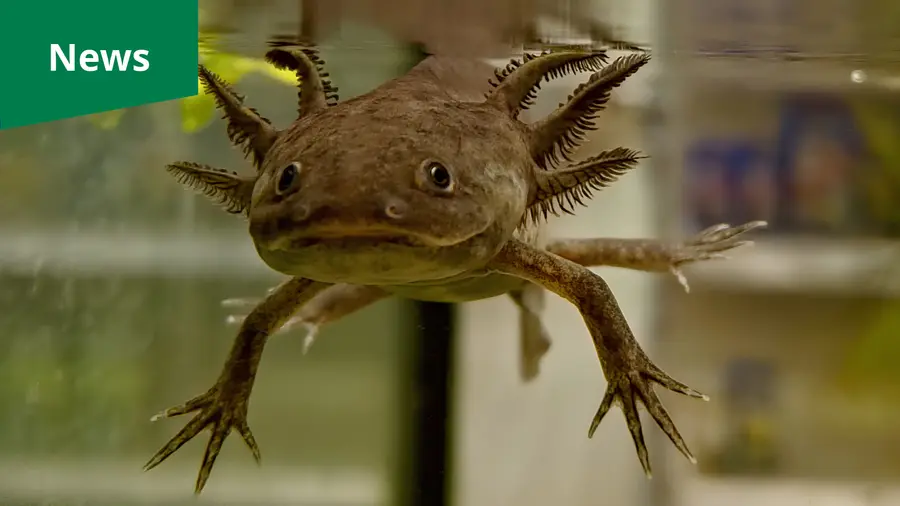
Axolotls have a remarkable ability to regenerate their body.
Axolotls regenerate limbs almost flawlessly, no matter the extent of the injury. Researchers at the Center for Regenerative Therapies Dresden (CRTD) and the Medical Faculty at TUD Dresden University of Technology now show another key to that precision: regeneration is not one-size-fits-all. Axolotls recruit specialized cells to break down existing bone and make room for the new skeleton, but largely skip this step with cartilage. The study was published in Nature Communications.
When an axolotl loses a limb, the newly formed tissue must fuse as seamlessly as possible with the stump. However, the skeleton consists of vastly different tissues depending on the location of the injury.
“No matter if axolotls have to regrow the arm from the middle of the forearm or near the wrist, they always get it right and end up with a limb almost indistinguishable from the original,” says Dr. Sandoval-Guzmán, research group leader at the Center for Regenerative Therapies Dresden (CRTD) and the Medical Faculty of TUD. “We wanted to know: is the regeneration process always the same or does it adapt to the specific tissue at the injury site?”
Breaking Down Bone but Leaving Cartilage
To answer this, the researchers in Dr. Sandoval-Guzmán’s group led by Dr. Rita Aires observed the step-by-step regeneration of a limb in axolotl. They discovered two different scenarios: the regenerative process responded differently depending on whether the new limb had to start growing from bony versus from cartilage-rich tissue.
In case of bone, specialized bone-clearing cells called osteoclasts arrive and break down large portion of the existing bone tissue. In more cartilage-rich tissue, osteoclasts are largely absent, so this osteoclast-dependent breakdown does not take place before regrowth begins.
“This initial breakdown of bone is crucial,” says Dr. Sandoval-Guzmán. “Our team has previously shown that without this step, the new limb regrows but the skeleton fails to integrate properly with the original bone. The breakdown prepares the old tissue to fuse with the new.”
Conversely, the lack of tissue breakdown by osteoclasts in cartilage was surprising. “We expected the body to treat all skeletal injuries similarly, but cartilage appears ready to host new growth almost immediately,” notes Dr. Rita Aires.
A Unique Molecular Signal
The team also pinpointed the molecular trigger behind this tissue-specific response: a signaling molecule named Loc483. Activated specifically at bone injury sites, Loc483 acts as a beacon to bring osteoclasts to the area. Intriguingly, among four-legged animals, Loc483 appears to be unique to amphibians.
To find the molecular signal, the team collaborated with the DRESDEN-concept Genome Center, experts in cutting-edge spatial transcriptomics technology. This method allowed the team to map the activity of thousands of genes across specific locations in the tissue without destroying its structure – a major advantage when studying cells embedded in hard bone or cartilage.
Lessons From the Axolotl
Each study of regeneration in axolotls adds another piece to our understanding of how successful regeneration works.
“We keep learning new aspects of this complex process of regeneration from the axolotls. Although the results come from a salamander that has abilities that are far beyond ours, the findings continue to be helpful. The different protocols for healing bones and cartilage in axolotls could inform new tailor-made approaches to complex bone fractures in humans and improving the integration of complex tissue grafts,” says Dr. Aires.
Animal research at TUD
Animal experiments remain necessary in scientific research. At TUD, they are carried out mainly in the life sciences and medicine, in order to develop effective therapies or investigate fundamental biological processes without exposing people to risk. Researchers who work with animals always operate in an ethical area of tension between animal welfare and important scientific insights, which can, for example, form the basis for developing new life-saving drugs and therapies. All animal experiments are subject to strict legal regulations and high ethical standards, such as the 3R principle (Replace, Reduce, Refine). Relevant information on the topic is available on the following website: https://tud.link/tfbwcc
Original Publication
Rita Aires, Sean D. Keeley, Kerstin Brandt, Mário Carreira, Doğa Berşan Güneş, Yağız Savcı, Pedro Capucho, Ulrike Anne Friedrich, Andreas Dahl, Can Aztekin and Tatiana Sandoval-Guzmán: Tissue composition shapes differential skeletal integration strategies during axolotl limb regeneration. Nature Communications (October 2026)
Link: https://doi.org/10.1038/s41467-026-78607-5