
Dec 18, 2025
Researchers discover that a hormone can access the brain by hitchhiking
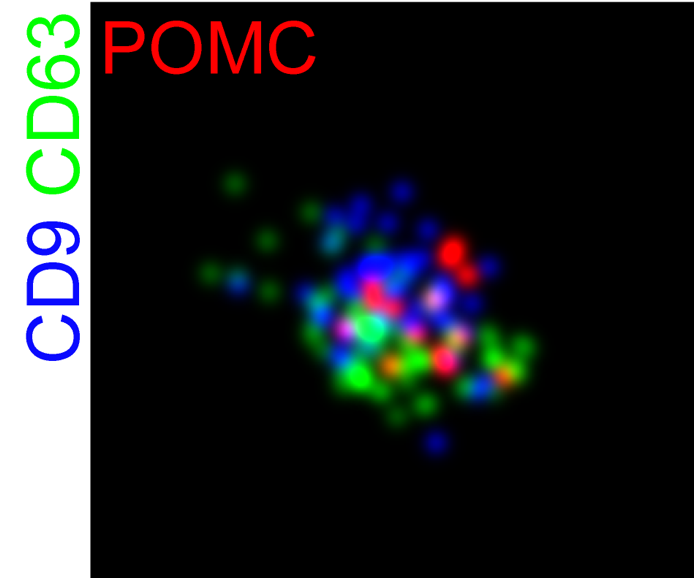
The micrograph shows the association of the prohormone called proopiomelanocortin (POMC) with plasma-derived CD9+CD63+ extracellular vesicles. Source: Adapted from Santos et al. PNAS, 2025, Volume 122, No. 51/ page 3.
Researchers at the Biotechnology Centre and Faculty of Medicine at Dresden University of Technology collaborated with international scientists and discovered that extracellular vesicles in the blood transport hormones throughout the body, including to the brain, and accelerate this transport in response to physical exercise.
An international team of researchers, including scientists from Biotechnology Centre (BIOTEC) and Faculty of Medicine at Dresden University of Technology, has discovered that tiny particles in the blood, called extracellular vesicles (EVs), are a major player in how a group of hormones are shuttled through the body. Physical exercise can stimulate this process. The findings, published in the journal Proceedings of the National Academy of Sciences (December 16, 2025, Vol 122, No 51), open the door to deeper understanding of hormone circulation and access to the brain, how exercise may trigger changes in energy balance, mental health, and immune function, and circulation of certain drugs.
Blood and other body fluids are teeming with EVs, i.e. small particles that exist outside of cells. EVs transmit signals from cell-to-cell within tissues and long distance across organ systems by delivering biological cargo such as proteins, lipids, and nucleic acids into cells. Scientists have known that EVs play key roles, from the immune response to cancer progression, but much less is known about how they might interact with hormones.
The researchers focused on a hormone precursor called proopiomelanocortin (POMC), which transforms into a range of hormones including endorphins (responsible for the runner’s high) and adrenocorticotropic hormone (ACTH), which manages the body’s stress response. Because exercise has been previously associated with these hormones, the researchers used exercise to provoke changes to shed light on interactions between POMC and EVs. The study found that vigorous exercise causes four times more POMC to hitch a ride on the EVs.
The same study also revealed that EV-bound POMC can cross human vascular barriers, including the blood-brain barrier in vitro, more effectively than POMC alone. Since POMC must be converted into so-called ‘mature’ hormones to trigger a response in the brain, which is notoriously difficult to access, further work is needed to understand how exercise-induced increases in POMC affect the brain.
The study was led by Prof. Aurelio Lorico of the Touro University Nevada (USA). Co-authors were research group leader Dr. Denis Corbeil and his colleague Dr. Jana Karbanová from BIOTEC and Medical Faculty. “The discovery of the binding of the prohormone to extracellular vesicles prompts us to rethink how hormones circulate in the bloodstream, which has enormous potential for regenerative medicine,” says Dr. Denis Corbeil.
Funding
Dr. Corbeil and his BIOTEC-associated research group, including Dr. Jana Karbanová, who took part in the study, are supported by the Faculty of Medicine Carl Gustav Carus at the Technische Universität Dresden.
Publication
Proceedings of the National Academy of Sciences: “Physical Exercise Increases Binding of POMC to Blood Extracellular Vesicles” by Mark F. Santos, Jacqueline Randa, Derek Tai, Giulio Vistoli, Nofar Avihen Schahaf, Serena Vittorio, Geily Fuentes, Rita Lauro, Sheila Mosallaei, Jana Karbanová, Alexandra M. K. Yokomizo, Denis Corbeil, Cheryl E. Hightower and Aurelio Lorico: (December 16, 2025; Vol 122, No. 51, e2525044122, DOI number 10.1073/pnas.2525044122)
Link: www.pnas.org/doi/10.1073/pnas.2525044122
About the Biotechnology Center
The BIOTEC was founded in 2000 as a central scientific unit of the TU Dresden with the goal of combining modern approaches in molecular and cell biology with the traditionally strong engineering in Dresden. Since 2016, the BIOTEC is part of the central scientific unit “Center for Molecular and Cellular Bioengineering” (CMCB) of the TU Dresden. The BIOTEC is fostering developments in research and teaching within the Molecular Bioengineering research field and combines approaches in cell biology, biophysics and bioinformatics. It plays a central role within the research priority area Health Sciences, Biomedicine and Bioengineering of the TU Dresden.
www.tud.de/biotec
www.tud.de/cmcb
Additional Resources:
Website of Dr. Corbeil’s group: https://tud.link/mdax
Scientific Contacts:
Dr. Denis Corbeil
Tel: +49 351 463 40118
E-mail: