
Oct 27, 2026
What Makes Us Human? Researchers Compare Brain Development in Humans and Great Apes
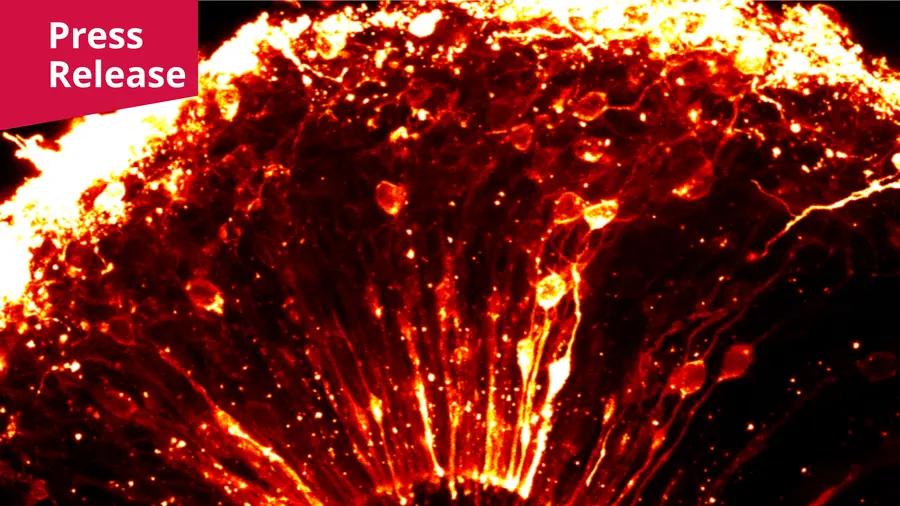
A microscopy picture of a human brain organoid. The organoid was stained with a special dye to highlight cell shape and branches.
How did the human brain become so much larger than that of our closest evolutionary relatives? Part of the answer lies not in new genes, but in how humans and non-human apes use the genes they share. Using brain organoids grown from stem cells, an international team led by Prof. Mareike Albert at TUD Dresden University of Technology compared early brain development in humans, chimpanzees, and gorillas. They found that in humans, genetic switches make certain genes more active, which likely make the cells that build the brain more branched – a trait linked to producing more neurons and, in turn, a bigger brain. The study is published in the journal Nature Communications.
In the brain, the neocortex is the area responsible for higher cognitive functions such as abstract thinking, long-term planning, and speech. The human neocortex is much larger than that of other great apes. Although certain human-specific genes have been linked to a larger brain, they alone do not explain the massive evolutionary expansion of the human neocortex.
“Changes in brain size actually arise during development. This is when the majority of neurons are generated. But developing brain tissue of non-human great apes is not available for research, and for good ethical reasons,” explains Prof. Mareike Albert, research group leader at the Center for Regenerative Therapies Dresden (CRTD) and the Faculty of Biology of TUD Dresden University of Technology, who led the study. “So we asked: how can we still compare brain development of different species side by side?”
The answer was brain organoids, tiny, three-dimensional tissue structures grown from stem cells. Organoids resemble the developing brain, in this case the neocortex. The researchers grew organoids from human, chimpanzee, and gorilla stem cells and compared the early stages of brain development between the species. They found clear differences in how the three species use their shared genes.
Same Genes, Different Settings
The human coding genome is 98-99% identical to that of chimpanzees and gorillas. Yet identical genes are not necessarily used in the same way. The team analyzed the gene activity in the neural stem cells in developing brain organoids and found that many genetic switches operate differently in humans.
“These genetic switches are short DNA sequences that control how active a gene is. You can think of them as sort of dimmers that turn genes up or down,” says Dr. Schütze, who led the experimental part of the study. “We found nearly 600 switches that are more active in human neural stem cells than in those of chimpanzees and gorillas.”
Many of these switches regulated genes known to shape the cell, especially helping a cell grow long, branched extensions. When the researchers switched off two of these genes in human organoids, the stem cells became less branched, and in one case the cells gave rise to fewer neurons. This is in line with earlier research suggesting that more branched stem cells pick up more signals from their surroundings, divide more often, and produce more neurons, which in turn leads to a bigger brain.
“It is not necessarily different genes that make a human brain special. As the nearly identical genomes suggest, we use largely the same toolkit as apes, just with different settings,” says Prof. Albert.
A New Window into Early Development
Great apes are endangered and strictly protected. As a result, how the brain of our closest living relatives develops has remained largely out of reach for research.
“Organoids give us a window into a stage of development that we otherwise could not study at all,” says Prof. Albert. “What makes us human is a fascinating question. With organoids, we can finally start answering parts of this question at the level of individual cells and genes.”
About The Study
The study is the result of an international collaboration with partners in Dresden (MPI-CBG, University Hospital Carl Gustav Carus, NCT/UCC Dresden), Munich (Helmholtz Munich), Hannover (Hannover Medical School), Milan (Human Technopole), Cambridge (MRC Laboratory of Molecular Biology), London (King’s College London), and Helsinki (University of Helsinki).
Original Publication
Theresa M. Schütze, Annika Kolodziejczyk, Nora Ditzer, Silvia Vangelisti, Emanuele Capra, Jeong-Eun Lee, Ilaria Chiaradia, Vida Kufrin, Seiya Yamada, Jula Peters, Maximilian Krause, Christina Eugster Oegema, Razvan P. Derihaci, Cahit Birdir, Takashi Namba, Alexander A. Wurm, Ulrich Martin, Pauline Wimberger, Katherine R. Long, Madeline A. Lancaster, Nereo Kalebic, Boyan Bonev and Mareike Albert: Human-specific morphoregulatory signatures in basal radial glia characterise neocortex evolution. Nature Communications (October 2026)
Link: https://doi.org/10.1038/s41467-026-78474-0
About the Center for Regenerative Therapies Dresden (CRTD)
The Center for Regenerative Therapies Dresden (CRTD) of TUD Dresden University of Technology is an academic home for scientists from around 25 nations. Their mission is to discover the principles of cell and tissue regeneration and leverage this for the recognition, treatment, and reversal of diseases. The CRTD links the bench to the clinic, scientists to clinicians to pool expertise in stem cells, developmental biology, gene-editing, and regeneration towards innovative therapies for neurodegenerative diseases such as Alzheimer's and Parkinson's disease, hematological diseases such as leukemia, metabolic diseases such as diabetes, bone and retina diseases. The CRTD was founded in 2006 as a research center of the German Research Foundation (DFG) and funded until 2018 as a DFG Research Center, as well as a Cluster of Excellence. Since 2019, the CRTD is funded by the TU Dresden and the Free State of Saxony.
The CRTD is one of three institutes of the central scientific unit Center for Molecular and Cellular Bioengineering (CMCB) of the TU Dresden.