
Nov 21, 2025
Stress and its consequences: The German Research Foundation (DFG) extends its multi-million euro funding for a Collaborative Research Center on adrenal gland disorders led by TU Dresden

The international research consortium in the CRC/TRR 205 works under the leadership of Prof. Stefan R. Bornstein.
The Collaborative Research Center (SFB) / Transregio 205 (TRR 205) for the investigation and treatment of adrenal gland disorders can continue its work in a third funding period. The German Research Foundation (DFG) announced today that it will fund the internationally leading consortium headed by the Faculty of Medicine of TU Dresden with several million euros for another three and a half years starting in 2026. The goal of SFB/TRR 205 "The Adrenal: Central Relay in Health and Disease" is to understand the central role of the adrenal glands in metabolic and inflammatory diseases and to develop new therapeutic approaches.
Worldwide, stress levels are increasing as a result of geopolitical tensions, economic uncertainties, and social conflicts. Stress affects the human body by releasing messenger substances via the adrenal hormonal system, which control numerous bodily functions. Dysregulation or overstimulation of the adrenal glands as a result of chronic stress can cause far-reaching changes in the body, including increased susceptibility to diabetes and cardiovascular disease and, in rare cases, the formation of tumors in the adrenal glands.
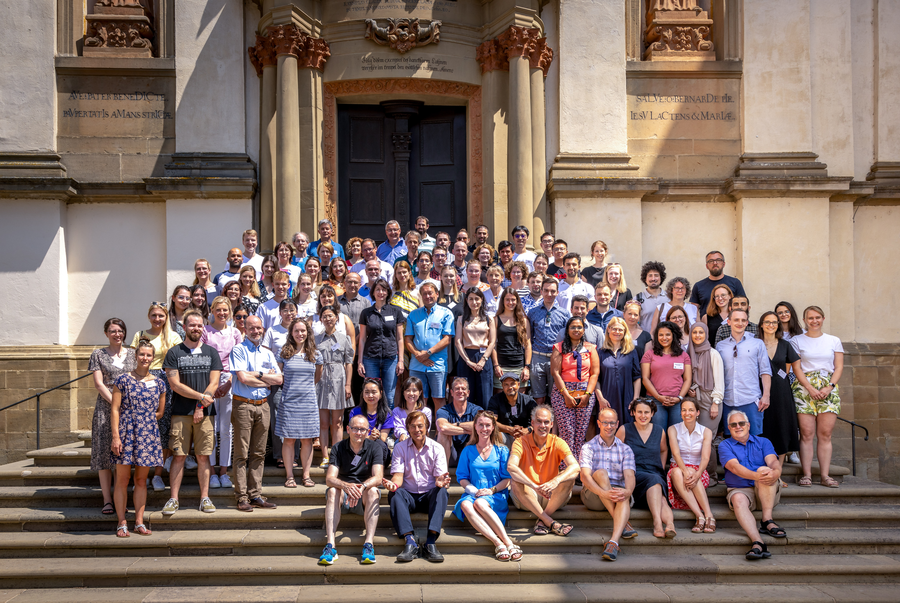
Group picture of the Collaborative Research Center (SFB) / Transregio 205 (TRR 205)
Since 2017, an international research consortium in SFB/TRR 205, led by Prof. Stefan R. Bornstein, Director of the Center for Internal Medicine and the Medical Clinic and Policlinic III at the Carl Gustav Carus University Hospital in Dresden, has been working on 22 subprojects at locations in Dresden, Munich, and Würzburg, as well as the transCampus in London and Zurich. Its goal is to conduct comprehensive research into the underlying mechanisms of adrenal gland disorders.
“The rapid increase in hypertension, diabetes, obesity, and the associated cardiovascular diseases is a serious manifestation of the modern stress syndrome,” explains Stefan Bornstein. “Since industry and pharmaceutical companies have so far addressed these complex disease patterns only to a limited extent, the funding provided by the DFG will be particularly important in order to be able to help affected patients effectively in the long term. “
The research achievements of TRR 205 impressively demonstrate the potential that lies in close cooperation between fundamental science and clinical medicine,” emphasizes Prof. Esther Troost, Dean of TU Dresden’s Faculty of Medicine. “The fact that the DFG is now supporting this excellent work once again is also a recognition of the outstanding quality and commitment of our researchers.”
Prof. Uwe Platzbecker, Medical Director of the University Hospital Dresden, underscores the clinical relevance: “The results from TRR 205 will have a direct impact on patient care in the coming years. They will help us to diagnose the consequences of stress and adrenal gland disorders in a targeted manner and to treat them more individually.”
The stated goal of the third funding period is to translate the results of basic research achieved in recent years, published in leading international journals from Nature to the New England Journal of Medicine, into clinical application.
“In the long term, the findings should be applied not only in specialized centers, but also in broader medical care,” adds Stefan Bornstein. “To this end, we are developing new models using machine learning and artificial intelligence.”
SFB/TRR 205: “The Adrenal: Central Relay in Health and Disease”
Since its launch in 2017, CRC/TRR 205 has received a total of nearly EUR 50M in funding from the DFG. The research project currently comprises 18 scientific and four service projects, which are supported by 47 subproject leaders at six institutions: TUD Dresden University of Technology, Ludwig Maximilian University of Munich, Julius Maximilian University of Würzburg, Technical University of Munich, Helmholtz-Zentrum Dresden-Rossendorf, and Helmholtz Munich.
More info: https://tu-dresden.de/med/mf/forschung-internationales/forschungsprofil/sfb-transregio-205
Contact:
Stefan R. Bornstein
Director of the Center for Internal Medicine and Medical Clinic and Policlinic III
at the Carl Gustav Carus University Hospital Dresden and International Affairs Officer at the Carl Gustav Carus Faculty of Medicine of TU Dresden
Email:
Tel: +49 351 458 5955
Anne-Stephanie Vetter
Public Relations Office
Carl Gustav Carus Faculty of Medicine
of TUD Dresden University of Technology
Tel: +49 351 458 17903
Email:
www.tu-dresden.de/med