
Sep 29, 2026
European Monastic Studies Visits Eberbach Abbey
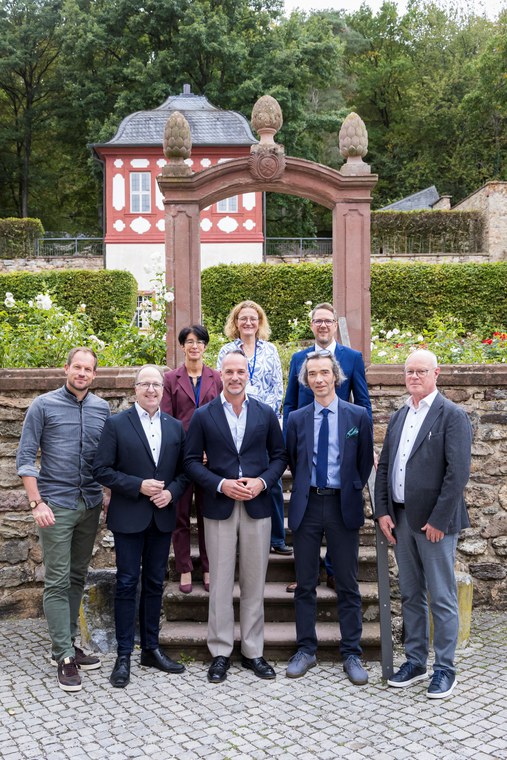
Sebastian Macho, Ingo Schon, Doris Moos, Julius Wagner, Gaby Lindenmann-Merz, Mirko Breitenstein, Christoph Degen, and Markus Harzenetter (from left)
An international symposium brings together the latest research on medieval infirmaries and hospitals at an extraordinary original site—and resolves a long-debated question regarding the monastery’s architectural history.
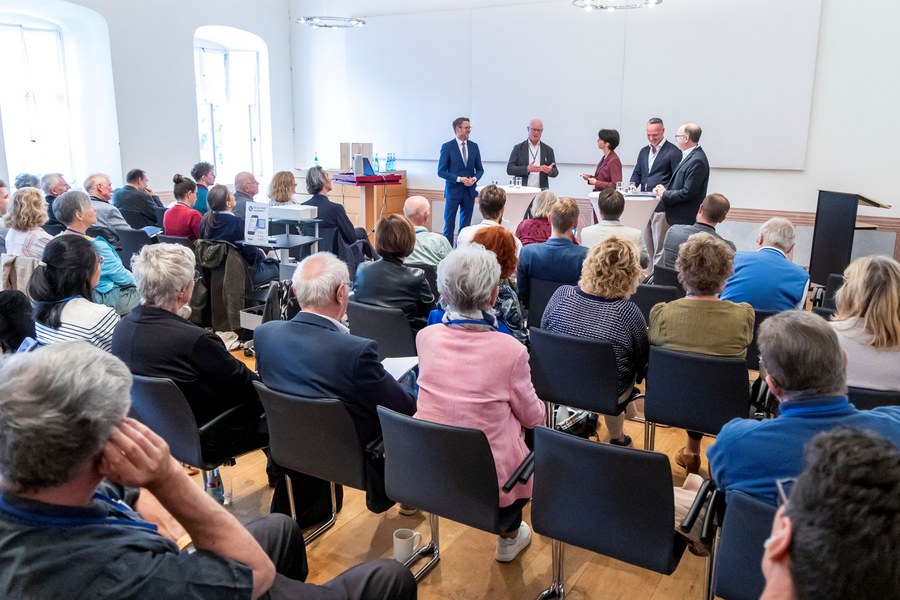
Das Podium der Fachtagung war prominent besetzt.
Scholars from across Europe gathered at Eberbach Abbey from September 24 to 26 to exchange the latest findings on medieval monastic infirmaries and hospitals. Under the title “The Same Yet Different—Monastic Infirmaries and Hospitals as Spaces of Christian Charity in the Middle Ages,” the Research Center for Comparative History of Religious Orders (FOVOG) at TU Dresden, the Eberbach Abbey Foundation, and the Friends of Eberbach Abbey Association jointly organized the international symposium.
The focus was on infirmaries and hospitals of various religious orders and monastic communities from the 12th to the 16th century. Presentations and discussions deliberately adopted a European and comparative perspective: How were healthcare and hospitality organized? What different functions did infirmaries and hospitals serve? And what do their architectural remains still tell us today about the daily life of medieval communities?
“Infirmaries and hospitals lead us directly to a central question regarding medieval communities: How was Christian care actually lived out and organized in everyday life? A European comparison shows that, despite shared religious foundations, there was a remarkable diversity of architectural, institutional, and functional solutions,” says Prof. Dr. Mirko Breitenstein, director of the Research Center for Comparative History of Religious Orders at TU Dresden. “It is precisely the exchange between different disciplines and the direct comparison of written and architectural sources that open up new perspectives here. Eberbach Abbey is an exceptional research site for this purpose—and the joint study of its architectural heritage has also led to a very concrete result: the long-debated building can be convincingly identified as the abbey’s infirmary.”
The conference was opened in the Fürstensaal of Eberbach Abbey together with Christoph Degen, State Secretary at the Hessian Ministry of Science and Research, Art, and Culture; Prof. Dr. Markus Harzenetter, President of the Hessian State Office for the Preservation of Historical Monuments; and Ingo Schon, a member of the Hessian State Parliament. Right from the start, this highlighted the close connection between scientific research, historic preservation, political responsibility, and the communication of cultural heritage.
“For many years, Dr. Gaby Lindenmann-Merz has examined the on-site architectural remains with great perseverance and exceptional dedication, thereby making a decisive contribution to documenting the infirmary and the hospital situation at Eberbach Abbey,” explained Doris Moos, chairwoman of the Friends of Eberbach Abbey Association. “As the Friends of Eberbach Abbey Association, we are particularly pleased that research from across Europe is now helping to further deepen our knowledge of the abbey and make it accessible to an interested public.”
In addition to the scholarly presentations, direct engagement with the historic site therefore played a central role. The Eberbach infirmary was not merely viewed as the setting for the conference, but as a historical source in its own right: a space that can still be experienced today and that provides insights into healthcare, monastic daily life, and the architecture of medieval communities.
For Eberbach Abbey, the conference yielded a particularly important insight
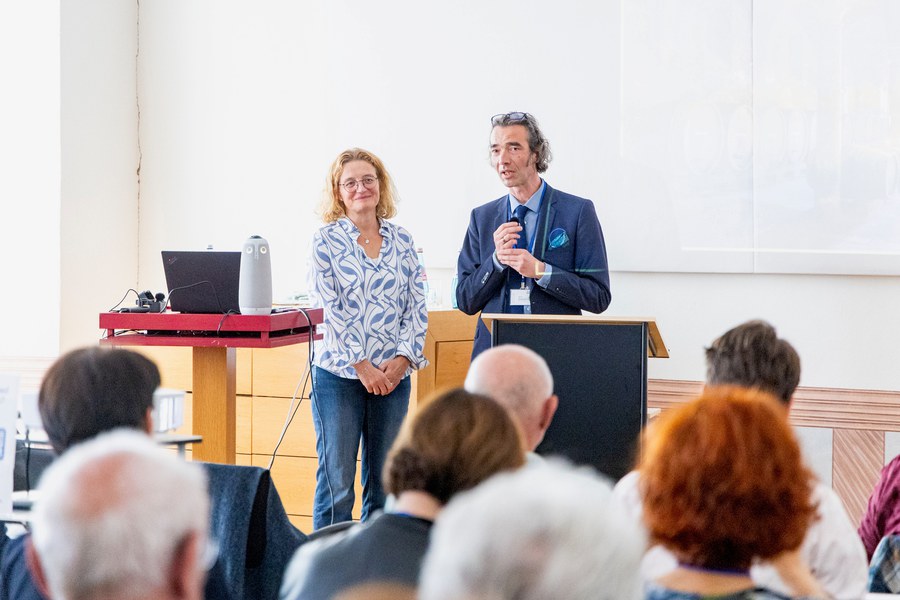
Gaby Lindemann-Merz und Mirko Breitenstein
For a long time, scholars debated whether the early-Gothic structure now known as the “Hospital Cellar” was in fact the monastery’s medieval infirmary. After jointly examining and discussing the findings, the experts gathered at the conference reached a clear conclusion: “The Hospital Cellar is the former infirmary of Eberbach Abbey,” said Dr. Gaby Lindenmann-Merz, one of the leading experts on the architectural history of Cistercian abbeys. For the Eberbach Abbey Foundation, this long-debated question has thus been scientifically resolved.
This is precisely what gave the conference venue its special significance. The Eberbach infirmary, dating from the first half of the 13th century, ranks among the most outstanding surviving examples of this architectural type in Europe. This allowed research to be discussed directly at the historical site—drawing on a combination of written sources, architectural evidence, and the latest scientific findings.
“Eberbach Abbey is one of the best-preserved Cistercian abbeys in Europe, where nearly 900 years of history are still immediately evident. The fact that an international symposium held here was also able to resolve a long-debated question regarding our own architectural history is of particular significance to us,” says Julius Wagner, Chairman of the Board of the Eberbach Abbey Foundation. “In the future, we can say with scientific certainty: The so-called ‘Hospital Cellar’ was the monastery’s infirmary. This precisely illustrates why we must not only preserve this historic site but also continually re-examine it through research. For us, research, historic preservation, and the interpretation of this site are inextricably linked.”
The international conference also served as an expression of close collaboration between the Research Center for Comparative History of Religious Orders at TU Dresden, the Eberbach Abbey Foundation, and the Friends of Eberbach Abbey Association. It brought together current European research with a significant surviving testament to medieval monastic culture—a place where history is not merely a subject of research but remains tangibly present to this day.
This is Eberbach Abbey
Eberbach Abbey, founded in 1136 by Cistercian monks under Bernard of Clairvaux, survives to this day as a fully preserved complex of outstanding Romanesque, Gothic, and Baroque buildings and ranks among the most significant and completely preserved monastic complexes in Europe. From the very beginning, viticulture served as the monastery’s economic foundation and enabled its development and significance over the centuries. Based on this historical connection, the Eberbach Abbey cultural monument and Hessische Staatsweingüter GmbH Kloster Eberbach form an inseparable unit. Since 1998, the Kloster Eberbach Foundation has been preserving and developing one of Europe’s most significant cultural monuments. Through a diverse program of culture, events, and wine culture, it uniquely bridges the past and the present. The foundation is self-financed through sources including admission fees, guided tours, events, donations, and rental and lease income; it also supports cultural projects in line with its mission: preserving values, shaping the future, and fostering dialogue.
The Hessian State Wineries of Kloster Eberbach are among the largest and most historic wineries in Germany. Through their wines, they carry on the centuries-old legacy of the Cistercians and combine monastic tradition with contemporary wine culture.