
Nov 26, 2026
Interview with Chiara Saueressig
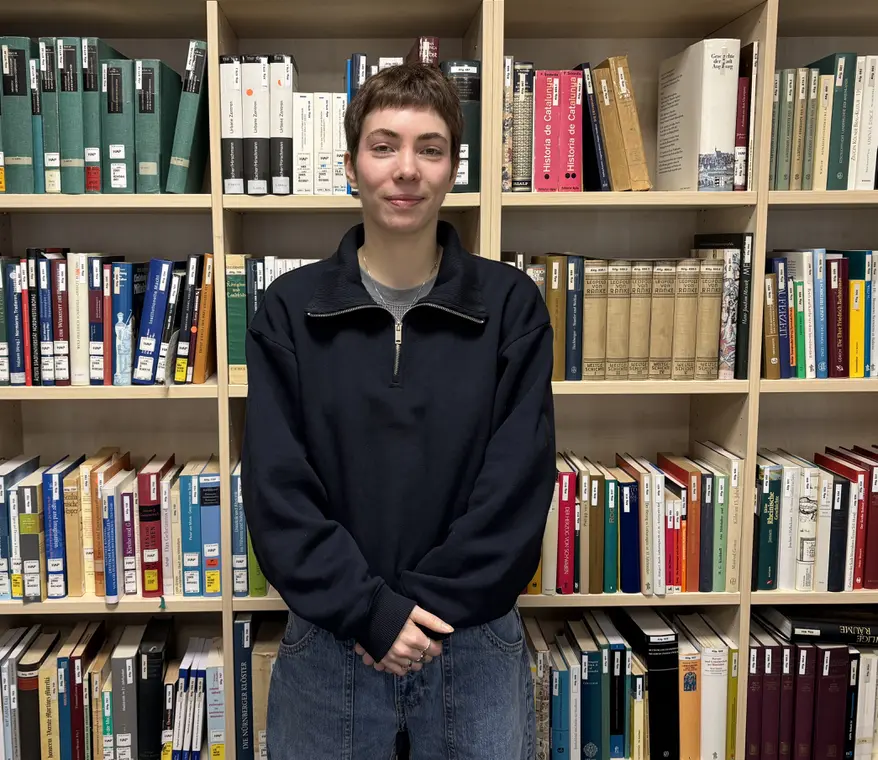
Chiara Saueressig is completing an internship with us at the Research Center for Comparative History of Religious Orders (FOVOG) during the winter semest . In this interview, she shares what particularly interests her about history, what experiences she’s had during her internship, and what she enjoyed most. The interview was conducted by Laura-Marie Lang.
Please introduce yourself briefly. Who are you, and what are you currently doing?
My name is Chiara; I’m pursuing a master’s degree in European Languages, focusing primarily on language theory, language change, and the cultural contexts in which language is used. During the 2026–27 winter semester, I’m completing my internship at the Research Center for Comparative History of Religious Orders (FOVOG). My goal is to apply my linguistic perspective to various historical sources and see what questions arise from them.
What interests you most about history, and do you have a favorite historical period?
To be honest, history was never really my strongest subject, and I probably wouldn’t have said in the past that I had a favorite era. But through my internship, I’ve realized that I’m growing to like the Middle Ages more and more. I actually think that’s a cool experience, because you realize how much your own perspective on a topic can change once you work with it more intensively.
Why did you decide to do your internship with us at FOVOG?
For my studies, I wanted to experience what academic research actually looks like outside the university seminar room. And so I was really excited when FOVOG offered me the opportunity to work in an interdisciplinary setting. Once I was there, I also realized how people from different disciplines come together here and that historical research is never conducted from just a single perspective.
What were your expectations going into the internship, and were they met?
I started with the expectation of gaining insight into everyday research life and better understanding how concrete research approaches emerge from a large volume of (sometimes even fragmented) sources. At the same time, I was curious to see how I could contribute my own linguistic knowledge and to what extent my experiences at FOVOG would be valuable for my future studies. My expectations were definitely met (and even exceeded).
What tasks did you take on during your internship, and what areas of historical research were you able to gain insight into?
At the beginning, I mainly focused on familiarizing myself with various topics on my own. In the process, I gained insights into monastic life, written records, and the relationship between the inner and outer worlds of a monastery, among other things. I found it particularly interesting that I was truly involved in current research considerations throughout the internship. For example, in a project on the written records of several Lüneburg monasteries, I’m exploring the role that a linguistic perspective can play in structuring and subsequently analyzing the sources.
Was there a highlight or a task that particularly stuck with you?
One highlight for me was definitely the moment when I realized that I could actually contribute based on my own academic interests. One topic that comes to mind here is historical multilingualism, which plays a major role in medieval sources. When you engage with them, it becomes clear how different languages were used and what conclusions can be drawn from this about the broader historical context.
What did you learn during the internship, and what experiences will you take with you in particular?
Above all, I learned that sources from non-linguistic fields of research can still be used to study a community’s language use. A text is not simply a text, but is always part of a specific historical, social, and material context. I also learned that research often doesn’t begin with a ready-made answer, but rather with the right question—and sometimes even with figuring out what question to ask of a given source in the first place.
Did the internship help you with your professional or academic orientation?
Yes, definitely. The internship showed me that I’d like to combine my linguistic interests more with questions from the fields of history and cultural studies. As I’d hoped, I also realized that I really enjoy the research process itself (that is, reading, asking questions, discussing, and developing ideas). This has definitely opened up new perspectives for my future academic path.
How would you describe your internship at FOVOG in three words?
Interdisciplinary, inspiring, surprising!