
24.11.2026
Fritz Thyssen Stiftung fördert internationale Konferenz zum Schreiben in der Spätantike
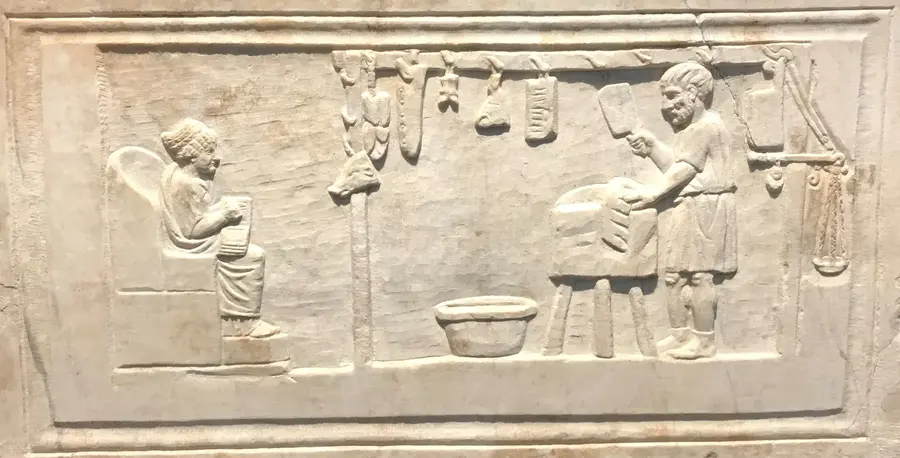
Image: Butcher and his wife (second century CE). Credits: SKD Skulpturensammlung, Nr. Inv. Hm 418. Picture: Jan Heilmann
Prof. Dr. Jan Heilmann (Professor für Biblische Theologie, Institut für Evangelische Theologie, TU Dresden) und Dr. Monika Amsler (Alte Geschichte/Judaistik, Bern) haben Fördermittel in Höhe von 16.000 Euro zur Durchführung einer internationalen und interdisziplinäre Konferenz bei der Fritz Thyssen Stiftung eingeworben. Knapp 20 Wissenschaftlerinnen und Wissenschaftler aus der Klassischen Philologie, Alten Geschichte, Judaistik, der Exegese und der Papyrologie werden sich vom 27.05.-29.05.2027 mit dem Schreiben als Kulturtechnik in der Spätantike beschäftigen.
Programm:
Writing as Cultural Technique in Late Antiquity: Intersections of Media Usage, Embodied Activities and Cognitive Concepts
How does writing shape culture?
Approaching writing in antiquity as a cultural
technique (Kulturtechnik) promises to shed new light
on writing beyond the oral–literacy dichotomy that
has governed its study for the past sixty years.
Analyzing writing in this way makes it possible to
understand it as a practice in its own right,
independent of oral communication, that is, neither
merely in its service nor in competition with it. The
conference will address questions such as how
writing materials shaped the cultural connotations
of writing; in what instances people wrote
themselves and when they relied on others to write
for them; how education transformed writing into a
cultural practice rather than a process of mechanical
reproduction; why people sometimes wrote even
when memorization would have been easier; and
what transformative properties were attributed to
letters and writing beyond their meaning and
content.
Thursday, May 27
15:30 Coffee
16:00 Introduction:
Jan Heilmann, Monika Amsler
Panel 1: WHEN WRITING MATTERS
16:15 Rachael Banes: “Lord, help!” and Other
Prayers in Late Antique Graffiti
16:45 Aleksandra Pawlikowska: Writing on the
Wall: Secondary Epigraphy from the
Monastery of St Phoibammon (Deir el-
Bahari)
17:15 Paweł Nowakowski: To scroll, or not to
scroll? Text layout in Late Antique
inscriptions
17:45 Final Discussion
Friday, May 28
Panel 2: WHEN MATTER MATTERS
09:00 Daniel Picus: Inscribed in Memory: Modes
of Writing and Representation in Rabbinic
Literature
09:30 Patrick Sänger: Ostraca from Ephesus:
New Insights into Writing Culture and
Epigraphic Habit on Site
10:00 Break
10:30 Isabelle Marthot-Santaniello: Writing as a
cultural technique in Late antiquity: the
view from the village of Aphrodito in
Middle-Egypt
11:00 Final Discussion
Saturday, May 29
Panel 3: CULTURAL ASPECTS OF WRITING AND
LITERARY EDUCATION
09:00 Sean Adams: Reading, Writing, Listening,
Speaking: The Interconnected Nature of
Learning in Ancient Education Settings
09:30 Franziska Müller: Editorial writing and
publication in antiquity. A case study of
ancient letter collections
10:00 Discussion
10:20 Break
10:50 Jonas Müller: Compositional practices in
the Early Imperial period and the New
Testament Gospels
11:20 Kiana Rezakhanlou: Malleable Material:
Hyphology and Quotation across Ancient
Literary-Rhetorical Theory
11:50 Final Discussion
Panel 4: WRITING IN SERVICE OF AN OTHER
13:15 Christopher Londa: The Reader’s Double:
Writing and Reciting in the Younger Pliny’s
Epistulae
13:45 Sabrina Inowlocki: A Scribe’s Self: Writing
sua manu as Ethical Technology in Late
Antiquity
14:15 Break
14:45 Sean Leatherbury: Spontaneous Writing?
Late Antique Pilgrim Inscriptions, Agency,
and Community
15:15 Final Discussion
16:00 Break
Panel 5: TRANSMATERIAL ASPECTS OF WRITING
16:30 Markéta Preininger: Writing to Change
Bodies: Formularies, Applied Texts, and
Writing as a Cultural Technique in Christian
Egypt
17:00 Cynthia Bruhn: Notions of Divine
Authorship and Writing in Religious Texts
17:30 Lydia Bremer-McCollum: Vibrant
Alphabet: Pachomian Letters, Angelic
Encounters, and the Agency of Letter
Forms
18:00 Final Discussion