
Information for students

Table of contents
Program Structure and Course of Study
A total of 120 credit points are awarded in the Master’s program in International Relations. The standard duration of study for full-time students is 4 semesters.
The degree program has a modular structure. In addition to required and elective courses in the core subjects of the respective specialization (at least 50 CP), students must complete interdisciplinary required modules totaling 25 CP.
You may earn an additional 20 CP either in further core subject modules or in the area of supplementary qualifications (modules in a third subject or courses in related social science disciplines).
The master’s thesis is scheduled for the fourth academic semester. It is worth 25 LP.
A tabular overview of the modules can be found here.
General Required Area


© PantherMedia / matej kastelic


© Crispin-Iven Mokry

© Karsten Eckold
These interdisciplinary modules are required for all specializations within the master’s program:
- Interdisciplinary Analysis of International Relations,
- Professional Internship,
- Research Design
Specializations
Depending on your interests and prior knowledge, you will choose one of the three available specializations.
The following specializations are available:
International Order and Institutions
The International Order and Institutions specialization provides you with in-depth knowledge of international politics and international law. This will enable you to analyze the challenges of legal and political governance in a globalized world and to independently develop interdisciplinary strategies for effectively addressing international problems and development processes.
Course Content:
- Fundamentals of international law governing the international order, including methods of international law
- Conditions for the emergence of forms of international order
- Structure and functioning of international organizations and institutions
- Forms of institutionalized cooperation in inter- and transnational relations
- Concepts and theories regarding the relationship between political and legal forms of order and governance, as well as issues of compliance, legitimacy, and efficiency in international regimes and organizations
In addition, students may choose from fundamental topics in Business Administration and Economics and other disciplines with an international focus.
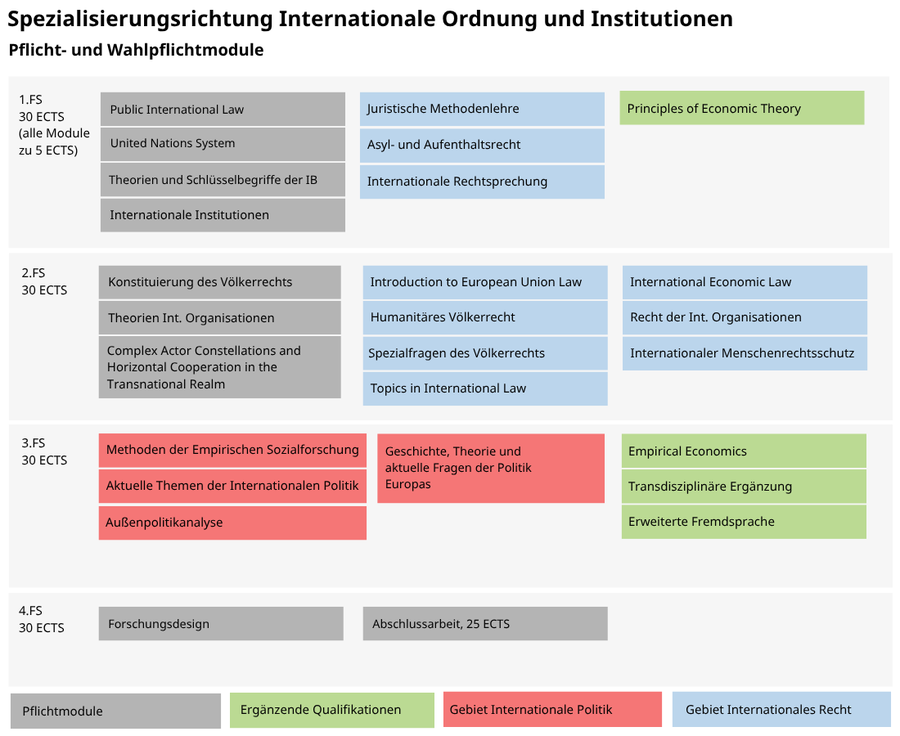
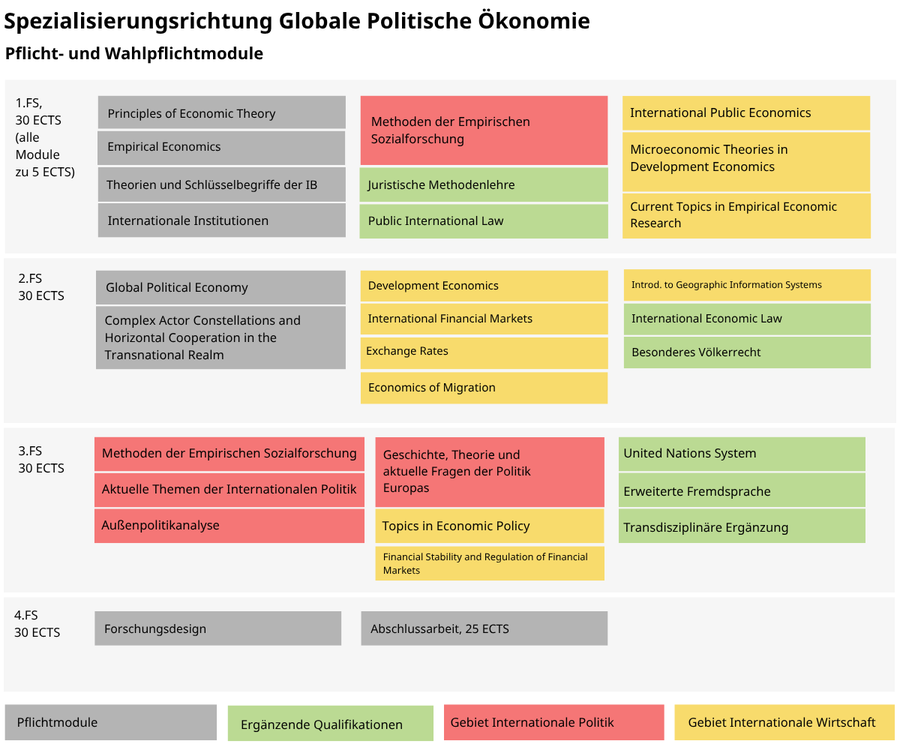
Global Political Economy
The Global Political Economy specialization provides you with in-depth knowledge of the interrelationships between international politics and economics. You will be equipped to analyze issues related to the global interaction between politics and economics. In addition, you will independently develop interdisciplinary solutions to effectively address problems in the political governance and regulation of global economic relations.
Course Content:
- Causes, trends, and analyses of the internationalization of national economies, particularly the integration of goods and factor markets and its consequences for welfare, distribution, and development
- Concepts and theories regarding the relationship between globalized markets and political regulatory and governance frameworks, as well as the associated issues of compliance, legitimacy, and efficiency
- The scope for action of national policy under the conditions of global economic governance within the framework of intergovernmental international organizations and regimes, the integration of private stakeholders into public-private governance structures, and the political economy of international economic relations
In addition, students may choose from fundamental topics in international law as well as other disciplines with an international focus.
International Law and Economics
The International Law and Economics specialization will help you gain a deep understanding of the international economy and international law. With this knowledge, you will be able to analyze how these two fields interact and independently devise solutions to problems in the global economy and its legal regulation.
Course Content:
- Causes, trends, and analyses of the internationalization of economies, particularly the integration of goods and factor markets and its implications for welfare
- The structure and role of institutions and organizations in internationalized economies
- The foundations of the international order under international law, including methods of international law
- International distribution issues, as well as trends and decision-making processes against the backdrop of economic and political interests
In addition, students may choose from fundamental topics in political science as well as other disciplines with an international focus.
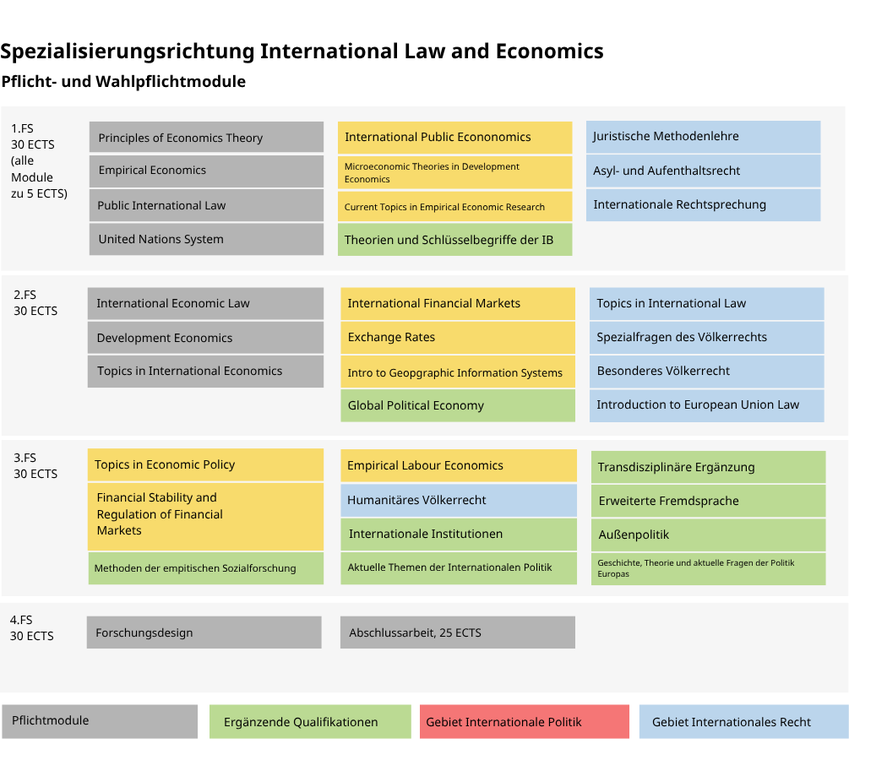
Within these specializations, you will take the corresponding required and elective modules, and you can easily set your own areas of focus within the elective component.


© Crispin-Iven Mokry


© Amac Garbe


© Crispin-Iven Mokry
Courses/Schedule

You can find an overview of the courses for the current semester and the current class schedule on our website under “Class Schedules.”
Academic Documents

Current versions of academic documents (academic, examination, and other regulations) can be found on our Regulations and Documents webpage.
You can find these documents in the form of Official Announcements on the GSW Student Office website.
Contact Persons
Academic Advising
If you have any questions about the content and structure of your degree program, our academic advising office is happy to assist you.
 © Thomas Moch
Ines Hantke M.A.
Recognition of credits earned abroad/ Study advisor/ Incomings
Send encrypted email via the SecureMail portal (for TUD external users only).