
Jul 13, 2026
"Oha! Adventure Science " showcased the diverse research landscape of Upper Lusatia
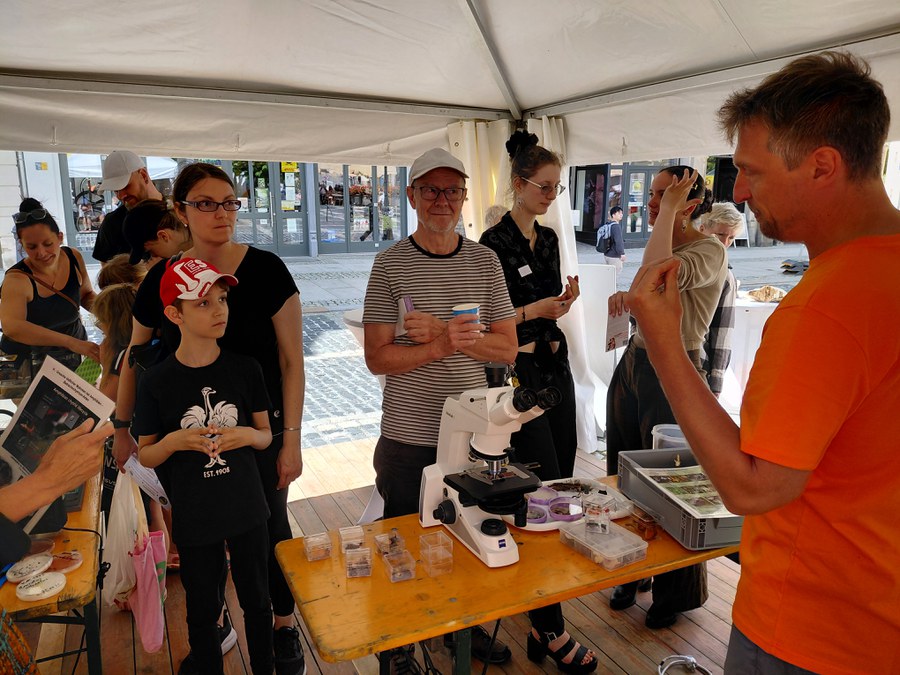
IHI employee Dr. Alexander Karich (left) uses the fungal specimens he brought along to explain IHI Zittau’s core research area in mycology to visitors at the Science Mile.
For several years now, Lusatia has been emerging as a major center of modern research—ranging from artificial intelligence to sustainable materials and radio astronomy. But what lies behind these projects? Will we be able to use 3D-printed bicycles in the future, have robots carry out construction work, or replace plastic with natural fibers? And how do technologies that make our energy supply more sustainable actually work?
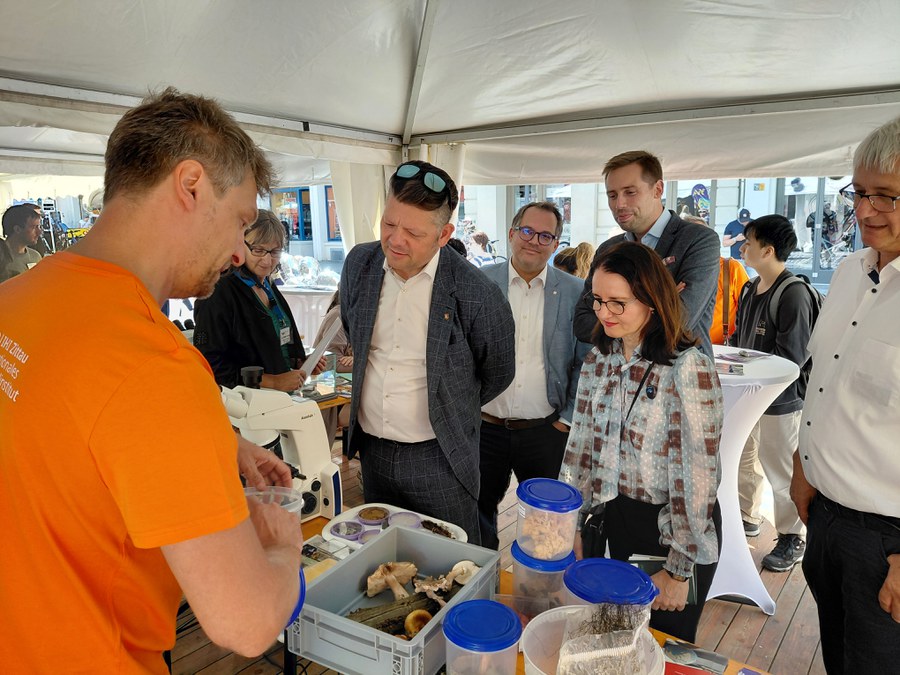
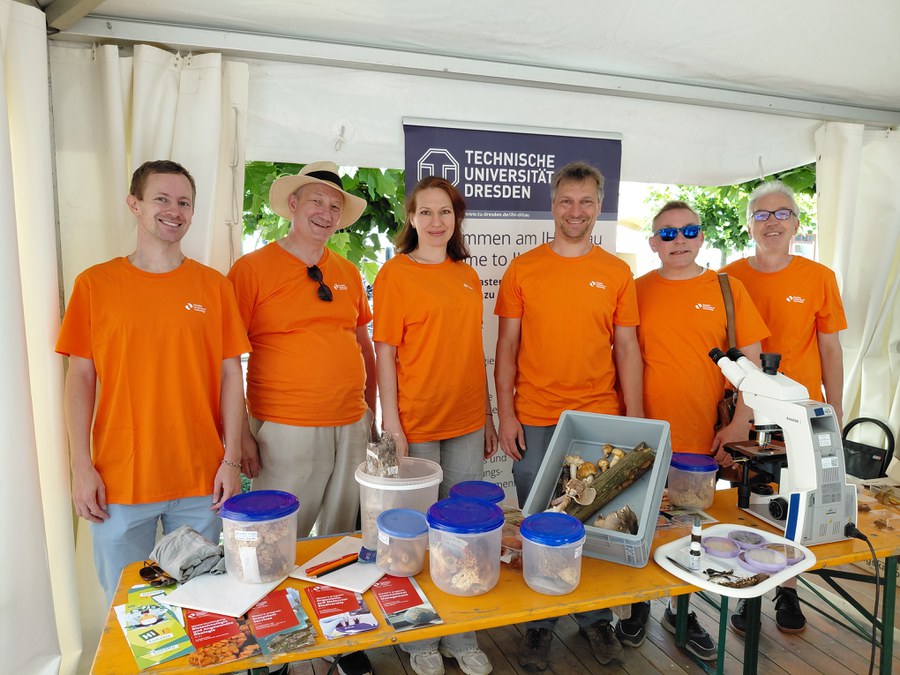
Answers to these and many other questions were provided by the science fair “Oha! – Adventure Science”, which took place at on July 11, 2026, as part of the Zittau City Festival. With support from the Saxon Agency for Structural Development (SAS), the partners of the Hi!Lusatia network transformed the market square and the area in front of St. John’s Church into an open laboratory for the whole family—naturally with the participation of the IHI Zittau, in front of whose headquarters the science festival took place. Visitors were not only able to learn about the IHI’s core research area on mycology through interesting fungal specimens, but were also offered tours of the IHI building and laboratories featuring small demonstration experiments.
Children, teens, and adults could also experience research up close at numerous other hands-on stations. Visitors were able to conduct experiments themselves, learn about new technologies, and talk with scientists. Complex topics such as sustainable technologies, automation, digitalization, and astronomical discoveries were presented in a way that was both understandable and engaging.
The diverse offerings from the participating institutions demonstrated just how exciting science can be: At the Center for Advanced Systems Understanding (CASUS) booth, visitors could test the electrical conductivity of pencils, assemble molecules using analog or digital methods, and playfully discover just how internationally oriented research in Lusatia already is.
The Zittau/Görlitz University of Applied Sciences also promised hands-on technology. In its mobile learning center, 3D printers, laser cutters, drones, and robotic arms invited visitors to try things out and explore. A small heat pump from the DLR_School_Lab at Zittau/Görlitz University of Applied Sciences made future technologies related to heat supply understandable and tangible. In this way, research became an experience for the whole family.
The program was complemented by an exhibition on the career opportunities arising from structural change in Lusatia. It highlights the new training, study, and career paths emerging as a result of research institutions and innovative companies establishing themselves in the region.
The Science Mile was opened by State Secretary Prof. Heike Graßmann, Mayor Thomas Zenker, and representatives of the participating partner institutions.
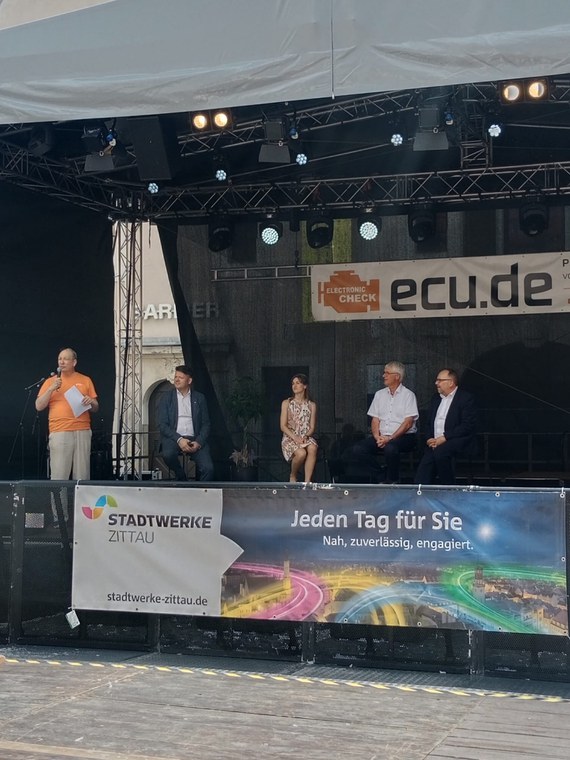
The Center for Teacher Education and Educational Research (ZLSB) at TU Dresden also demonstrated how closely science, education, and regional development are intertwined. With the opening of a regional office for teacher education in Zittau, schools in eastern Saxony and TU Dresden will be even more closely connected—promoting shorter distances, strong partnerships, and better educational opportunities in the region.
Through the “High-Quality Career Change” program, more than 1,000 career changers have already been qualified for the teaching profession through a scientifically sound and practice-oriented approach. The regional office was officially opened on the main stage during the ongoing Oha! on the main stage by Zittau’s Mayor Thomas Zenker, IHI Director Prof. Thorsten Claus, ZLSB Director Prof. Axel Gehrmann, and Regional Office Director Dr. Elisa Rößler.
Numerous partners from academia and research are involved
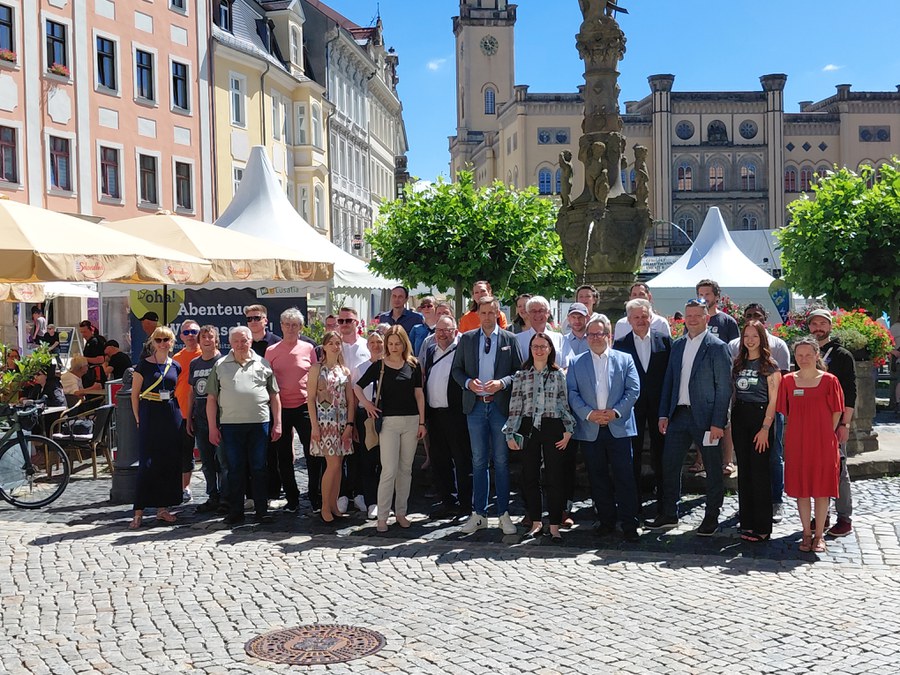
Participants in the Science Mile included, among others:
• 4transfer
• Center for Advanced Systems Understanding (CASUS)
• German Center for Astrophysics
• German Aerospace Center (DLR)
• Saxony Cooperative State University
• Fraunhofer Institute for Machine Tools and Forming Technology (IWU)
• Hi!Lusatia e.V.
• Zittau/Görlitz University of Applied Sciences
• IBZ St. Marienthal
• International Institute (IHI) Zittau at TU Dresden
• Siemens Energy
• Senckenberg Museum of Natural History, Görlitz
• Center for Teacher Education and Educational Research (ZLSB)
“Oha—that stands for ‘Upper Lusatia Knows Its Stuff,’” explains Lisa Bail of the Hi!Lusatia e.V. association and organizer of the event. “We want to spark curiosity, make research visible, and show what exciting developments are taking place right on our doorstep.
Science shapes the future of our region—and that’s exactly what we want to bring to life together.”
The Saxon Agency for Structural Development (SAS) is guiding the transformation of Saxony’s lignite mining regions and supporting regional stakeholders in developing and implementing projects for the future. As a supporter of the Science Mile, it helps highlight the opportunities presented by structural change and promotes dialogue between science, business, and society.
Further information: www.abenteuer-wissenschaft.de