
Holographic Stimulation Platform for Optogenetics
The stimulation platform is built around two ferroelectric spatial light modulators which allow for fast arbitrary 3d light shaping in the sample volume. Two separate beam paths allow for simultaneous sample illumination with multiple wavelengths which can be fiber-coupled to the platform as required. Currently, the platform offers 488nm and 589nm light, e.g. for the actuation of the opsins ChR2 or Chrimson as well as eNpHR. Light shapes in the sample plane are e.g. multiple foci as well as homogeneous or graded shapes. The field of view can be adapted as needed, e.g. to fit electrophysiology readout devices like multi-electrode arrays.
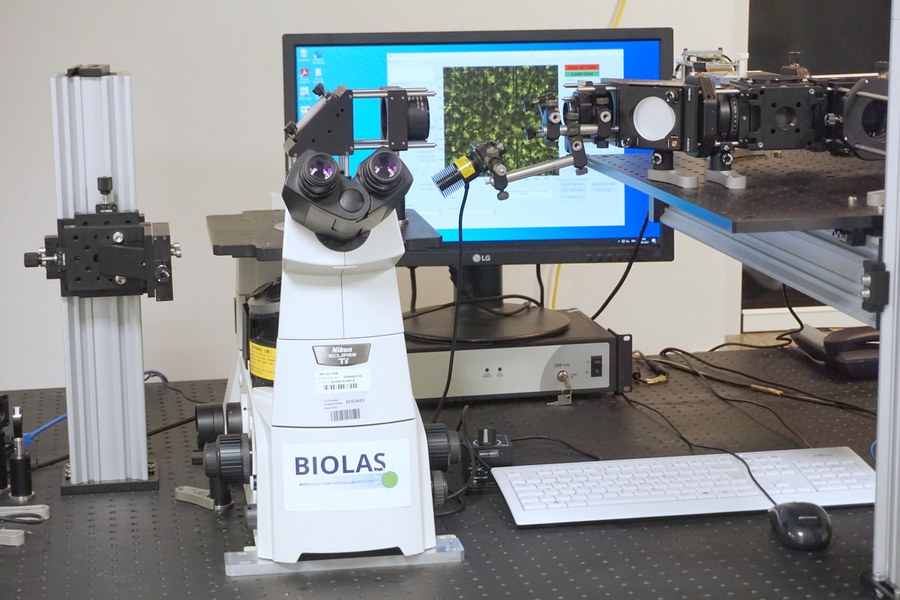
Our optogenetic stimulation platform consisting of an inverted microscope and adaptive stimulation optics
- 488nm laser diode suited for ChR2 activation
- Ferroelectric spatial light modulator (Forth Dimension Displays) for display of FullHD computer generated holograms
- Up to 1.7kHz frame rate for fast kinetics
- Multiple simultaneous spot stimulation at single cell resolution
-Lateral and axial scanning w/o moving parts-Cellular lateral resolution with long working distance (>30mm)
- Light source easily interchangeable for different (color-) channels
- GUI for calibration and stimulation protocols
System parameters at a glance
Exemplary applications at MST
Closed-loop control of human cardiomyocyte contractions
Here, we have demonstrated the closed-loop all-optical label-free control of the contractions of in-vitro cultures of human induced-pluripotent-stem-cell-derived cardiomyocytes.
Optogenetic tracking of neuronal signal pathways
Here, we used the platform to track signaling pathways in developing random networks of human induced-pluripotent-stem-cell-derived excitatory neurons by holographically stimulating individual neurons and by tracking elicited action potentials using a multi-electrod array.
Related publications
R. Wendland, F. Schmieder, M. Sikandar, W.-H. Zimmermann, O. Bergmann, J. Czarske, L. Büttner, "Real-time optogenetic control of excitation wavefronts in human cardiomyocytes using holographic one- and two-photon stimulation", SPIE Photonics West, 13836-7, San Francisco, USA (18th Jan 2026)
L. Büttner, R. Wendland, F. Schmieder, M. Sikandar, W.-H. Zimmermann, O. Bergmann, J. Czarske, "Label-Free Sensing and Real-Time Holographic Optogenetic Control of Cardiac Excitation Wave-fronts", presentation FM1B.2, Frontiers in Optics, Denver, Colorado, USA, (26th-30th Oct 2025)
F. Schmieder, L. Büttner, A.T. Pierce, W. Derks, O. Bergmann, J.W. Czarske, "Single-cell investigation of excitation wavefront propagation in in vitro human induced cardiomyocytes using a digital holographic stimulation system", SPIE Photonics West, San Francisco, USA (January 27th, 2024)
F. Schmieder, L. Büttner, W. Derks, O. Bergmann, J. Czarske, "Simultaneous optogenetic stimulation and inhibition using fast ferroelectric spatial light modulators and digital holograms", SPIE Digital Optical Technologies 126240J, Munich (2023)
R. Habibey, J. Striebel, F. Schmieder, J. Czarske, V. Busskamp, "Long-term morphological and functional dynamics of human stem cell-derived neuronal networks on high-density micro-electrode arrays", Frontiers in Neuroscience 16 (2022) doi:10.3389/fnins.2022.951964
S. Junge, F. Schmieder, P. Sasse, J. Czarske, M.L. Torres-Mapa, A. Heisterkamp, "Holographic optogenetic stimulation with calcium imaging as an all optical tool for cardiac electrophysiology", Journal of Biophotonics 15, e202100352 (2022) . doi:10.3389/fnins.2022.951964
Schmieder, F., Habibey, R., Striebel, J., Büttner, L., Czarske, J. & Busskamp, V. "Tracking connectivity maps in human stem cell-derived neuronal networks by holographic optogenetics", Life Science Alliance 5, (2022). doi:10.26508/lsa.202101268
Schmieder, F., Büttner, L., Hanitzsch, T., Busskamp, V. & Czarske, J. W. "Two-Wavelength Computational Holography for Aberration-Corrected Simultaneous Optogenetic Stimulation and Inhibition of In Vitro Biological Samples", Appl. Sci. 12, 2283 (2022). doi: 10.3390/app12052283