
Perovskite-based memory devices for neuromorphic and photonic computing
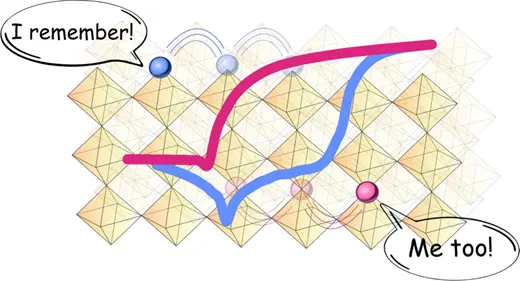
Our Chair has made important contributions to the emerging field of perovskite-basedmemory devices, exploring the potential of metal halide perovskites for energy-efficient neuromorphic computing. Our research encompasses both electrically driven memristors and optically operated memlumors, demonstrating how the dynamic electronic and optical properties of these materials can be exploited to realise memory functions. For example, together with collaborators, we demonstrated that metal halide perovskites can serve as an all-photonic memory device, termed a memlumor, which combines light emission with history-dependent memory effects. More recently, our group demonstrated that the memristive behaviour of metal halide perovskite devices can be controlled through stoichiometric engineering, establishing a strategy to induce analogue memristive switching through precise control of perovskite composition. Together, these studies establish new opportunities for integrating perovskite optoelectronics and electronic memory into energy-efficient electronic and photonic neuromorphic computing platforms.
Key peer-reviewed publications:
- Bou et al., Emergence of Memristive Behavior in Perovskite Devices by Stoichiometric Engineering, ACS Energy Letters (2026). https://doi.org/10.1021/acsenergylett.6c00659
- Marunchenko et al., Memlumor: A Luminescent Memory Device for Energy-Efficient Photonic Neuromorphic Computing, ACS Energy Letters (2024). https://doi.org/10.1021/acsenergylett.4c00691
- Marunchenko et al., Charge Trapping and Defect Dynamics as Origin of Memory Effects in Metal Halide Perovskite Memlumors, The Journal of Physical Chemistry Letters (2024). https://doi.org/10.1021/acs.jpclett.4c00985