
Advancing vacuum-based fabrication and processing of metal halide perovskites
An important research direction of our Chair concerns the development and understanding of solvent-free fabrication methods for metal halide perovskites. In particular, we focus on developing novel engineering approaches to control the structural, electronic and optical properties of vapour-deposited perovskites. For example, we have demonstrated that additive engineering is a powerful strategy for enabling both single-source and sequential deposition of phase-pure FAPbI₃ solar cells. We have also demonstrated that the co-evaporation of molecular dopants alongside the perovskite precursors enables the realisation of controlled electrical n- and p-type doped perovskites that could be utilised to form PN junctions. Together, these advances establish important foundations for the development of reproducible and scalable vacuum-processed perovskite electronics and optoelectronics.
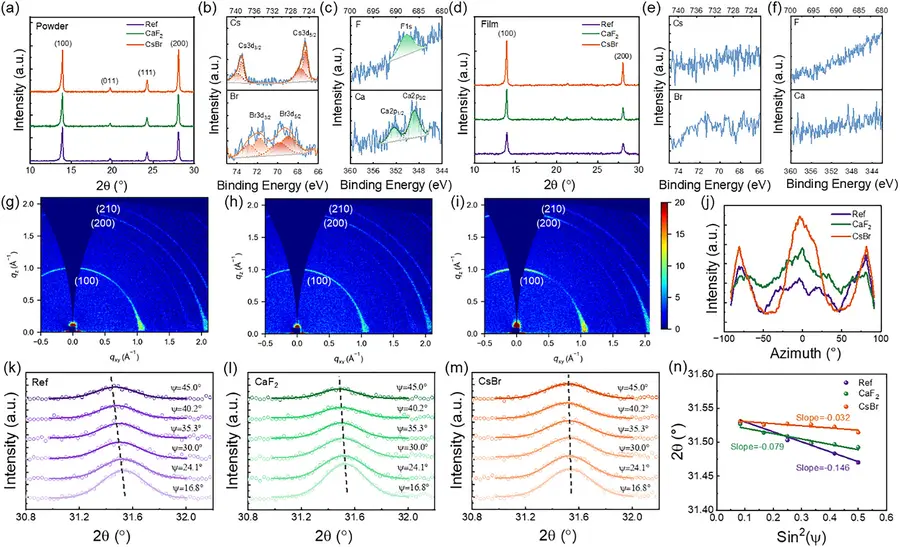
Key publications:
- Zhang et al., High‐Sublimation‐Temperature Additives for Efficient Perovskite Solar Cells via Single‐Source Evaporation, Advanced Energy Materials (2026). https://doi.org/10.1002/aenm.70901
- R. Ji et al., Solvent‐free fabrication methods of metal halide perovskites, Advanced Materials (2025). https://doi.org/10.1002/adma.202416604
- Siliavka et al., Additive Engineering of Sequentially Evaporated FAPbI3 Solar Cells, Advanced Energy Materials (2025). https://doi.org/10.1002/aenm.202500963
- Schramm et al., Electrical Doping of Metal Halide Perovskites by Co‐Evaporation and Application in PN Junctions, Advanced Materials (2024). https://doi.org/10.1002/adma.202314289