
Curriculum
The standard duration of studies is four semesters, three for coursework and one for the master thesis. Students can enter the master’s program at the beginning of each winter semester.
For prerequisites and the application procedure please see Application
Degree
Graduates earn a Master of Science degree (M.Sc.) with a track-specific supplement.
Curriculum
The core curriculum teaches computational modelling (machine learning and data analysis) and computer simulation (numerical methods). The tracks cover a wide range of applications. We provide comprehensive mentoring throughout the entire master´s program.
The following tracks are currently offered:
- Computational Life Science (scholarships are available)
- Computational Mathematics
- Visual Computing
- Computational Modeling in Energy Economics (partially requires German language)
- Computational Engineering
- Applied Artificial Intelligence (scholarships are available)
- Computational Environmental Science and Engineering
The program has a modular structure consisting of the compulsory area, the basic compulsory elective area (COR-modules, language modules, scientific methodological basic training modules) and the track-specific compulsory and compulsory elective area.
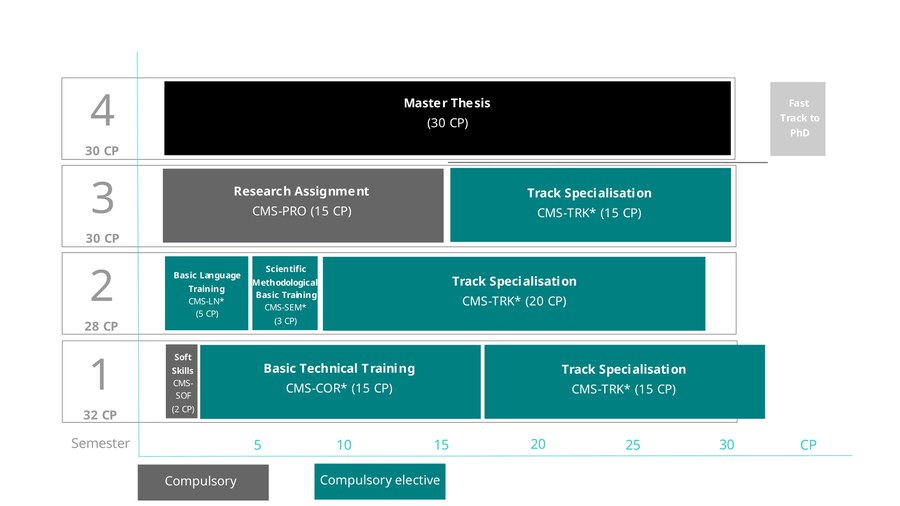
1st semester:
- Students select three COR-modules (in the scope of about 15 credit points)
- Soft Skills module (2 credit points)
- Students select modules of the respective track according to the study plan (in the scope of about 15 credit points)
2nd semester:
- Students select one language course (5 credit points)
- Students select one seminar of the scientific methodology basic area (3 credit points)
- Students select modules of the respective track according to the study plan (in the scope of about 20 credit points)
3rd semester:
- Research module (15 credit points): Application of acquired knowledge in an independent research project
- Students select modules of the respective track according to the study plan (in the scope of about 15 credit points)
The compulsory elective area of the selected track comprises modules in the scope of 50 credits.
The master's program focusses on equipping students with long-lasting transferrable knowledge and cross-application transfer competences. The former is achieved through the universally valid content of the core modules, and the latter is achieved through the cross-track seminars and the research project in a research group.