"eLOS" project
eLOS - Energetically locally optimized system for a low-emission building stock in Germany by means of
digital twins
| Project management and coordination: |
Prof. Dr.-Ing. habil. Joachim Seifert |
|---|---|
|
Client: |
BMWE (FKZ: 03EN1096A) |
| Project partner: |
EBC E.ON ERC RWTH Aachen University |
| Duration: | 07/2024 - 06/2027 |
| Link: |
Brief description
Heat pump technology is considered a key technology for the future of heating technology and makes a decisive contribution to the decarbonization of the building sector. Manufacturers offer systems in various performance classes, but these are often not optimally adapted to individual building requirements. Significant efficiency gains can be achieved by making targeted adjustments on the hardware and software side to suit local conditions.
The aim of the research and development project is to investigate the regional adaptability of heat pump systems. To this end, a method kit based on a digital twin is to be developed, which can be used at the "production end" as well as in the "field". However, the method kit will not only be used to ensure product quality and detect faults, but will also contain an interface for independent efficiency assessment by the consumer. The aim is to increase the acceptance of heat pump technology, which will benefit the customer's purchasing decision in the long term. At the same time, a tool for the realistic assessment of locally differing efficiency values is to be developed for improved communication with the customer. Manufacturers of heat pumps are to be enabled to integrate digitalization strategies directly into the entire production and life cycle of the products and to derive new business models from this. The idea of regionalizing heat pumps should serve as a guideline for all work in the project.

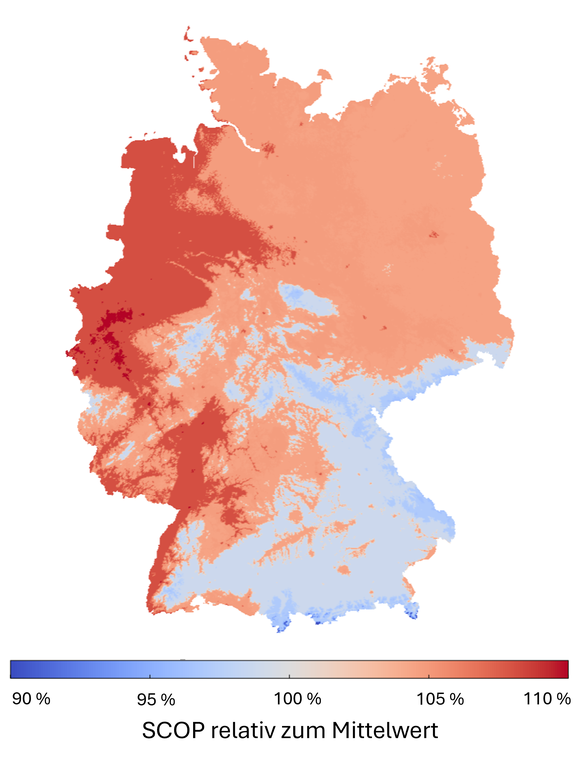
A key project result: the map of Germany with efficiency parameters
The efficiency of air-to-water heat pumps is significantly influenced by regional climatic conditions. With the comprehensive provision of high-resolution test reference years by the German Weather Service, a consistent meteorological data basis in a 1 × 1 km grid is available for the whole of Germany for the first time. However, the high spatial resolution of the TRY data leads to several hundred thousand individual time series for the whole of Germany. For many scientific questions - especially in the context of regional energy analyses or scenario considerations - separate processing of each individual grid cell is not computationally efficient.
Against this background, a structured, regional consolidation of climate data is required. The aim is to combine meteorologically similar locations into groups and thus reduce the amount of data without significantly distorting the climatic characteristics. Clustering methods offer a systematic approach for this. By selecting a suitable feature representation, both seasonal structures and energetically relevant temperature characteristics can be taken into account.
Based on a clustering-based climatic regionalization of high-resolution test reference years, this project develops a Germany-wide map of the seasonal coefficient of performance (SCOP) for air-to-water heat pumps in a 1 × 1 km grid. Dynamic annual simulations are carried out for representative cluster locations using the TRNSYS-TUD simulation environment. Single and multi-family houses with different thermal insulation standards (existing buildings, new buildings) and different system temperature levels are considered.
Theshow a pronounced climatic differentiation in efficiency. In the selectable maps, the SCOP is given relative to the mean value of all SCOPs for all building types. For single-family houses, the location-dependent spread ΔSCOP is up to 0.9, for multi-family houses around 1.0. For the majority of Germany, the spread is within ΔSCOP ≤ 0.5. The temperature level of the heat transfer (radiator/ underfloor heating) proves to be the dominant influencing factor.
Please use for detailed informations the following link: Germany map efficiencies ASHP