Fields of activity
The research areas at the Chair can be distinguished thematically and are briefly presented below.
Spectroscopy and thermal characterization
Contact person: Dr. Maja Glorius
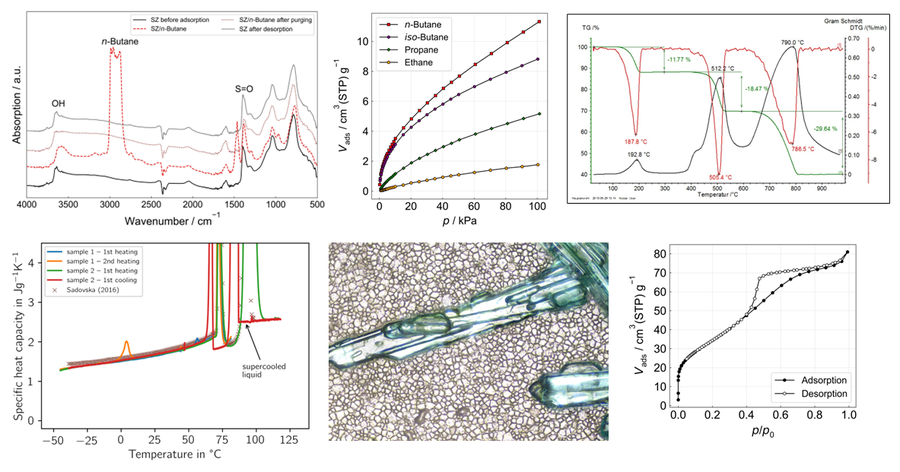
The Spectroscopy and Thermal Characterization working group is concerned with the investigation of sorption processes of gases and liquids on the surfaces of porous materials, the investigation of phase transformations and the determination of material parameters such as heat capacity, enthalpies of fusion and thermal conductivities. To characterize these processes, we have various measuring devices at our disposal, such as an FTIR spectrometer with extensive equipment (ATR cells, DRIFTS cells, high and low temperature measurements), a thermobalance with exhaust gas analysis, measuring devices for gas sorption (BET and N2-BET), a Calvet calorimeter, a heated stage microscope, a climate chamber, a system for macrokinetic adsorption and for temperature-programmed ammonia desorption (TPAD).
Transient methods
Contact person: Dr.-Ing. Constantino Grau
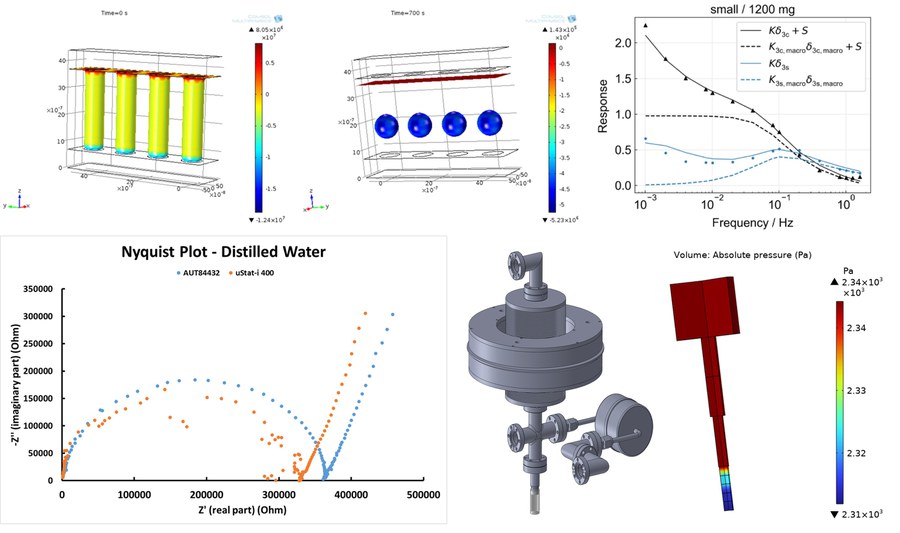
In the transient methods group, we investigate and characterize time-dependent phenomena such as diffusion, adsorption, heat transfer and fluid dynamics. Our central characterization techniques include frequency response analysis (FR) for the investigation of gas/porous media diffusion and adsorption as well as electrochemical impedance spectroscopy (EIS) for the analysis of diffusion, adsorption, reaction and transport processes in liquids and solids. In addition, we have proven expertise in multiphysics simulation, particularly for fundamental processes such as surface diffusion, adsorption, heat transfer, multiphase flows and moving interfaces.
Molecule-based theoretical methods
Contact: Dr. Tommy Lorenz
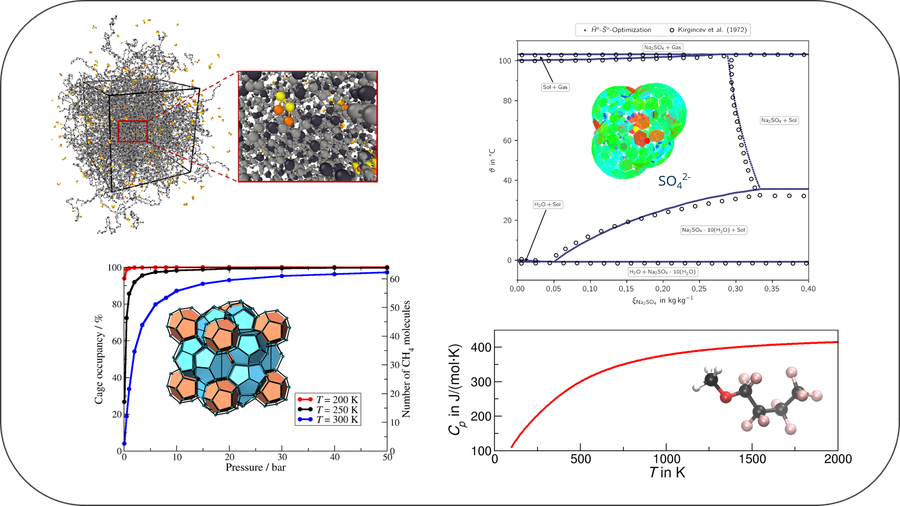
This research area focuses, among others, on the determination of material properties using computational and simulation methods at the atomic and molecular scales. The focus is on both equilibrium states and non-equilibrium and transport processes, which can be studied, for example, using molecular dynamics or Monte Carlo simulations. In addition to methods of statistical thermodynamics, ab initio, empirical, and semi-empirical methods are primarily employed.
At the Chair of Thermodynamics, this includes investigating gas-solid interactions in gas hydrates (storage media) and catalysts. Another area of research involves the calculation of structural, thermal, and mechanical properties of solids and polymers, as well as the determination of parameters for thermal equations of state and the investigation and description of phase stabilities and equilibria.
Thermal energy machines and working fluids (sCO2)
Contact person : Dr.-ing. habil. Andreas Jäger
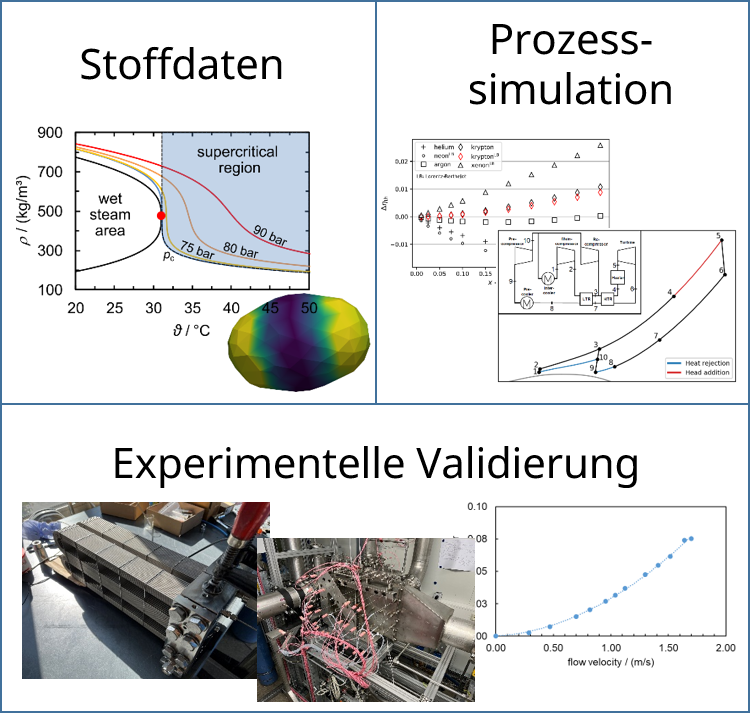
The working group Thermal Energy Machines and Working Fluids (sCO2) deals with the system integration of thermal energy machines and plant components, such as heat exchangers, in processes and systems of thermal energy technology. It also investigates how new working fluids can be used to increase the efficiency of energy technology processes and their components, with a particular focus on power plant processes with supercritical CO2 (suCOO-Lab). Furthermore, models for thermodynamic material data and transport variables of mixtures as well as phase equilibrium algorithms are developed in the working group and used for the optimization of energy technology processes.
SustainING. Socially and environmentally responsible engineering
Contact person: Dr. phil. Sandra Buchmüller
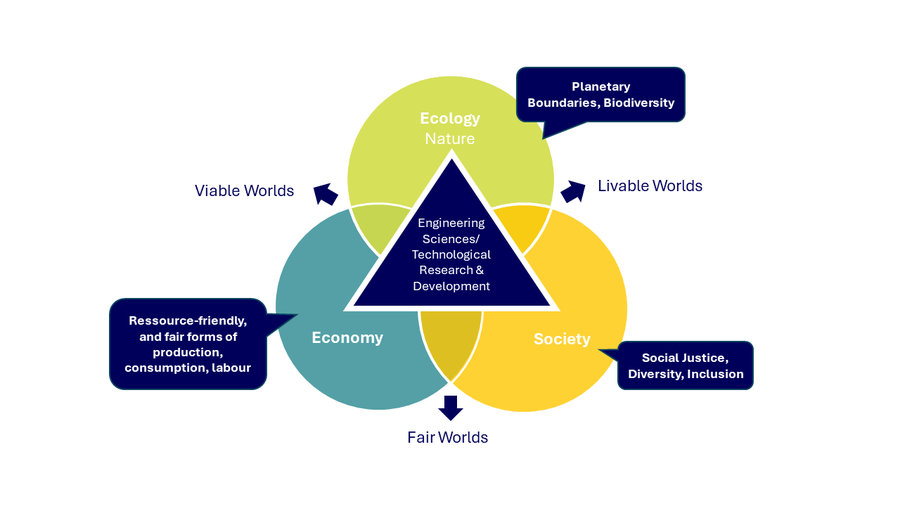
The SustainING working group examines the relationship between technology and sustainability. It examines engineering and technical research, development, and application processes within the complex interplay of social, ecological, and economic factors, and explores the role of technology and the responsibility of engineers in the context of local and global crises as well as necessary transformation processes. Specifically, the working group addresses topics such as the sustainable development and use of AI, possibilities for a socially just energy transition, the potential and limits of decarbonization in industry and transportation, the danger of “greenwashing,” as well as the job profile and the culture of engineering, including internalized gender and masculinity stereotypes. Drawing on approaches and empirical studies from Feminist Science and Technology Studies, Environmental & Energy Humanities, Critical Data Studies, climate and environmental sciences, the working group focuses on power relations, hierarchies and inequalities. These are illustrated through concrete case studies and application examples and are further examined using methods from design and transformation research. The overall goal is to turn the highly technology- and economy-oriented and male-dominated disciplinary research culture into a more responsible practice by integrating social and ecological perspectives into teaching. For this purpose, the working group develops and offers both disciplinary and interdisciplinary formats for different target groups.