
Technological and systemic impacts of the hydrogen economy (as part of the 4th Boysen-TU Dresden Research Training Group 2023)
Brief description
Germany and the broader European Union continue to pursue the energy systems transition to renewable sources across electricity, industry, mobility, and service sectors. Especially with wind and solar, the intermittent nature of their generation coupled with an increased generation capacity, requires powerful storage solutions, with green hydrogen produced via electrolysis emerging with great focus. Moreover, hydrogen can also be reconverted to electricity for mobility and industrial applications.
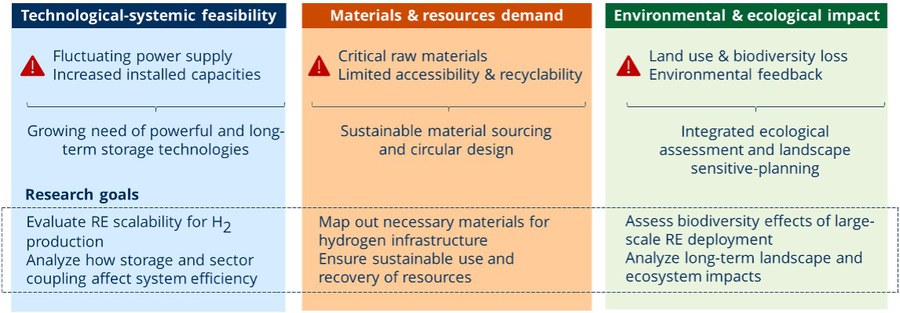
Germany already produces hydrogen at scale for industrial applications but national targets set 10 GW for electrolysis capacity by 2030. However, when expanding the use of renewable energy, the effects in the areas of technology and system integration have so far only been partially considered. The areas of ecology and biodiversity, landscape impacts, thermodynamic feedback on the environment, as well as raw material supply are not being currently considered in a cumulative approach.
To address these gaps, the 4th Boysen-TU Dresden-Research Training Group (2023-2026) brings together PhD researchers across multiple fields to investigate the foundations of a sustainable green hydrogen economy. This collaborative doctoral program, jointly funded by the Friedrich und Elisabeth Boysen Foundation and TU Dresden, is divided into 4 clusters – this project (F1) belongs to Cluster F: Impact H2 Green.
Cluster F overall objectives
- Develop a sustainable green hydrogen economy (the ‘GreenGas Deal’ vision);
- Exploit wind and solar potential from technological, landscape and economic perspectives;
- Create simulation models and transparent frameworks for forecasting and monitoring.
Within this cluster, this subproject (F1) focuses specifically on the technological-systemic impacts of renewable energy expansion and hydrogen integration.
Subproject F1 – Focus Areas
Publications
- Inês S. Almeida, Eva M. Salgado, António M. A. Ferreira and José C. M. Pire:
Evaluation of Oscillatory Flow Conditions for Microalgal CO2 Capture and Biomass Sedimentation Kinetics: Experimental and Mathematical Approach. In: BioTech 2026, 15(2), Link: https://doi.org/10.3390/biotech15020036
Related Links
- Website 4th Boysen-TU Dresden-Research Training Group: https://tu-dresden.de/boysen/4-grk-2023-2026
- Website Cluster F: https://tu-dresden.de/boysen/4-grk-2023-2026/cluster-1/cluster-f