
09.04.2026
Flugturbulenz? Nicht mit uns!
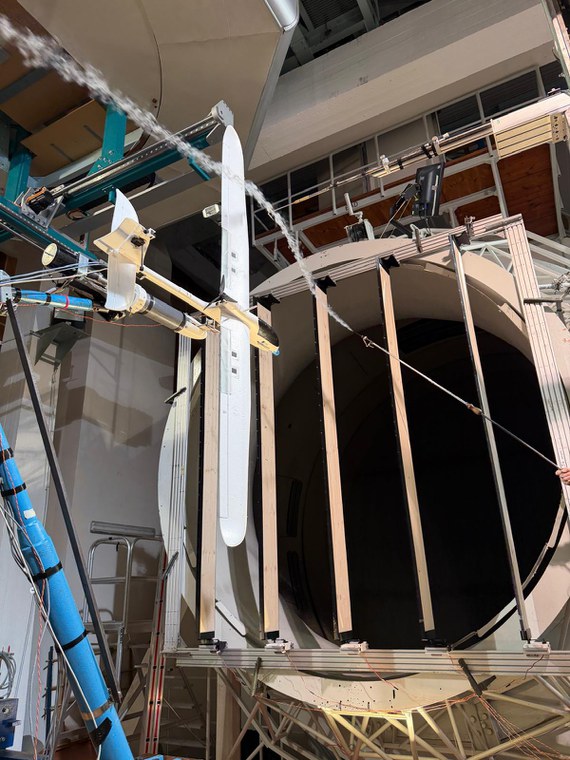
Der Lehrstuhl für Flugmechanik und Flugregelung führte kürzlich eine spannende Messkampagne im Windkanal in Zusammenarbeit mit dem Wiener Start-up Turbulence Solutions durch. Das Unternehmen entwickelte ein innovatives aktives Böenkompensationssystem, das die Flugstabilität und den Passagierkomfort bei turbulenten Flugbedingungen verbessert. Diese hochmoderne Technologie nutzt eine automatisch gesteuerte Klappe, um den zusätzlichen Auftrieb auszugleichen, der durch turbulenzbedingte Änderungen des Anstellwinkels entsteht.
Das System stützt sich auf Echtzeitdaten einer im Flugzeug integrierten Mehrlochsonde, welche den Anströmungsvektor bestimmt. Auf Grundlage dieser Daten wird die Klappe durch einen selbst entwickelten Flugregler dynamisch ausgelenkt, um die Auswirkungen von Turbulenzen zu neutralisieren und so für ruhigere Flugbedingungen zu sorgen. Um dieses System zu verbessern und weiter zu verfeinern, brachte Turbulence Solutions ihr UAV (Unmanned Aerial Vehicle) in unseren Windkanal.
Die Düse unseres Windkanals wurde für diese Kampagne mit einem speziell entwickelten Böengenerator ausgestattet. Dieser Apparat, bestehend aus fünf synchron gesteuerten Klappen, war in der Lage, Böen mit Frequenzen von bis zu 4 Hz und Amplituden von 10 Grad zu erzeugen. Diese Konfiguration ermöglichte eine präzise Simulation turbulenter Bedingungen und stellte eine ideale Umgebung für die Erprobung des Böenkompensationssystems dar.
Der Messaufbau war für uns eine einzigartige Kombination aus synchronisierten Messgeräten. Eine 6-Komponenten-Kraftwaage, auf der das UAV montiert ist. Nick- und Rollwinkel waren elektrisch einstellbar. Die Strömung wurde extern mit einem X-Zweidraht Konstanttemperatur-Anemometer (CTA) gemessen, das auch zur Quantifizierung des Nachlaufkorridors des Böengenerators vor der UAV-Installation verwendet wurde. Das Flugzeug war mit einer integrierten Mehrloch-Drucksonde zur Messung lokaler Strömungswinkel und -geschwindigkeiten ausgestattet. Die Auslenkung des Böengenerators wurde ebenfalls aufgezeichnet. Schließlich durften die allgemeinen Windkanaldaten – Eintrittsgeschwindigkeit, Dichte und Temperatur – natürlich nicht fehlen. Alle Messgeräte erfassten Daten mit einer Rate von mindestens 200 Hz und einer Synchronisationsgenauigkeit von nur 1 Sample, was 5 ms entspricht.
Die Auswertung der Messdaten ist noch nicht abgeschlossen, aber eine Reduktion der Auftriebsreaktion des Flugzeugs auf die Turbulenzen ist bereits in den Rohdaten sichtbar. Dies verspricht einer verringerten Turbulenzwahrnehmung für Piloten und Passagiere. Daher gilt diese Kampagne bereits jetzt als Erfolg, und für uns und Turbulence Solutions ist dies ein wichtiger Schritt im interdisziplinären Bereich der experimentellen Aerodynamik und Flugregelung von UAVs.
© FMR