
Wind load of antenna systems
Wind loads play a crucial role in the design, construction, and operation of telecommunications infrastructure. Base station antennas, in particular, are the most exposed structural elements at a site and are primarily responsible for the mechanical loads on masts and towers. The design of the support structures for the assembly and installation of antenna systems is therefore largely determined by the expected wind loads. Wind tunnel testing has become the standard method for determining these wind loads. The NGMN BASTA guideline describes standardized procedures for determining and documenting wind loads on base station antennas. In North America, wind loads are typically determined in accordance with the ANSI/TIA-222 guideline, while in Europe and Asia, the EN 1991-1-4 standard applies. These standards require that wind loads be determined either by calculation or through wind tunnel testing, with the latter being preferred, particularly for complex or aerodynamically challenging antenna shapes.
Configuration
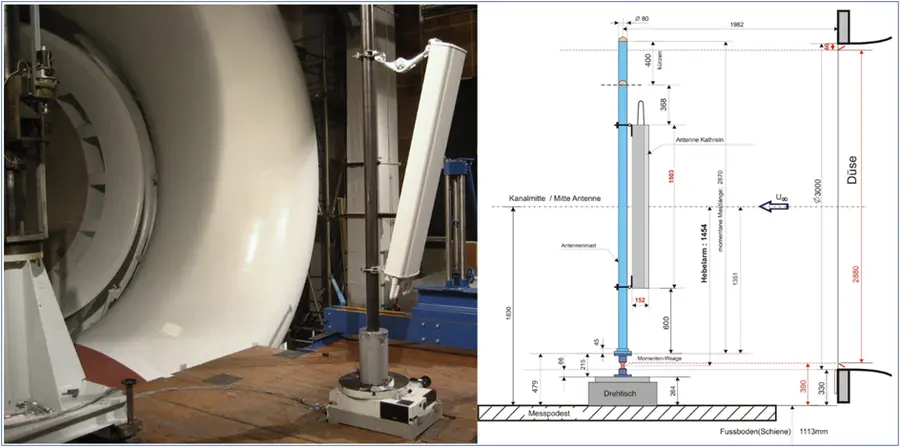
For wind tunnel testing, the antenna systems are positioned centrally in the middle of the open test section, where a nozzle with a diameter of 3 m is used, enabling maximum air speeds of up to 40 m/s. The mast is secured to the floor of the wind tunnel in accordance with the NGMN BASTA guideline. A turntable is used to vary the angle of attack, while a bending moment gauge attached to the base of the mast records the resulting torques. The applied drag forces can be calculated from the measured torques using the known lever arm and the respective angle of rotation. To ensure that the determined forces are attributable exclusively to the antenna, the influence of the mast on the measurement is recorded separately. Based on these corrected measurement values, the dimensionless drag coefficients are finally determined, which allow for a characterization of the aerodynamic behavior of the antenna systems that is independent of the specific test conditions.
Test Procedure
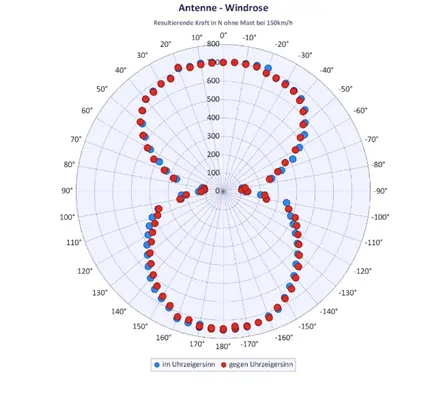
As part of the wind tunnel investigations, 360° measurements are first performed in the angular range from +190° to −190° to fully capture the flow behavior of the antennas across all flow directions. These measurements are taken at a wind speed of 38 m/s and form the basis for the subsequent analysis of the Reynolds number dependence.
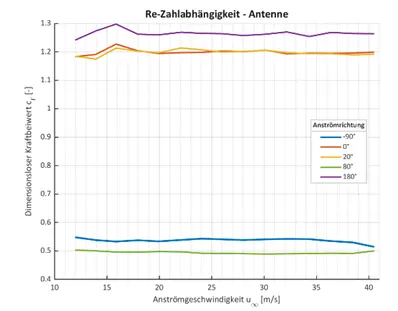
To enable a reliable extrapolation of the determined force coefficients to a reference speed of 150 km/h, the dependence of the force coefficients on the Reynolds number is determined for each antenna at selected orientations—but at least at 0°—. To do this, the antenna orientation is kept constant while the wind speed is gradually increased from 12 m/s to 40 m/s. In this way, the influence of the Reynolds number can be systematically determined, and the transferability of the measurement results to real-world operating conditions can be ensured.