Apr 01, 2022
SAMSax

The SAMSax project consortium
Sustainable Additive Manufacturing in Saxony (SAMSax)
|
Duration |
04/2022 - 06/2025 |
|
Funding by |
SMIL / SAB |
|
Funding code |
100623737 |
|
contact |
|
|
Keywords |
Additive manufacturing, residual materials, sustainability, circular economy, resource conservation, real laboratory |
The simul+ model project Sustainable Additive Manufacturing in Saxony pursued the goal of making Saxony's industry more sustainable and resource-efficient. The real-world laboratory showed how bio-based, natural and industrial waste materials can be turned into new products using additive manufacturing - i.e. 3D printing.
While plastics, metals or ceramics were primarily used in traditional 3D printing, SAMSax demonstrated that organic or industrial residues are also a valuable resource. For example, organic residues from agriculture and industry were successfully processed and transformed into functional components. This created a completely new, sustainable material cycle.
Thanks to the successful reintegration of residual materials, the project opened up new potential for Saxon industry - especially for companies that were already active in additive manufacturing. The expanded variety of materials led to
- a reduction in the CO₂ footprint,
- a strengthening of the future viability and competitiveness of the regional economy
- the establishment of closed material cycles in Saxony.
The SAMSax real-world laboratory was located at the TU Bergakademie Freiberg. It served both to demonstrate the innovative concept and to establish a strong network of companies, research institutions and public partners. Prototype applications were developed in numerous practical projects, which made the approach of a regional circular economy visible.
Results
- A total of 53 different residual materials from industry and agriculture were analyzed as part of SAMSax.
- Of these 53, 25 residual materials were successfully used for 3D printing and evaluated in terms of their suitability and application.
- The use of Miscanthus grass was particularly successful: the project team used it to produce dimensionally stable objects - including stage design elements such as column capitals, which were used at the Chemnitz Municipal Theater.
- In addition, other residual materials such as wood dust and shavings from sawmills, chaff straw, mineral residues from the metal and mining industries and other residual materials were examined and partially processed.
- The technology developed in the project includes an open-material multi-material 3D printer with a large build volume (1 m³) and several print heads, which can be used to print many different sustainable or recycled materials.
- Alternative additive processes such as paste extrusion were also evaluated through the use of natural or bio-based binders.
Partners
- Freiberg University of Mining and Technology, Chair of Additive Manufacturing
- Chemnitz University of Technology, Chair of Ergonomics and Innovation Management
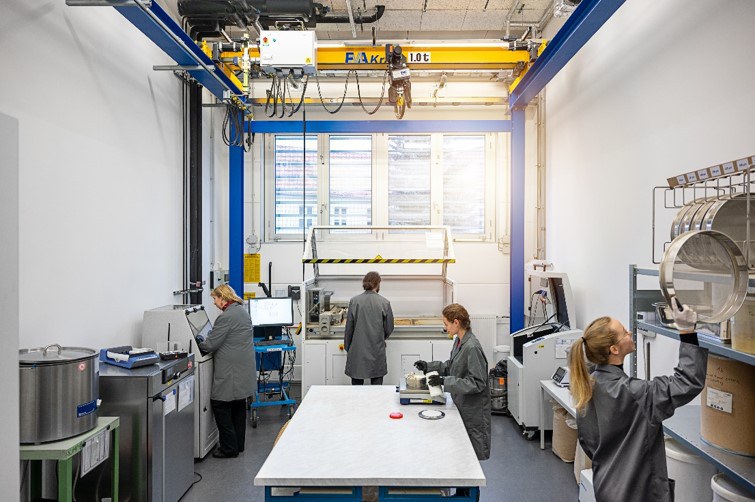
Blick in das SAMSax Reallabor
Funding information
The project was funded by the Free State of Saxony via the simul+ InnovationHub of the Saxon State Ministry for Infrastructure and Regional Development (SMIL).