
May 26, 2026
Immunotherapy in focus - The "Co-Culture of Colorectal Patient Derived Tumor Organoids with Tumor-Infiltrating T-Cells" project
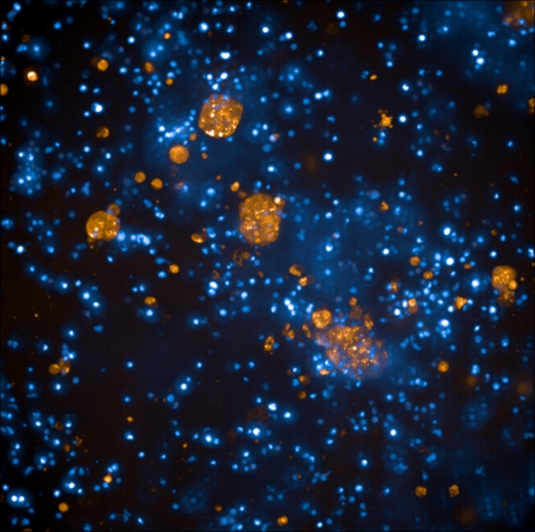
A closer look at the details: Functional staining to analyze the interaction between tumor cells and immune cells.
A report by Hanne Malin Reinhart
The background
Despite intensive medical research, the prognosis for patients with gastrointestinal tumors, such as colorectal cancer (CRC) or gastric cancer (GAC), often remains unfavorable. One reason for this is that modern immunotherapies, which have already shown great success with other types of cancer, are often ineffective with these tumors.
I have been fascinated by oncology since the beginning of my medical studies - both in clinical application and in research. As part of my doctorate in the Stange working group (VTG laboratory), I have therefore been investigating the immunological basis of this therapy resistance since 2022. The aim is to better understand the complex interactions in the tumor microenvironment in order to find more effective treatment options in the future.
The experimental approach and results to date
The central idea of my project was to set up a preclinical co-culture platform. For this, I use fresh tumor tissue directly from the operating room, which is transferred into a three-dimensional cell culture system. In parallel, I isolate and expand tumor-infiltrating T cells (TILs) from the same patient sample.
Thanks to FOSTER funding, I was able to significantly expand this approach:
- Methodological optimization: a particular milestone was the establishment of a setup for live-cell imaging, which allows us to observe the interaction between immune and tumor cells in real time
- Functional analyses: Newly established staining methods now allow us to analyze more precisely how the immune cells react to the tumor.
- Teamwork and promotion of early-career researchers: The funding enabled us to involve another student in a targeted manner in this topic. Through her collaboration, she has made a decisive contribution to successfully establishing the new experimental setup, which has greatly enriched the scientific exchange in our working group.
The support from FOSTER not only provided me with the necessary material resources for complex analyses, but also strengthened my scientific independence, as I was able to take responsibility for project planning and the guidance of a team member for the first time
An outlook
We are aiming to publish the results of our work scientifically in 2026. The project is already having a lasting impact: the original idea has already given rise to a further project on the co-culture of gastric carcinoma cells.
For my personal career, my time in the lab has cemented my desire to work as a clinician scientist later on. It is important to me to contribute to new basic research as well as to stay close to patients in everyday clinical practice. Even if the path from the lab bench to clinical application takes years, this close connection between the two areas is the most sensible way for me to contribute to improving oncological therapies in the long term.