
Oct 23, 2026
“Absolutely go for it!” What medical students gain from studying abroad
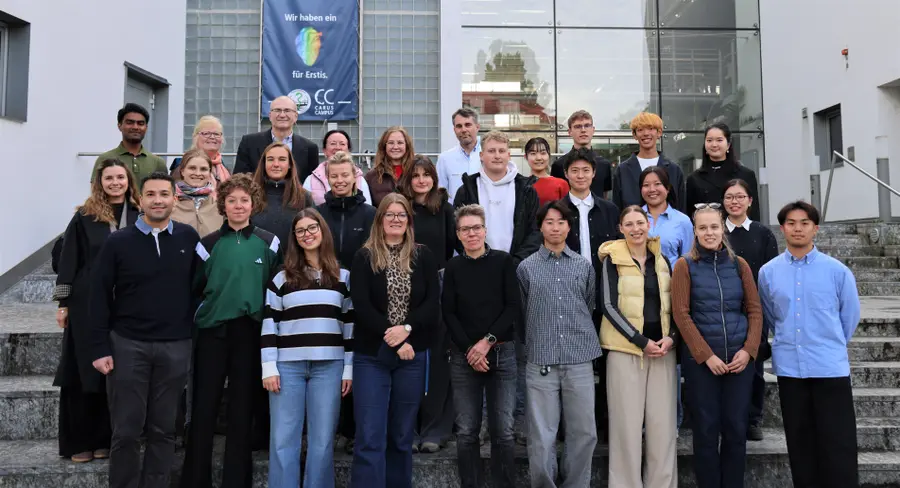
Austauschstudierende und ihre Betreuer:innen an der Hochschulmedizin Dresden.
Eight Japanese students are currently visiting Dresden, and 13 Dresden students will head to Japan, South Korea, and Australia in the coming weeks for clinical rotations. Additionally, one Australian student just completed a four-week surgery rotation at University Hospital Dresden. The fall season is bringing a surge of activity to the three international exchange programs at the Carl Gustav Carus Faculty of Medicine.
Three Partners, One Goal
Rarely have so many exchange programs been underway at the same time: Since the end of August, eight medical students from Shinshu University (Matsumoto, Japan) have been staying at the Faculty of Medicine and the University Hospital Dresden for three, where they are working in research groups and clinical departments. In return, seven Dresden students will travel to Japan in November for one tertial of their practical year (PJ), two will go to Gachon University in South Korea, and four will go to Flinders University in Adelaide, Australia.
The partnership with Shinshu University began in 2016 and is funded by the DAAD and Erasmus+. Since the start of the collaboration, 35 Japanese students have visited Dresden, and 38 Dresden students have visited Matsumoto. Intercultural support is an integral part of the program. Japanese guests take a German language course, and Dresden students preparing for their clinical rotation learn about everyday hospital life and Japanese culture. This year, Gachon University in South Korea has joined the exchange program. For the first time, Dresden students can complete one third of their clinical rotation there. The Faculty of Medicine also has a long-standing, two-way exchange program with Flinders University. Students from Adelaide come to Dresden for electives, and Dresden students travel to Australia for their clinical rotations.
Guests from Japan: Research, Clinical Work, and a Second Home
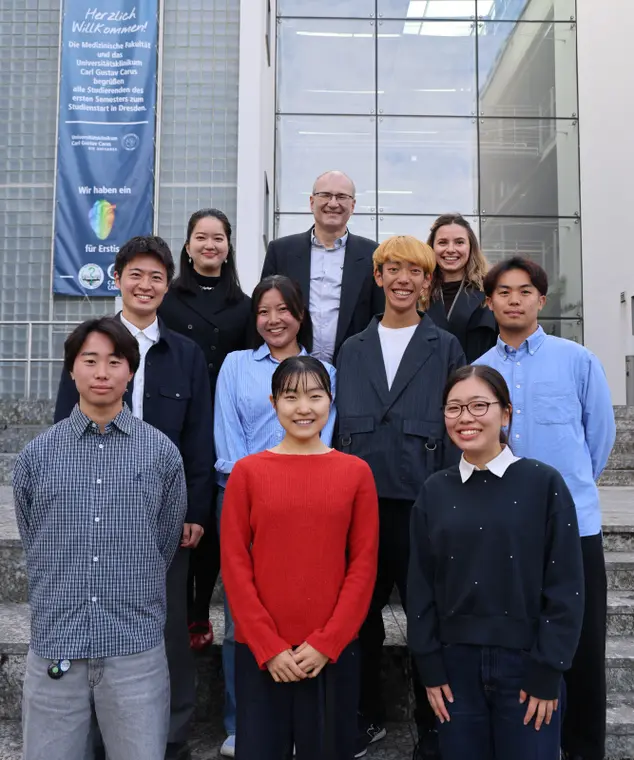
Studierende aus Japan mit Prof. Henning Morawietz (oben, 2. v.l.) und Peggy Zolal (oben, 3.v.l.).
Eight students from Shinshu University are currently visiting Dresden: Yasuhiro Kashima, Tamaki Kiriishi, Kosuke Sato, Nana Fujii, Sota Mukaiyama, Momoko Suga, Kanoko Oyama, and Komi Hayakawa. They are conducting research in labs and research groups throughout the city, from the CRTD and the DZNE to OncoRay, the Department of Pharmacology, the Department of Experimental Neurosurgery, the Department of Internal Medicine I, and the Department of Obstetrics and Gynecology. The group would like to express their heartfelt gratitude to all supervisors who welcomed the guests into their teams. Their commitment is what makes this exchange possible.
The students outlined what the guests from Matsumoto are taking away from their stay in Dresden, summarized by Momoko Suga. Their work in research was particularly memorable: „Being able to conduct basic research at a university abroad as a medical student is a rare and invaluable opportunity. Working with researchers in an international academic setting has broadened our horizons and provided insights that could not have been gained from lectures alone."
They also gained new learning experiences: "One of the biggest differences compared to Japan was the greater emphasis on taking the initiative in our studies. We had so many opportunities to think for ourselves, make our own decisions, and pursue our interests. This encouraged us to take responsibility for our own learning.”
One highlight of the exchange was the two-day visit to the Department of Neurosurgery at Chemnitz Hospital in late September. There, the students observed surgeries under the guidance of Prof. Matthias Kirsch. Dr. Mao Ogino, resident physician from Tokyo, accompanied the students in Chemnitz and shared her firsthand experiences of the differences between daily hospital life in Japan and Germany.
Outside of the lab and hospital, the students explored Dresden on their own: "After traveling through various European countries, we realized how much Germany and Japan have in common. Even after only three months, coming back to Dresden feels like coming to our little second home!"
Four Weeks of Surgery: Mann Barot from Adelaide
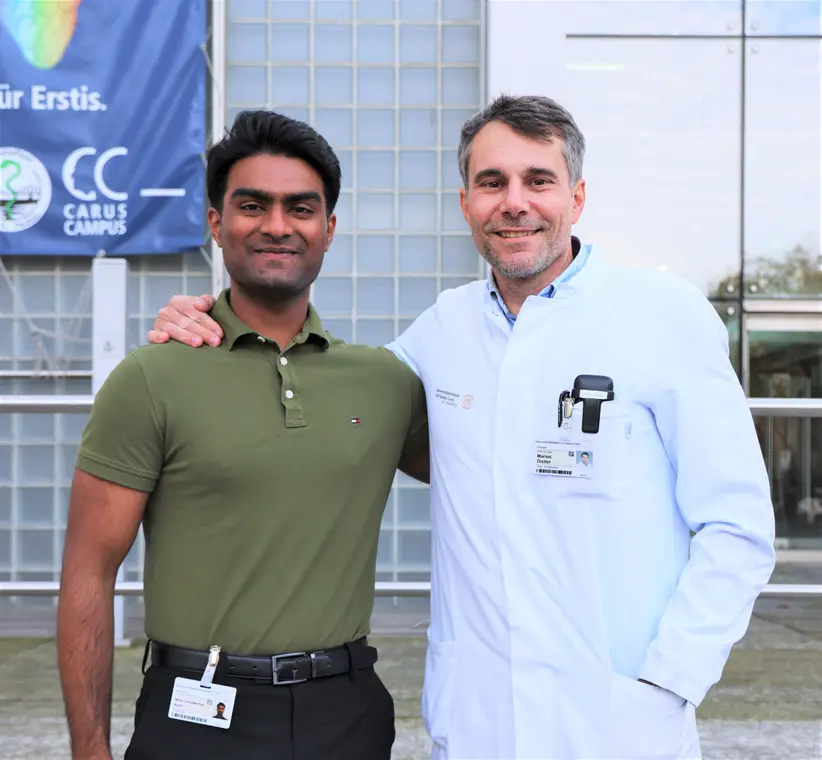
Mann Barot (l.) und sein Betreuer Prof. Marius Distler (r.).
Meanwhile, Mann Barot, a final-year medical student at Flinders University, completed an elective in orthopedics and visceral surgery at University Hospital Dresden from September 14 to October 16. Shortly before his exams, he wanted to venture out new once more: “It was an incredible opportunity to experience how medicine is practiced outside of Australia, with all the similarities and differences in healthcare systems, clinical approaches, and surgical training.”
He was impressed by how early and naturally medical students and young doctors in Dresden are integrated into clinical practice: "German students have the opportunity to develop practical skills and take on responsibility relatively early in their training. At first, this may seem challenging, but I’ve seen how valuable such experiences are for clinical safety and competence." According to Barot, access to the operating room is much more strictly regulated for students in Australia. This made him appreciate the opportunity to observe complex procedures and surgical teamwork in Dresden up close all the more.
Barot also praises the support he received, specifically the organization and assistance provided by the International Office and the Office of Academic Affairs, which he says were “outstanding from the initial planning stages through to the end of the internship.” He is also grateful to his clinical team, who made it possible for him to attend his first international surgical conference in Belgium.
In addition to daily life at the hospital, Barot was captivated by Dresden and its surroundings, including the Frauenkirche, the Zwinger, the banks of the Elbe, and trips to Meissen and Saxon Switzerland. He also enjoyed Eierschecke (traditional Saxon cake) and weekend trips to Prague, Berlin, and Leipzig. His advice to fellow students considering an internship abroad: "Absolutely go for it! Learn at least a little of the local language beforehand – even basic knowledge makes a big difference in day-to-day clinical work. Take advantage of every opportunity. Be proactive at the hospital, get to know new people, and explore as much as possible."
Future prospects
The exchange programs require a great deal of organizational work. The result is a program that meets all students' needs. Participants in the exchange with Japan receive a comprehensive package with full funding. Applications for corresponding funding have been submitted for the exchanges with South Korea and Australia. Peggy Zolal, the International Affairs Advisor in the Research and International team, oversees the partnerships. Marlen Zumpe and Maria Schramm from the Office of Academic Affairs provide administrative support to students.
Prof. Henning Morawietz, Head of the Vascular Endothelium/Microcirculation Division at the Department of Internal Medicine III and initiator of the collaboration with Shinshu University, sums it up: „I have been involved in the exchange with Shinshu University since 2016, and every year, I see how much our students and guests benefit from it. The fact that we are able to offer such reliable, well-funded programs today is primarily thanks to Ms. Zolal, who nurtures the partnerships and secures their funding with great dedication.”