
Apr 30, 2026
CardioEpiX: stem cell technology for diagnostics and therapy development for heart diseases
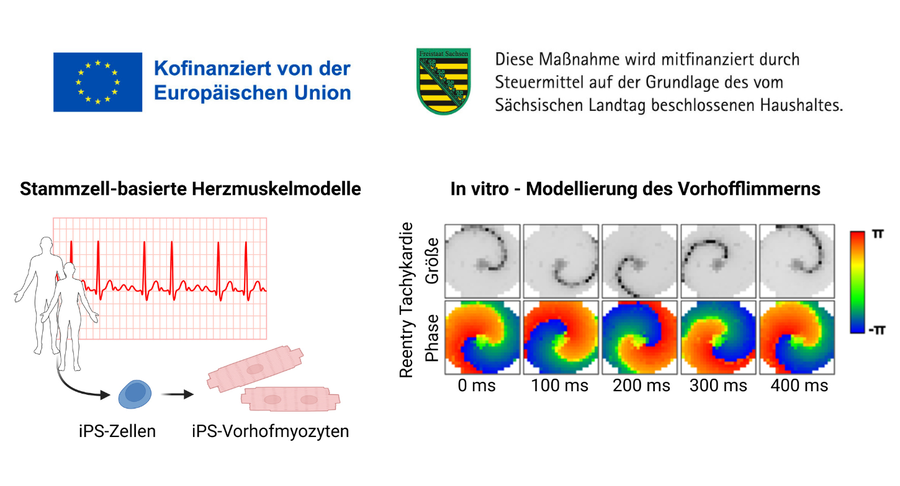
Links: iPS‑Vorhofmyozyten, die die typischen Merkmale von Vorhofflimmern abbilden können. Rechts: Elektrische Aktivität der Herzmuskelzellen bei der in‑vitro Modellierung von Vorhofflimmern.
Atrial fibrillation (AFib) is one of the most common cardiac arrhythmias worldwide and is a significant risk factor for strokes, heart attacks and heart failure. The disease is caused by disordered electrical impulses in the atria, which destabilize the heart rhythm and impair blood flow in the heart. Targeted treatment requires methods that reliably map different forms of the disease and enable patient-specific analyses.
The CardioEpiX project is developing a stem cell-based in vitro tool that addresses precisely these requirements. Under the leadership of Prof. Kaomei Guan, the team is investigating various clinically relevant forms of atrial fibrillation using patient-specific models. The basis for this are induced pluripotent stem cells (iPS cells), from which heart muscle cells are generated that reproduce typical characteristics of the respective form of the disease. These models enable detailed phenotyping and form the basis for the evaluation of active substances with regard to efficacy and possible risks.
The project is a collaboration between the Institute of Pharmacology and Toxicology of the TUD Faculty of Medicine, the Chair of Biochemical Cell Technology at Leipzig University and the Saxon company Sciospec Scientific Instruments GmbH. While clinically relevant forms of atrial fibrillation are presented at the TUD using patient-specific cell models and drugs are evaluated in terms of efficacy and risk, Leipzig University is concentrating on the development of high-density microelectrode arrays with integrated sensors and optimized stimulation technology. Sciospec is developing an independent measuring system with integrated incubation, an economical manufacturing process for the sensors and software-supported data evaluation.
The combination of these competencies creates a tool that provides new insights into the behavior of cardiac cells, improves diagnostics and supports the development of safe and effective therapies. CardioEpiX thus creates the basis for a new generation of patient-specific cardiac research.
The project is co-funded by the European Union and supported by the Saxon state: Europe supports Saxony.
Scientific contact:
Prof. Kaomei Guan
Institute of Pharmacology and Toxicology
Carl Gustav Carus Faculty of Medicine at the
TUD Dresden University of Technology
+49 351 458-6246
Kaomei.Guan@tu-dresden.de