
May 18, 2026
Keeping memory alive: A contemporary witness talk with Renate Aris
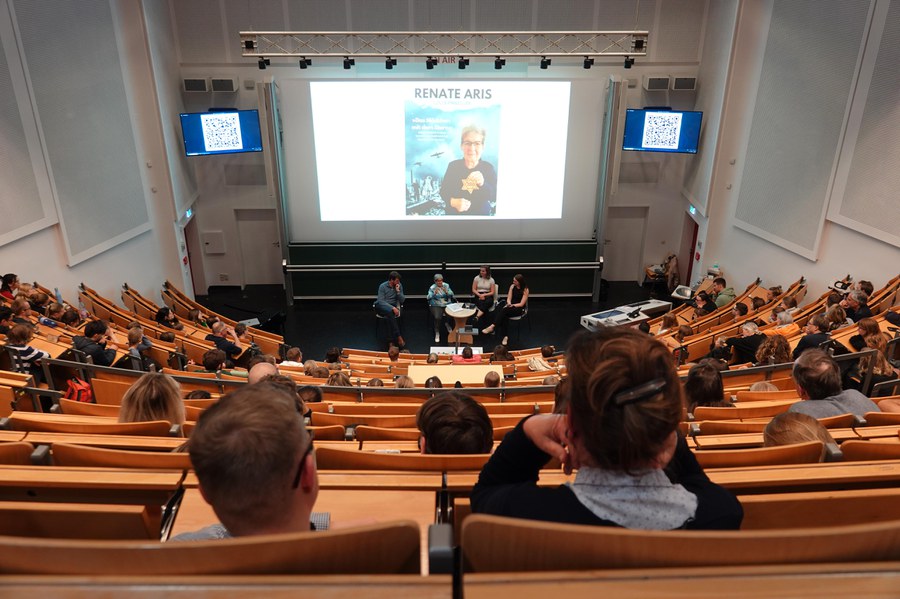
A quiet lecture hall is rare. A completely full lecture hall, in which hardly a sound can be heard for hours on end, is even rarer. On Tuesday evening, 12 May 2026, this was exactly what happened: the discussion with Holocaust survivor Renate Aris, organized by the Faculty Student Council for Medicine/Dentistry, transformed the lecture hall into a place of remembrance, listening, and responsibility. She is the last survivor of the Holocaust in the greater Dresden area and tirelessly educates people about the events of the Nazi era.
After the introduction by Prof. Florian Bruns from the Institute of History, Theory and Ethics of Medicine, Renate Aris spoke with vivid clarity about persecution, loss and survival. Her lively and vivid narrative style and the memorabilia she brought with her, including her Jewish star and original food ration cards, were particularly moving. These were words that allowed no historical distance, words that made National Socialism appear not as a closed chapter in a textbook, but as a human tragedy. Told by someone who had to live through this time herself, personal and formative experiences became vivid images in the minds of the audience.
The diversity of the audience was particularly impressive: Children and older guests, students, professors, and employees of the University Hospital came together to listen, remember, and set an example against forgetting. The packed lecture hall made it clear that remembering history is not a question of age or profession, but remains a responsibility for society as a whole.
The evening impressively demonstrated how indispensable interviews with contemporary witnesses are for a living culture of remembrance. Especially at a time when anti-Semitic and misanthropic tendencies are becoming more visible again, this talk was far more than just a university event: it was an urgent appeal for attitude, responsibility, and humanity. For the future and the time after contemporary witnesses, Ms. Aris would like to see meeting places and hopes that the Alte Leipziger Bahnhof in Dresden will become one in order to enable an exchange and commemoration of the numerous deportations.
The fact that the eyewitness talk ended with minutes of applause reflected the deep emotional impact of the evening. What was left behind was not only dismay, but also the realization that remembering is never just about the past, but also about our present and our future.