
Aug 21, 2026
Ensuring Health Care – Solutions for Saxony's Hospitals
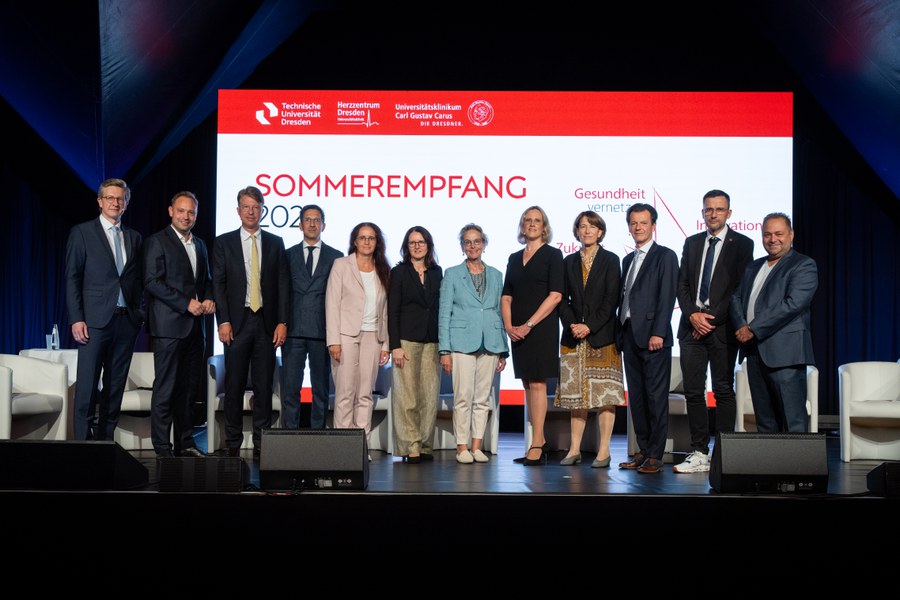
Oliver Wehner (Herzzentrum), Landtagspräsident Alexander Dierks, Prof. Uwe Platzbecker (UKDD), Prof. Axel Linke (Herzzentrum), Staatssekretärin Dagmar Neukirch, Staatssekretärin Prof. Heike Graßmann, TUD-Rektorin Prof. Ursula Staudinger, Prof. Esther Troost (MF-TUD), Prof. Vjera Holthoff-Detto (Klinikdirektorin Psychiatrie/Psychotherapie), Janko Haft (UKDD), Mirko Radloff (Pflegedirektion UKDD) und Prof. Ilker Eyüpoglu (Klinikdirektor Neurochirugie / MF-TUD).
How can health care in Saxony become stable and accessible to everyone in the long term? Dresden University Hospital, the TUD Faculty of Medicine, and the Dresden Heart Center will explore this question at their first joint Summer Reception. On August 21, at the invitation of the three key stakeholders in Dresden’s university medical community, representatives from politics, business, healthcare, research, and medicine will come together, including Alexander Dierks, President of the Saxony State Parliament, and Michael Kretschmer, Saxony’s Minister President. Under the motto “Connecting Health. Embracing Innovation. Shaping the Future”, participants will discuss current challenges and opportunities for medicine, nursing, science, and research. Now more than ever, large hospitals and medical training institutions are expected to ensure the availability of medical care.
An aging society, a shortage of skilled workers, and rising cost pressures in the healthcare sector are currently major concerns for hospitals throughout Germany. The question of how to ensure modern healthcare is sustainable in the long term is a key concern for stakeholders in hospitals, health insurance companies, and professional associations. Dresden University Hospital, the Faculty of Medicine at TU Dresden, and the Dresden Heart Center are addressing this issue.
At the first joint summer reception hosted by the three institutions on August 21, 2026, in Dresden, they will engage in dialogue with representatives from politics, business, and academia. Strong networks and diverse collaborations play a major role in this effort. In the future, medical services will be increasingly shaped by the sensible and coordinated use of resources. The overarching effort to address diagnostics, therapy, follow-up care, and preventive care will be a shared responsibility among various stakeholders.
Examples of this already exist: not least the close collaboration between the Dresden Heart Center and Dresden University Hospital in the care of cardiac conditions. The Dresden University Hospital also collaborates with other institutions in the region in the care of geriatric patients, as well as in the fields of visceral surgery and orthopedics. The transfer of knowledge from research and teaching into medical practice—and thus directly to the benefit of optimal patient care—has been similarly successful. For example, starting this year, the German Research Foundation (DFG) has been funding, among other things, a research group at the School of Medicine that, as part of the ETNA project, is developing strategies for regulating immune responses in a targeted manner following a heart attack. Together with the Dresden Heart Center, the Faculty is breaking new ground in this effort to provide more effective treatments for the growing number of patients worldwide.
The Faculty of Medicine leverages internationalization in a targeted manner to expand collaborations, attract talent, and build scientific bridges between Dresden and leading partner institutions worldwide. Through strategic partnerships, international exchange programs, and funding initiatives conducted in a targeted manner—including those with London and Zurich—it enhances the visibility of Dresden as a center of scientific excellence and contributes significantly to raising the national and international profile of TU Dresden.
Prof. Uwe Platzbecker, Chief Medical Officer, Dresden University Hospital:
“Medical care, diagnostics, and therapies are becoming increasingly specialized and personalized. This requires a shared commitment to think outside the box in the best interests of patients. And it requires cross-sector collaboration with healthcare providers in the region. As the team representing the three stakeholders at this summer reception, we’re demonstrating how this can work. Together, we want to help develop sustainable frameworks for collaboration across all of Saxony.”
Prof. Esther Troost, Dean of the TUD Faculty of Medicine:
“Networking does not end at the boundaries of a single institution—this also applies to science. After all, today major medical questions can only be answered through collaboration between clinical practice and research. Medical research provides important impetus for novel therapies and care models. At the same time, modern teaching will focus on training the next generation of medical professionals, while also keeping rural areas in mind—for example, through the MEDiC model degree program in collaboration with the Kinikum Chemnitz.”
Oliver Wehner, Managing Director of the Dresden Heart Center:
“In the end, it’s people who matter. Especially in medicine, the saying holds true: Together we are stronger. When cutting-edge medicine, research, and clinical experience work in unison, we can open new doors for patients. With the new Heart Center, one of Europe’s most modern heart centers will be established by 2029. It’s both high-tech and heart-centered. This will create the conditions for medicine at the highest level. We must now harness this potential together with the University Hospital and the School of Medicine. We want to join forces and make Saxony a leading center for modern cardiac medicine.”
Michael Kretschmer, Minister President of Saxony:
“Saxony is a strong hub for science and healthcare. This is no coincidence, but rather the result of investments in a targeted manner in research, innovation, and cutting-edge medicine. University Medicine Dresden demonstrates what is possible when these fields come together. We are continuing to build on this strength: with approximately 20 million euros for the branch of the German Cancer Research Center and with the new Dresden Heart Center, in which a total of approximately 300 million euros is being invested. In doing so, we are not only creating excellent conditions for research and medical progress. Above all, we are ensuring that cutting-edge medicine reaches the people of Saxony and provides them with tangible help.”
Alexander Dierks, President of the Saxon State Parliament:
“Ultimately, all patients in Saxony benefit from the strong networks in cutting-edge medicine. These networks and collaborations between hospitals ensure that the knowledge, experience, and innovation from our major medical centers reach the very places where people live. Especially in an aging society, we must ensure both: reliable medical care across the region and hospitals with strong capabilities for high-quality, cutting-edge medicine at our university hospitals.”
Further Information
https://www.sana.de/herzzentrum-dresden
Media Contact
Carl Gustav Carus University Hospital Dresden
Annechristin Bonß, Press Officer
Phone: 0351 / 458 4162
Email:
Carl Gustav Carus Faculty of Medicine at TUD Dresden University of Technology
Anne-Stephanie Vetter, Staff Unit for Public Relations
Phone: 0351 458 17903
Email:
Dresden Heart Center GmbH University Hospital at TU Dresden
Romy Zieke, Press Officer
Phone: 0351 / 450 1555
Email: