
Jan 30, 2026
Dresden University Medicine at the 2026 NUM CONVENTION
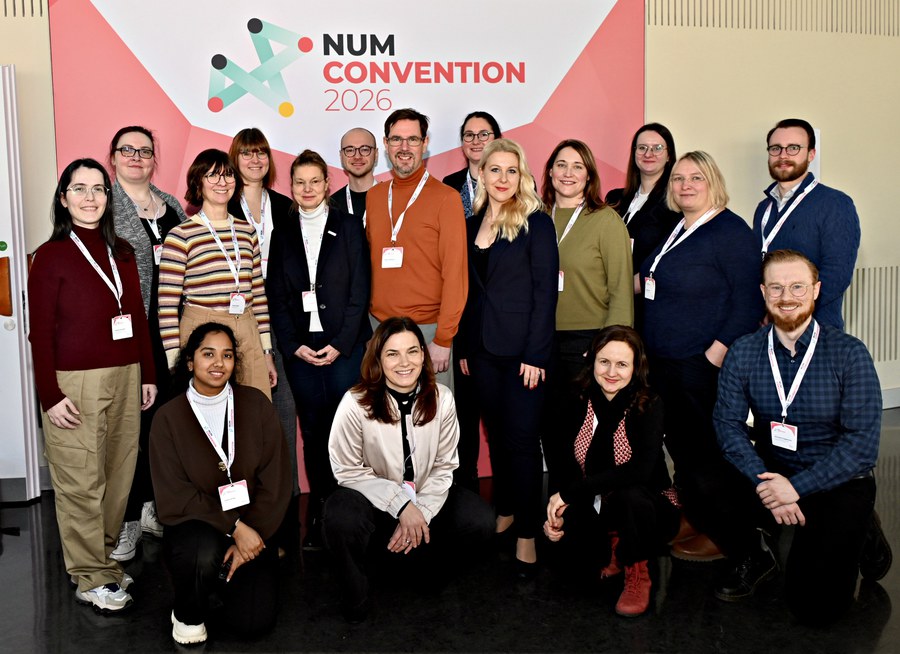
NUM Dresden team.
University Medicine Dresden (HSMD) was strongly represented at the 2026 NUM CONVENTION in Berlin with a team of 25 people. Under the motto "NUM 3.0: On the way to an open and sustainable research platform", 700 guests, including researchers, clinicians and political decision-makers, came together to discuss the future of clinical research in Germany and to jointly focus on the next development stage of NUM.
The Executive Manager for the School of Medicine, Dr. Jessica Barlinn, as well as Dresden representatives from the ZMI, ZEGV, Anaesthesiology and Intensive Care, Neurology, Clinical Infectiology , Pathology, Children's Hospital, KKS and Biobank Dresden, who together made the breadth and strength of Dresden's commitment visible.
Firm anchoring of the HSMD in the NUM
Dresden's active presence on site reflects its firm anchoring in the Network of University Medicine (NUM): the site plays a key role in the network's research, infrastructure and management policy within the current NUM 3.0 funding phase (01.07.2025-30.06.2030):
For example, the site is involved in all 12 infrastructures (AKTIN, specialist network for infections, specialist network for intensive care medicine, specialist network for stroke, German Biobank Network(GBN), NATON, NUKLEUS, NUM-DIZ, NUM-SAR, NUM Study Network (NUM SN), NUM-MB, RACOON) as well as in currently 11 projects and associated studies of the research line (canTEN, eLEVATE, ENRICH, NUM4Rare, RAPID, RACOON AI Brain Tumor, RACOON COMPARE, RACOON INCLUDED, RACOON MARDER, RACOON PAIN, SNAP), provides 6 steering committee members and (co-)spokespersons. (co-)spokespersons and is leading the development of a registry for rare diseases (NUM4Rare). In addition, the HSMD has a local NUM Staff Unit (LokS) as part of the management line, which - linked to the Center for Medical Informatics (ZMI) - acts as a central interface, takes over science management and represents the NUM stakeholders externally.
NUM Community Dresden: 20 medical and scientific institutions
The Dresden NUM community currently comprises 20 medical and scientific institutions:
- BioBank Dresden (BBD)
- Data Integration Center Dresden (DIZ)
- Institute for Clinical Chemistry and Laboratory Medicine (IKL)
- Institute for Clinical Genetics
- Institute for Medical Informatics and Biometry (IMB)
- Institute for Medical Microbiology and Virology
- Institute of Pathology
- Institute and Polyclinic for Diagnostics and Interventional Radiology
- Institute and Polyclinic for Neuroradiology
- Clinic and Polyclinic for Anesthesiology and Intensive Therapy
- Clinic and Polyclinic for Pediatrics and Adolescent Medicine (KIK)
- Clinic and Polyclinic for Neurology
- Clinical Infectiology
- Coordination Center for Clinical Studies Dresden (KKS)
- Laboratory Diagnostic Center (MiBi, VIR, Clinical Chemistry)
- Pneumology at the MK 1
- Trust Center Dresden (THS)
- University Center for Rare Diseases (USE)
- Center for Evidence-based Healthcare (ZEGV)
- Center for Medical Informatics (ZMI)
With this commitment, the Dresden NUM stakeholders are making a significant contribution to the further development of university medicine and to strengthening Dresden as a research location.
Background:
The Network University Medicine (NUM) was founded in April 2020 to coordinate clinical COVID-19 research throughout university medicine. Since then, researchers from all 37 German university hospitals have been working together on joint platforms in interdisciplinary research projects under the umbrella of the NUM. The network has established specialized research infrastructures for this purpose. These methodological, technical and organizational platforms are maintained in the NUM and can be used for a wide range of clinical research projects, for example to support data acquisition and data and biosample management for large, multicentre clinical trials. The aim is to establish the NUM as a central contact point ("one-stop store") for medical research and to bring clinical research in Germany and Germany as a science and university location back to the forefront of international research.