
Jan 20, 2026
Microbiology core dataset – a standard for the joint use of data in university medicine
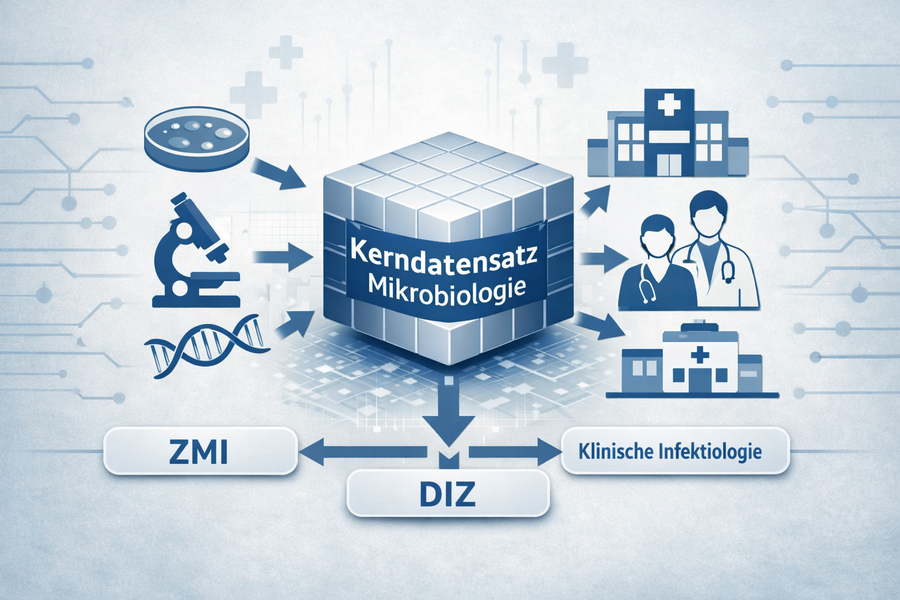
The consistent implementation of the Microbiology core dataset of the Medical Informatics Initiative (MII) offers the Faculty of Medicine enormous opportunities for research, teaching, profile building, and third-party funding acquisition. The core dataset defines which microbiological data should be kept in a standardized form across the university, including laboratory tests such as culture, microscopy, molecular diagnostics, serology, and immunology. Microorganism characteristics such as pathogen names, resistance mechanisms, and examined biosamples are also recorded. The MRGN classification of the Robert Koch Institute can also be mapped via the data model. Modeling is interoperable according to HL7 FHIR via ART-DECOR and Forge/Simplifier.net.
The Microbiology core dataset is currently being actively implemented at the Dresden site and prepared for the local data integration center (DIZ). The work is being carried out in close interdisciplinary collaboration between the Center for Medical Informatics (ZMI) and Clinical Infectiology.
For clinical research, this will facilitate cross-site studies and methods, as well as the reuse of evaluation scripts. Digital standardization also strengthens the university's profile as an innovative location for university medicine and facilitates the connection to national research infrastructures, including not only the Medical Informatics Initiative, but also the nationwide Network of University Medicine (NUM), where Dresden University Medicine now participates in 20 research projects and infrastructures, or the National Research Data Infrastructure (NFDI).
Current links to the core dataset include:
- Risk Principe (MII): development of a prediction model for hospital-acquired infections such as HOBSI (Hospital-Onset Bloodstream Infections).
- NUM Study Network: development of a Germany-wide infrastructure for clinical and clinical-epidemiological studies.
- NUM SNID - Specialist Network for Infections: connecting the expertise for the prevention and treatment of infectious diseases.
The use of the MII core dataset enables sustainable, digital, and interconnected university medicine that is visible both nationally and internationally and facilitates research cooperation.
Further information:
RISK PRINCIPE - RISK Prediction for Risk-stratified INfection Control and PrEvention (ZMI)
Together against infectious diseases: The specialist network for infections is growing (NUM SN)