
Aug 24, 2026
Teamwork of Psychiatry and Neuroradiology: ⁷Li MRI makes lithium visible in the brain
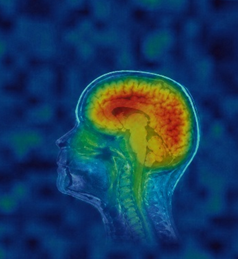
Schematic representation of ⁷Li-MRI/¹H-MRI fusion imaging, created based on the methodology described in the publication.
An interdisciplinary team led by Prof. Philipp Ritter and Dr. Katinka Edelmann (Department of Psychiatry and Psychotherapy) as well as Dr. Annett Werner (Department Diagnostic and Interventional Neuroradiology) has successfully examined lithium directly in the human brain using an innovative form of magnetic resonance imaging (MRI). The results of the collaboration with Dr. David Cousins and Prof. Peter Thelwall ( Newcastle University) were published in The Lancet Psychiatry in June 2026.
Lithium remains one of the most important treatment options for bipolar disorder and is administered once or twice daily. Both regimens are considered similarly effective but result in different daily patterns in the blood: one daily dose leads to higher nighttime peaks and lower daytime levels. Until now, it was unclear whether these fluctuations balance out in the brain.
The research team used ⁷Li MRI, which detects the signal of the lithium isotope ⁷Li instead of the hydrogen signal. Combined with high-resolution ¹H images, this technique makes the distribution of lithium in the brain visible and allows its tracking over time. In Dresden, 41 patients on stable medication, 20 receiving once-daily dosing and 21 receiving twice-daily dosing, were scanned three times within a ten-hour period, with blood samples drawn concurrently each time.
Brain concentrations closely mirrored blood concentrations throughout the day. Twelve hours after administration (the established measurement time point) there was no difference between the two dosing regimens, either in the blood or in the brain. Thus, blood concentration measurements provide a reliable indicator for the target organ. With twice-daily dosing, brain concentrations remained more stable over the course of the day; furthermore, concentrations in the white matter were higher than in the gray matter. This provides flexibility for more individualized treatment decisions, for example, with regard to tolerability, adherence, and the day-night rhythm.
It is the world’s largest ⁷Li-MRI study and the first to include repeated measurements in patients with bipolar disorder. The method was developed at Newcastle University and established across Europe as part of the Horizon 2020 initiative R-LiNK in collaboration with CEA NeuroSpin (Paris). All examinations took place at the Study Center for Mental Disorders at the TUD Faculty of Medicine and University Hospital Dresden. The work was funded by the Baszucki Brain Research Foundation and the German Research Foundation (DFG).
The study demonstrates how neuroradiological methods can directly address key questions in psychopharmacology within the brain, the target organ, and highlights the close collaboration between psychiatry and neuroradiology in Dresden.
Original publication: Ritter P, Edelmann K, Thelwall PE, et al. (2026). Brain lithium temporospatial kinetics in bipolar disorder: a repeated-measures ⁷Li MRI study of dosing regimens in Germany, The Lancet Psychiatry. DOI: 10.1016/S2215-0366(26)00153-7