
Oct 28, 2026
TUD Faculty of Medicine and Medical University of Lusatia – Carl Thiem Sign Cooperation Agreement
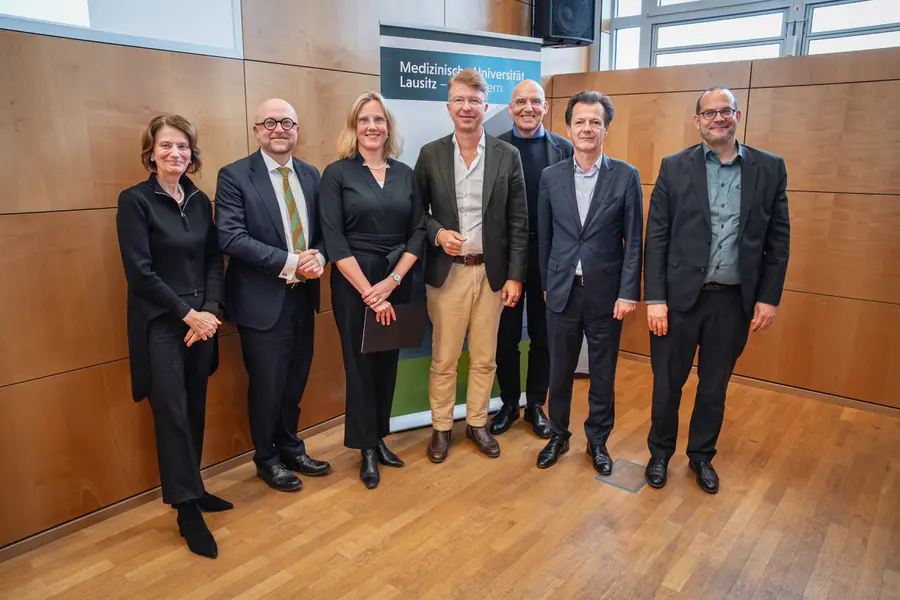
Representatives of Dresden University Medicine and MUL – CT together with Robert Denk (second from left), Head of the Higher Education Department at the Saxon State Ministry for Science, Culture and Tourism, and Tobias Dünow (first from right), State Secretary at the Brandenburg Ministry for Science, Research and Culture.
The Medical University of Lusatia – Carl Thiem (MUL – CT) and the Carl Gustav Carus Faculty of Medicine at TUD Dresden University of Technology (MF-TUD) are expanding their collaboration in research, teaching, and faculty development. A joint cooperation agreement provides the foundation for interdisciplinary research projects, innovative educational programs, and new stimuli for healthcare in Lusatia. The partnership focuses on digital medicine, novel medical technologies, and healthcare research in rural regions.
“The future of healthcare depends decisively on how well we succeed in bringing together scientific and practice-oriented disciplines and fostering interprofessional collaboration across institutional and state boundaries. Cooperation with the TUD Faculty of Medicine gives us the opportunity to further integrate medical expertise, technological innovation, and healthcare research. This creates tremendous potential not only for research and teaching, but also for sustainable and future-oriented healthcare. Our shared goal is to strengthen Lusatia as a cross-state region for healthcare and science and to generate new momentum for a holistic approach to healthcare that equally addresses scientific progress and the needs of people in the region,” says Prof. Eckhard Nagel, Chair of the MUL – CT Executive Board.
Tobias Dünow, State Secretary at the Brandenburg Ministry for Science, Research and Culture, adds: “The challenges facing healthcare do not stop at state borders, and neither should our collaboration. Within the framework of the Lusatia Health Model Region, we can not only study healthcare delivery, but actively transform it. Through MUL – CT, we are building a network for research, education, and healthcare that encompasses this entire region. Cooperation with the TUD Faculty of Medicine unites our strengths: Dresden gains new opportunities for healthcare research, while we benefit from the scientific experience of an established medical faculty. This is what collaborative healthcare looks like.”
The new partnership expands healthcare research in the Lusatia Health Model Region by adding a strong scientific hub in Saxony. The Faculty of Medicine will contribute its expertise to joint teaching and research activities across different areas of healthcare, building on existing collaborations with Brandenburg University of Technology Cottbus-Senftenberg (BTU) and the Robert Koch Institute.
Prof. Esther Troost, Dean of the TUD Faculty of Medicine, explains: “This cooperation is an important contribution to educating the next generation for the region. Joint teaching programs and qualification pathways will strengthen the medical workforce in both Saxony and Brandenburg. At the same time, it creates a shared research perspective: those who understand the realities of healthcare provision in Lusatia are also able to address its challenges through research. Both institutions stand to benefit equally. The region becomes a source of inspiration for new research, while research becomes a driver of regional development.”
Among other areas, cooperation in medical informatics will be expanded. The TUD Center for Medical Informatics and the Data Integration Center at MUL – CT intend to initiate joint research and development projects with particular focus on the interfaces between healthcare delivery, health services research, and digitalization.
The expertise of the Center for Evidence-Based Healthcare (ZEGV) will also contribute to joint projects on healthcare delivery, prevention, and public health. The goal is to strengthen the scientific foundations for needs-based healthcare in the region.
Prof. Adelheid Kuhlmey, MUL – CT Founding Executive Board Member, emphasizes: “For us, as an academic medical center currently under development, collaboration with such an experienced partner as the TUD Faculty of Medicine is of particular significance. Together, we aim to advance research projects and develop new concepts for medical education. One specific initiative is entitled ‘Medicine in Transition.’ Its objective is to integrate digitalization and innovative medical technologies into interdisciplinary and interprofessional teaching. Here, we can draw on connections to the engineering sciences, both through TUD and through cooperation with BTU in Cottbus. Planned projects include joint elective courses, summer schools, and additional study programs. Our students should learn to address medical questions across disciplinary boundaries.”
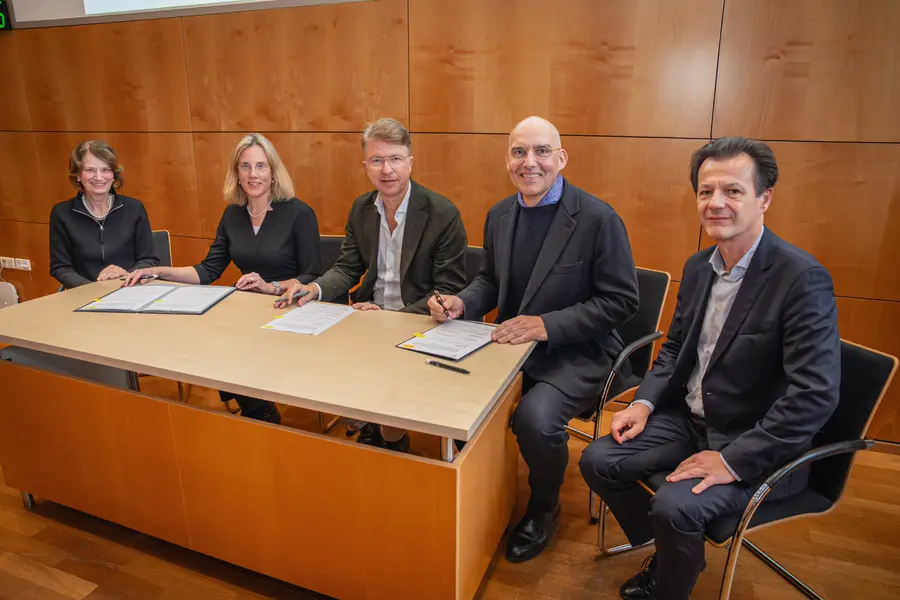
From left to right: Prof. Adelheid Kuhlmey (MUL – CT), Prof. Esther Troost (TUD Faculty of Medicine), Prof. Uwe Platzbecker (University Hospital Dresden), Prof. Eckhard Nagel (MUL – CT), and Janko Haft (University Hospital Dresden) at the signing of the cooperation agreement.
In addition, both partners will exchange experience in designing academic programs, developing curricula, and ensuring quality standards of medical training. Beyond research and teaching, the cooperation also encompasses the organization of medical faculties. Areas of exchange include governance structures, academic career pathways, and staff development. The institutions also intend to learn from one another and share best practices in financial management, third-party funding acquisition, and academic administration.
In the long term, the collaboration aims to improve healthcare in rural regions through evidence-based and digital approaches while strengthening Lusatia as an attractive center for healthcare and science.
Press Contact at TUD Faculty of Medicine
Anne-Stephanie Vetter
Public Relations Office
Faculty of Medicine at TUD
Dresden University of Technology
+49 (0) 351 458 17903
Press Contact at MUL – CT
Britta March
Head of Corporate Communications and Press Officer
Medical University of Lusatia – Carl Thiem
+49 (0) 355 46 3255
Background
The Faculty of Medicine at TUD Dresden University of Technology (MF-TUD) sets national and international standards through its research focus areas in oncology, metabolic diseases (particularly diabetes), and neurological and psychiatric disorders, supported by the use of digital technologies.
Students benefit from a diverse academic portfolio featuring innovative teaching in medicine, dentistry, public health, midwifery, medical radiation sciences, biomedical engineering, and the model medical degree program in Chemnitz.
Together with University Hospital Carl Gustav Carus Dresden, the Faculty forms Dresden University Medicine. Close collaboration with leading research institutions such as the Helmholtz-Zentrum Dresden-Rossendorf, Fraunhofer Institutes, and the Max Planck Institute of Molecular Cell Biology and Genetics makes Dresden a center of excellence for innovative, patient-oriented medicine and outstanding research.
The Medical University of Lusatia – Carl Thiem (MUL – CT) was established on July 1, 2024, as Brandenburg’s first and only public academic medical center. Supported by EUR 3.7 billion in funding from the federal and state governments through 2038, it is the largest structural transformation project associated with Germany’s coal phase-out, bringing together healthcare, research, and education under one roof. Its interdisciplinary research priorities are healthcare systems research and digital health. Digital solutions, modern models of care, and a consistent focus on connected, integrated healthcare delivery in rural regions make the university unique within Germany. Closely linked to the university is the Lusatia Health Model Region, where the healthcare systems of the future are being developed.
MUL – CT currently employs around 4,300 staff members from more than 60 countries. In the winter semester of 2026/27, the first cohort of 38 students began the model medical degree program. Beginning in 2028, three additional master's programs are planned: Advanced Nursing Practice, Medical Data Science, and Health Systems Sciences.