
Jul 02, 2026
First medical student on clinical rotation at the Spreewald Clinic
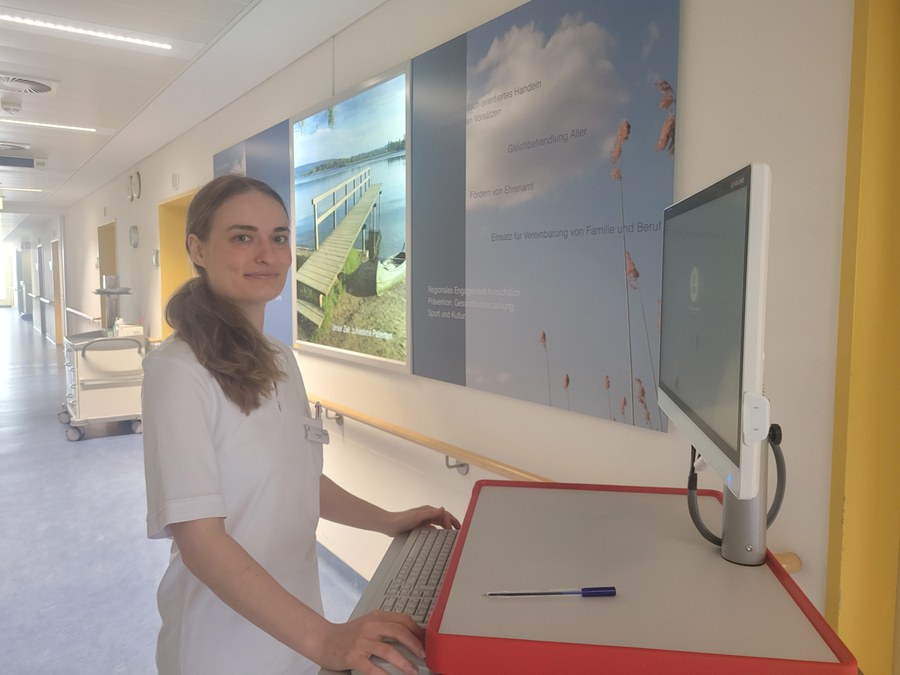
Ulrike Heilenz ist die erste Medizinstudierende, die in der Spreewaldklinik Lübben das Praktische Jahr absolviert.
To ensure that patients continue to receive expert care in the future, Dahme-Spreewald Hospital is now stepping up its commitment to the education and training of medical students. As a recognized academic teaching hospital, the healthcare provider offers young professionals valuable insights into everyday hospital life, in-depth instruction in close contact with patients, and intensive support. Ulrike Heilenz is the first medical student to complete her clinical rotation (PJ) at the Spreewald Clinic.
“I really wanted to come to Lübben because I want to learn as much as possible, and so far, I’m really enjoying my PJ. Here, I’m gaining insights into a wide variety of areas, and teaching is taken very seriously. The doctors take the time to explain things to me in detail and answer my questions,” says Ulrike Heilenz. A native of the Spreewald region, she is studying medicine in a MEDiC model degree program at the TUD and has returned to her hometown for her PJ.
A Multifaceted Clinical Rotation
Ulrike Heilenz has been looking forward to working alongside others and gaining experience in the midst of everyday hospital life for a long time. That’s because the aspiring doctor already has very specific ideas about how and where she’d like to practice in the future. A native of the Spreewald region, she already holds a degree in nutritional science and hopes to work as a general practitioner specializing in diabetology, nutrition, and preventive medicine. “Taking a holistic view of the patient is important to me. That’s why I think it’s great that I can be part of the team here in the operating room, in the central emergency department, or during outpatient appointments at the medical care center. I’m also learning when it’s appropriate to refer patients to the hospital for further treatment,” explains the student, who is delighted by the many facets of her clinical rotation. The focus on close integration between outpatient and inpatient care is particularly important to her with a view to her future career as a family physician. During her clinical rotation at the Spreewaldklinik, Ulrike Heilenz not only gets to observe experienced physicians at work but also contributes herself, for example, during initial consultations with patients or when designing medication plans.
A Win-Win Situation
One person who accompanies the students on their field trip into the daily routine of the clinic and imparts a wealth of knowledge is Dr. Ronny Hendrischke. “Clinical rotation students enrich the daily clinical routine in many ways. Every staff member contributes to the training, and since this is how today’s generation operates, everything said is naturally verified online, and everyone strives to convey the information as accurately as possible. So for the staff, it’s like a little test every day. It’s a win-win situation for everyone involved,” says the chief of the Department of General and Visceral Surgery. The experienced physician serves as an examiner at the Brandenburg State Medical Association several times a month, which allows him to simulate exam situations for the PJ students. This is a major advantage, as it gives the future doctors a taste of what to expect on the third state examination.
Today in the clinical rotation, tomorrow a resident
Intensive professional guidance, broad knowledge transfer, close patient contact, and an openness to questions: There are good reasons for the Spreewaldklinik team’s strong commitment to supporting the next generation of doctors: “Of course, we hope that some of the students will remember us and, provided the Department is a good fit, return as resident physicians,” explains Dr. Ronny Hendrischke.
During the final phase of their medical studies, students can complete their clinical rotation (PJ) across three 16-week rotations in surgery, internal medicine, and a specialty department of their choice. “We are pleased to support young professionals on their educational journey and equip them with broad knowledge. During the PJ, we have the opportunity to teach them all of our diagnostic, therapeutic, and surgical procedures right here at our hospital,” emphasizes Medical Director Dr. Benno Bretag. This is an investment with a long-term perspective: By ensuring that young professionals receive a rigorous and well-rounded education, the Dahme-Spreewald Hospital makes a valuable contribution to the competent care of future patients.
About the Dahme-Spreewald Hospital
The Dahme-Spreewald Hospital Group comprises two locations: the Spreewaldklinik Lübben and the Achenbach Hospital in Königs Wusterhausen. The two hospitals treat more than 25,000 inpatients and more than 50,000 outpatients annually. To this end, the two hospitals, which provide primary and standard care, have a total of 448 beds across nine medical departments. The annually increasing number of patients treated underscores the importance and acceptance of competent, high-quality care in the region. The Dahme-Spreewald Hospital demonstrates particular expertise in setting the course for areas that will be important in the future. For example, palliative care and specialized pain management are already firmly established as part of the treatment spectrum. At the Heinz-Sielmann Health Academy, which is also operated by the Dahme-Spreewald Hospital, more than 130 students are being prepared for a career in nursing. The Health Academy is one of the largest institutions of its kind in the state of Brandenburg. In addition, outpatient care services have been available since 2019. Initially, these were provided by the Dahme-Spreewald Medical Care Center in Königs Wusterhausen in the fields of general medicine/internal medicine, surgery, and pediatrics and adolescent medicine; and since 2022, by the Lübben Polyclinic Medical Care Center in the fields of general medicine, gynecology, and surgery.
Source: Dahme-Spreewald Hospital