
May 29, 2026
Together Against Tuberculosis (TAT) wins jury prize at StuFoExpo 2026
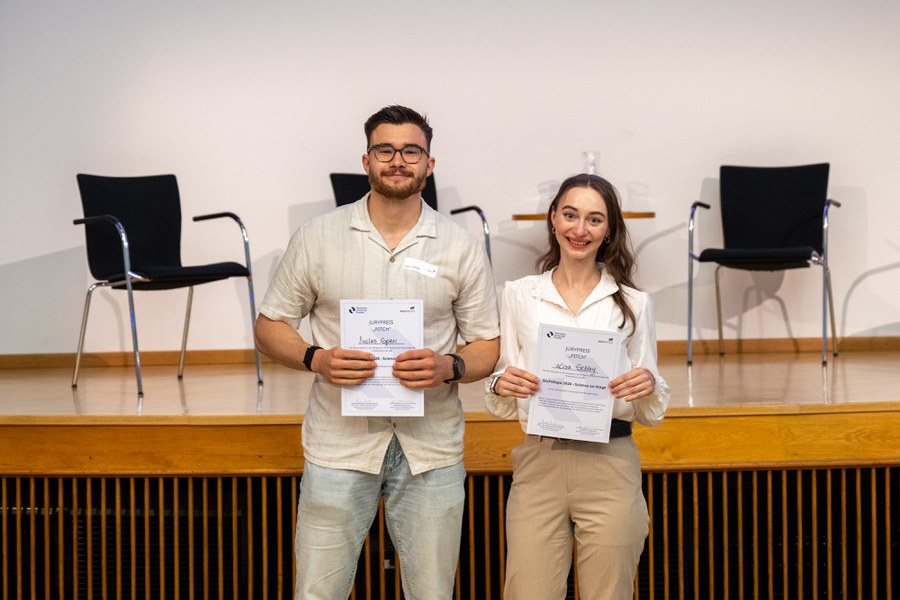
Studierende Niclas Speri und Lisa Schley bei der Preisverleihung.
On May 7, 2026, the Dülfer Hall at TU Dresden once again became a stage for creative and innovative student research. At the ninth edition of StuFoExpo under the motto "Science on Stage", students delighted the audience with exciting and entertaining insights into their research projects. Around 140 guests experienced an afternoon/evening full of inspiration, exchange and scientific highlights.
The university medical community was also represented: Lisa Schley and Niclas Speri presented the Together Against Tuberculosis (TAT) initiative and won the jury prize for their pitch. The TAT project aims to promote treatment adherence by providing student support and establishing an interdisciplinary teaching format. The service-learning approach links university teaching with public health services and outpatient care. Since June 2025, six students have supported five patients, and two therapies have been successfully completed. This support has a stabilising effect. The project strengthens competencies regarding social factors and patient care, demonstrates the potential for networked collaboration and will be evaluated further.
Lisa Schley shares her impressions: "Making science visible is difficult. Reaching people on an emotional level is even harder. That’s what we learned and experienced at StuFoExpo. When we first heard the motto 'Science on Stage,' our main goal was to give our project, Together Against Tuberculosis (TAT), the visibility it deserves. Winning the jury prize for the best pitch overwhelmed us emotionally.
Even during the preparation phase, we realized how difficult it is to convey a complex health topic in a way that is both understandable and emotionally accessible in just a few minutes, especially to an audience with diverse disciplines and perspectives. That’s why the workshop with actor Sven Hönig wasn’t just about stage presence or storytelling. It was about truly reaching people. It was about the deliberate composition of language, images, and emotions. In short, it was about rhetoric. The exchange with the other participants was also particularly valuable. In a short amount of time, an environment of honest, interdisciplinary collaboration emerged, characterized by openness, feedback, and shared uncertainties.
For our pitch, we made a conscious decision to focus solely on conveying essential information. Instead, we told the story of a patient’s treatment journey filled with obstacles, crossroads, and dangers embedded within everyday symbolism. Our goal was to convey knowledge and make the emotional reality of tuberculosis treatment visible and tangible. After all, that is exactly what TAT is all about. It’s not just about the disease. It’s about supporting people during difficult times. This experience has shown us that effective science communication occurs when people begin to understand why something is important.