
Oct 09, 2026
2026 vdek Future Prize: TUD Faculty of Medicine Wins Third Prize for Pioneering Project in Gender-Sensitive Care
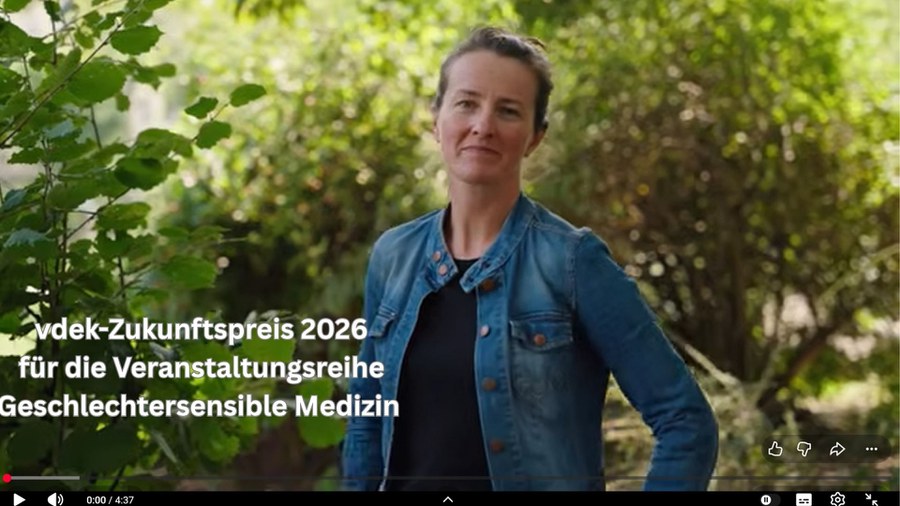
“Health for All Genders” is the motto of the 2026 Future Prize awarded by the the Verband der Ersatzkassen e. V. (vdek). The award recognizes projects committed to gender-sensitive healthcare. The focus is on how the different health conditions and needs of women and men can be better taken into account in medical education, diagnostics and treatment.
On October 7, 2026, the award winners were honored at the “vdek Future Forum” event in Berlin.
The vdek Future Prize, with a total prize fund of 25,000 euros, was awarded to three projects:
- First Prize: Training for gender- and culturally-sensitive care in emergency situations
- Second Prize: Gender-Sensitive Support to Combat Smoking
- Third Prize: Integrating gender-sensitive medicine into medical education
Film showcases award-winning projects
All three award-winning projects are featured in the film “vdek Future Prize 2026 – Health for All Genders.”
Award Winner: “Gender-Sensitive Medicine” Lecture Series
The third prize, worth 5,000 euros, goes to the Faculty of Medicine at TUD Dresden University of Technology for its interdisciplinary online lecture series “Gender-Sensitive Medicine.” Through ten lectures, the series teaches students and healthcare professionals how gender differences impact diagnosis, treatment, and research. The aim is to raise awareness of these differences and to establish gender-sensitive medicine sustainably in medical education and healthcare delivery.
Silke Heinke, head of the vdek regional office in Saxony, congratulates the Dresden project: “We are particularly pleased that a project from Saxony at TUD has been honored with this year’s vdek Future Prize. Gender-sensitive medicine is not a niche topic, but rather a key component of more tailored and higher-quality care. Those who recognize and take into account differences in symptoms, diagnostics, or treatment outcomes can better avoid misdiagnosis, under-treatment, and over-treatment. The Dresden lecture series addresses a crucial point: it introduces this knowledge during medical training and, at the same time, carries it forward into continuing education and therefore into healthcare practice.”
Embedding Knowledge Early in Education and Care
Established in 2022, the “Gender-Sensitive Medicine” lecture series combines lectures and seminars and is aimed at both medical students and qualified healthcare professionals. The online lectures are certified by the Saxon State Medical Association as continuing medical education; students can take the series as an elective course. The content addresses gender-dependent and gender-specific aspects across a range of medical specialties, including emergency medicine, radiology, infectious diseases, psychiatry and orthopedics.
The aim is to raise awareness among both future and practicing physicians of areas in which gender-related differences have so far not been adequately taken into account in education, research and clinical care. In the long term, the goal is to strengthen and permanently integrate gender-sensitive medicine into the medical curriculum. The lecture series considers gender both as a biological and as a social factor. It addresses differences in symptoms, diagnosis, treatment and care, as well as potential stereotypical assumptions in everyday clinical practice.
PD Dr. Monika Valtink, Staff Unit for Gender Equality and Diversity Management, and Anne Röhle, from the Institute for Didactics and Teaching Research in Medicine at the TU Dresden Faculty of Medicine, jointly implemented and established the course on a permanent basis. They are pleased that their commitment has been recognized and that the award will help raise the visibility of the issue: “Gender plays a role in every discipline, every profession and every healthcare context. Research, education and healthcare need to integrate gender — as well as other diversity categories — more strongly as a variable into their work. The work of the past years has clearly shown that everyone benefits when medicine becomes more gender-equitable. However, there is still a long way to go before gender-sensitive medicine is genuinely embedded longitudinally throughout the curriculum and implemented in practice.”
Successful Format to Be Further Institutionalized
The Dresden program is now firmly established as a required elective and is being continuously developed. The required elective was already fully booked with a waiting list for the summer semester of 2026. Insights from the series of courses have also already been incorporated into other course content. At the same time, a cross-campus working group in Dresden and Chemnitz is working on the long-term integration of gender-sensitive medicine into the curriculum.
About the vdek Future Prize: An Award from the Social Self-Administration
The vdek Future Prize is awarded by the Social Self-Governance body of the six substitute health insurance funds: TK, BARMER, DAK-Gesundheit, KKH, hkk, and HEK. Since 2010, the prize has recognized innovative ideas and concepts that advance healthcare. A jury of experts in health policy, medicine, and self-governance selects the award recipients.
For more information on the vdek Future Prize, visit https://www.vdek.com/politik/vdek-zukunftspreis.html
Contact:
Anke Weber
Association of Alternative Health Insurance Funds (vdek)
Saxony Regional Office
Policy and Communications Advisor
www.vdek.com