
About us
Table of contents
The SFB/TRR 237 is an interdisciplinary research network comprising the University of Bonn, Ludwig Maximilian University of Munich, and the Technical University of Dresden. Since its founding in 2018, it has been funded by the German Research Foundation (DFG).
Close collaboration and shared responsibility among the three locations characterize the network. Accordingly, the role of network chair rotates among the participating universities: Günther Hartmann (Bonn) initiated the network and led it during the first funding period. In the second funding period, Veit Hornung (Munich) took over this role. With the start of the third funding period, Min Ae Lee-Kirsch (Dresden) has now assumed the role of spokesperson.
The shift to Dresden underscores the network’s translational focus: Through close clinical ties and an established infrastructure for patient-oriented research, findings from basic research are to be linked to medical questions.
The following institutions are part of the current research network:







Forschungsfragen
The scientists working in CRC 237 are interested in gaining new insights into the molecular mechanisms involved in the defense against nucleic acids. With 26 ongoing research projects and an interdisciplinary and highly complementary team of scientists, the CRC is uniquely positioned to address pressing questions in the field:
-
What are the exact non-self features in nucleic acids that are being detected by nucleic acid sensors or restriction factors?
-
How do nucleic acid-metabolizing systems govern or contribute to self vs. non-self discrimination?
-
How are threshold behaviours of nucleic acid sensors and restriction systems realised at the molecular level?
-
How is the subcellular positioning and trafficking of nucleic acid sensors regulated and how do their signalling cascades operate?
-
How do defects in pathways of nucleic acid sensing and metabolism trigger systemic autoimmunity and what counter-regulatory mechanisms exist?
-
What determines the immunogenicity of nucleic acids in the context of infection and vaccination and how can these features be leveraged for nucleic acid-based therapeutic approaches?
-
Employing systems approaches, can we identify minimal endotypes in patients suffering from dysregulated nucleic acid immune responses, and how can these inform us about underlying pathophysiological mechanisms and guide therapy?
-
Having learned much from rare monogenic diseases, can we also identify common genetic variants to understand interindividual heterogeneity in Nucleic Acid Immunity?
The results of this work will not only provide fundamental insights into the functioning of the immune system but will also provide important building blocks for the development of new diagnostic and therapeutic concepts for a variety of important diseases, including viral infections, sterile inflammatory diseases and cancer.
Overview
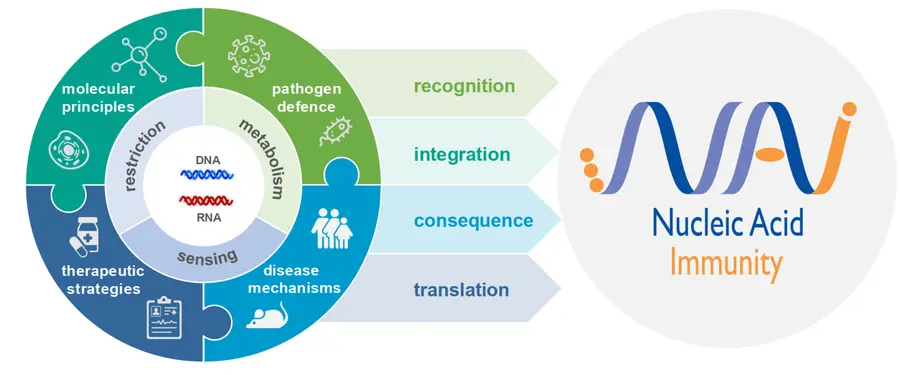
Until the establishment of this CRC, the different mechanisms of nucleic acid defense in vertebrates have generally been studied separately and unrelated to each other. This initiative integrates them under the same umbrella: Nucleic Acid Immunity is the holistic approach to study the interaction of (1) nucleic acid recognizing pattern recognition receptors ("sensors"), (2) restriction factors and (3) nucleic acid-metabolizing enzymes in the context of foreign nucleic acid recognition. Given the close interrelationship of these systems, an integrated approach, such as the one pursued in this consortium, is warranted to study them.
While this system is evolutionarily adapted to recognize microbial and viral pathogens, its erroneous activation is the cause of many sterile inflammatory diseases characterized by abnormal activation of an antiviral state. Studying these diseases and their underlying pathways will not only provide new insights into disease pathology, but will also allow us to develop tools for more sensitive and specific disease diagnosis and prognosis. At the same time, we expect that our findings will enable us to develop new therapeutic strategies in the long term.
Research Program
The research program is divided into two main research areas. Area A investigates the mechanisms of nucleic acid immunity on the molecular and cellular level, whereas area B focuses on the functional consequences of nucleic acid immunity on a systemic level. Within each area, the projects are subdivided into specific research topics:
Area A, Mechanisms of nucleic acid immunity on the molecular and cellular level:
- Recognition of nucleic acids (A01, A02, A04, A05, A23, A25, A27, A30)
- Regulation of nucleic acid recognition by nucleases and metabolism (A07)
- Role of downstream signalling pathways and their regulation (A10, A11, A26)
Area B, Functional consequences of nucleic acid immunity on a systemic level:
- Nucleic Acid Immunity in infection and vaccination (B14, B15, B29)
- Nucleic Acid Immunity in sterile inflammatory diseases (B16, B17, B19, B20, B21, B22)
In addition, our CRC benefits from a central administrative project (Z), which play a vital role in supporting our researchers. The structure facilitate scientific and administrative coordination, provide collaborative infrastructure and assist with -omics data analysis, ultimately helping to drive the success of our research projects.