
Apr 29, 2026
Interprofessional learning on the stroke unit - piloting IPSTA
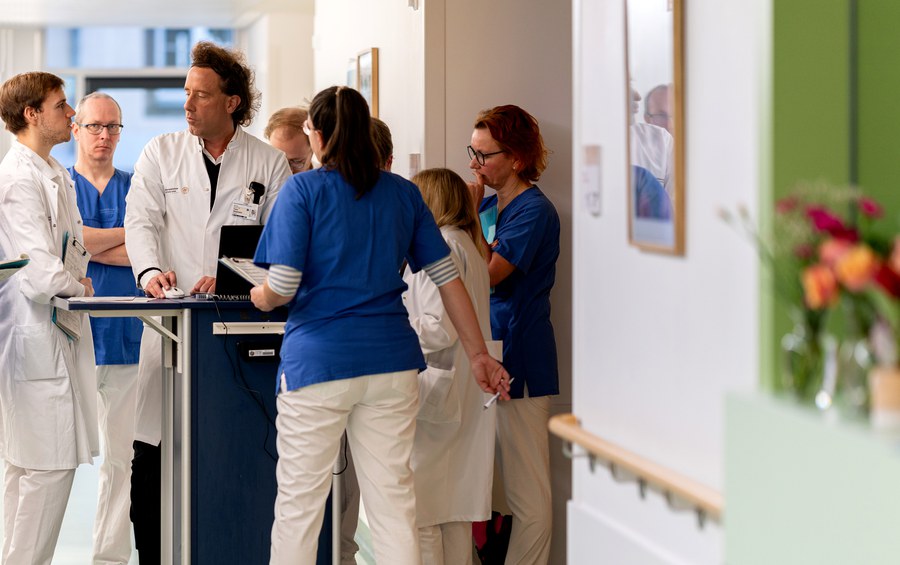
The team at the interprofessional training center (IPSTA).
The Institute for Didactics and Teaching Research in Medicine played a major role in the piloting of the first Interprofessional Training Station (IPSTA) at Dresden University Hospital this year by coordinating and providing scientific support. Read the following article, published by the University Hospital Dresden:
"Interprofessional learning on the stroke unit - Dresden University Hospital establishes new learning model
The University Hospital Carl Gustav Carus Dresden is focusing on modern formats for training and further education. In spring, the format of the interprofessional training station (IPSTA) was tested for the first time in a pilot phase. Students and trainees from various healthcare professions independently take over patient care and the complete management of diagnostics and therapy for the patients entrusted to them on a ward. "When training young people for different professions, we always feel the desire to get to know the practical side of things as early as possible and to put theoretical knowledge into practice. We respond to this and therefore rely on modern training formats. That is our claim as a modern employer," says Prof. Uwe Platzbecker, Medical Director at Dresden University Hospital.
Two nursing trainees, two medical students, two patient rooms. And always present: a medical and nursing mentor. As part of a university medical cooperation between the Department of Neurology at Dresden University Hospital and the Institute for Didactics and Teaching Research in Medicine at TU Dresden, the project for an interprofessional training ward (IPSTA) was launched in spring 2026 as part of a pilot phase. This type of modern training format is becoming increasingly important. As initiators in the first phase, those responsible from the Department of Practice Transfer at the university hospital therefore also played an important role. Together, it was possible to transfer and optimize the concept, coordination and scientific support on the stroke unit to practical operations.
The first models of an interprofessional training ward were developed in Scandinavia at the end of the 1990s. Students and trainees from various healthcare professions independently take over patient care and the complete management of diagnostics and therapy for the patients entrusted to them. They are supported and accompanied in the background by an interprofessional team from medicine, nursing and practice management. The close cooperation, short coordination channels and distribution of tasks in a targeted manner increase mutual understanding. The participants learn together with, from and about each other - with the aim of providing patients with the best possible care and strengthening interprofessional skills. "The direct insights into everyday life on the ward make this learning format so valuable. Listening, learning from each other and developing a lasting mutual understanding between the medical service and nursing - these are the key successes of this pilot phase, which we have received positively," says Steffi Luczak-Streck, Team Leader of the Central Practice Guidance at the University Hospital.
Vanessa, Richard, Claudia, Elena and Franz tried out how this works in the pilot project: The two medical students in their practical year and the three nursing trainees in their third year of training were assigned to the stroke unit (NEU-SU). They all took away very personal insights into the tasks and challenges of the other professional group: "Working in a team made me less worried about approaching the doctors and asking questions," says trainee Claudia. "My self-confidence grew over the course of the project from being overwhelmed at first. The opportunity to slowly grow into such a responsibility helped me a lot," says medical student Vanessa, summing up her personal experience. "At the beginning, I had a lot of respect for having to act independently here. Right from the start, you're in the thick of things instead of just being there. Making your own decisions and taking responsibility for them as part of a team was a formative experience," says medical student Richard. "Seeing how quickly we grew together as a team shows me what added value this has for our future day-to-day work. The exchange of ideas - even on minor issues - gives us security and a good feeling," says nursing trainee Franz.
The Stroke Unit at the Clinic and Polyclinic for Neurology is to be used regularly as an interdisciplinary training ward in future. "The response from the trainees and medical students has been remarkable. The project has already attracted a great deal of attention during its two-week duration. Especially in a highly specialized area such as the stroke unit, it is crucial to master complex processes together as a team under real-life conditions," explains Prof. Timo Siepmann, who was in charge of the project together with ward physician Dr. Martin Arndt". "With IPSTA, we are creating framework conditions that enable interdisciplinary learning. It's about independence, professional exchange and, above all, realistic situations in everyday working life. The participants have the opportunity to explore their own limits with a secure background and gradually take on responsibility," says Corinna Jork, nursing manager of the project.
During the pilot phase, all participants documented their experiences and shared what they had learned in daily reflection sessions. Employees from the Institute for Didactics and Teaching Research in Medicine at TU Dresden also supported IPSTA and the conclusion was positive: "Projects like this are particularly successful when the motivation of the participants is high. It stands and falls with the teams and here we have experienced great commitment at all levels. This experience is also extremely valuable for us and the further development of our teaching concepts for the university hospital," says Director Prof. Marjo Wijnen-Meijer."
You can find the original article here.
If you have any questions about the content of the project or are interested in working with us, please contact our IDL staff.
Contact formedia representatives:
University Hospital Carl Gustav Carus Dresden
Alexander Hesse, Press Officer
Tel. 0351 / 458 4164
E-mail: Press Office