
Sep 24, 2026
New DFG-project approved for IMB: „Virtual niche: Computational modelling and simulation of spatio-temporal dynamics of hematopoietic stem cells in their local microenvironment“
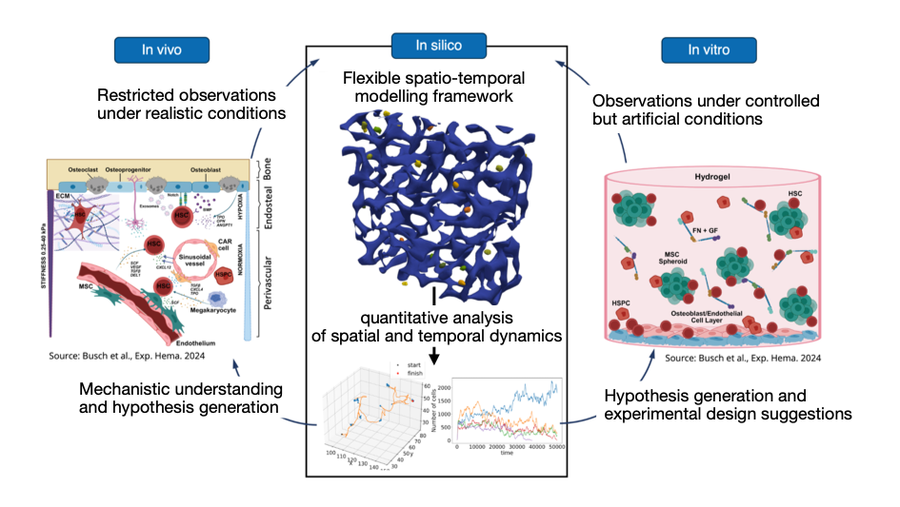
In a healthy organism, hematopoietic stem cells (HSCs) are primarily found in the bone marrow. There, they are surrounded by a specialized microenvironment that HSCs require to survive and perform their functions properly. In the literature, this microenvironment is often referred to as the stem cell niche.
Although many components of the niche (including various cell types and parts of the extracellular matrix) have been identified experimentally, it remains unclear exactly how the dynamic interaction of all these components—and thus the regulation of HSCs—takes place. Such an understanding is not only of interest from a basic science perspective. It is also highly relevant from a practical medical standpoint, as many diseases—such as leukaemia—are caused by abnormalities in stem cells and their regulation. Thus, a better understanding of stem cell–niche interactions has the potential to contribute to improved treatment options.
In the project, which is now funded by the DFG with €338,000, experimental in vitro and in vivo observations are to be integrated within an in silico simulation environment. Specifically, it is the goal to virtually integrate complementary experimental findings—that is, highly restricted observations in realistic environments (in vivo) and observations that are more easily quantifiable and controllable in artificial environments (in vitro)—in order to better understand the overall system dynamics.
The project, led by Prof. Ingo Roeder, is being carried out at the IMB with the collaboration of Prof. Ingmar Glauche and Dipl.-Biomath. Thomas Zerjatke. In addition, a doctoral position in the natural sciences (to be advertised) will be included in this project. On the experimental side, the project is supported by various local and international research groups. These include the IKL at the Dresden Faculty of Medicine (Prof. Kalafati), the Leibniz Institute for Polymer Research Dresden (Prof. Werner), the University of Glasgow (Profs. Wheadon, Copland, Salmeron-Sanchez, Dalby), the University Hospital of Zurich (Prof. Nombela Arrieta), and ICREA Barcelona (Prof. Florian). With respect to the use of specific software tools, we are also collaborating with the TU Dresden’s ZIH (Dr. Brusch).