
16.01.2026
Neuer Open-Access-Artikel: Patient-Reported Outcomes als Kompass der onkologischen Versorgung
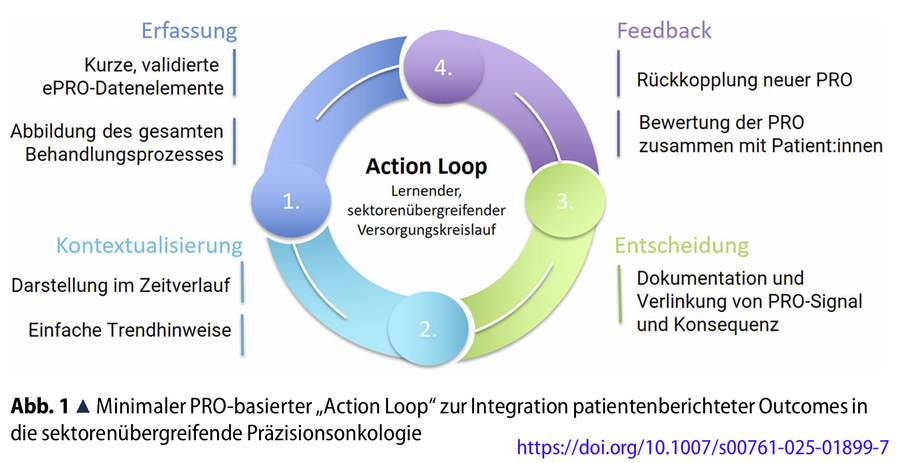
Wie können Patient-Reported Outcomes (PROs) so in die onkologische Versorgung integriert werden, dass sie nicht nur erhoben, sondern auch wirksam genutzt werden?
Ein neuer Open-Access-Artikel in Die Onkologie gibt darauf eine klare Antwort – mit einem praxisnahen Konzept für den sektorenübergreifenden Einsatz von PROs von der Hausarztpraxis bis ins Molekulare Tumorboard (MTB).
PROs: Mehr als Fragebögen
PROs erfassen, wie Patient:innen ihre Symptome, Nebenwirkungen, Funktionsfähigkeit und Lebensqualität selbst erleben. Gerade in der personalisierten Onkologie liefern sie damit eine Perspektive, die klinische und molekulare Daten sinnvoll ergänzt. In der Praxis haben PROs jedoch häufig eine zu geringe Wirkung – etwa weil sie isoliert erhoben, nicht zurückgespiegelt oder nicht systematisch in Entscheidungen einbezogen werden.
Der nun veröffentlichte Beitrag setzt genau hier an.
Ein minimaler „Action Loop“ für die Praxis
Zentraler Bestandteil des Artikels ist ein minimaler Action Loop, der zeigt, wie PROs Schritt für Schritt in klinische Workflows eingebettet werden können:
- Erfassung kurzer, validierter PROs
- Kontextualisierung im zeitlichen Verlauf und im klinischen Kontext
- Entscheidung, bei der PRO-Signale explizit berücksichtigt werden
- Feedback, um Wirkung und Anpassungen sichtbar zu machen
Dieser Kreislauf macht deutlich: PROs entfalten ihren Nutzen nicht durch Erhebung allein, sondern erst dann, wenn sie sichtbar, rückgekoppelt und entscheidungsrelevant werden.
Sektorenübergreifend gedacht – realistisch umgesetzt
Der Artikel ordnet PROs entlang der gesamten Patient Journey ein: vom hausärztlichen Erstkontakt über die fachärztliche Versorgung bis hin zum Molekularen Tumorboard und zurück in die Nachsorge. Ein besonderer Fokus liegt auf der elektronischen Patientenakte (ePA) als potenziellem sektorenübergreifendem Rückgrat.
Dabei wird der aktuelle Reifegrad klar benannt: Die ePA ist derzeit noch kein flächendeckender PRO-Arbeitsplatz. Der Beitrag zeigt daher pragmatische Übergangswege, etwa über ePRO-Lösungen, strukturierte Zusammenfassungen und führende Visualisierungen in Tumorzentrumssystemen wie MTB-cBioPortal.
Warum das für Patient:innen wichtig ist
Für Patient:innen bedeutet dieser Ansatz vor allem eines:
Ihre Rückmeldungen bleiben nicht folgenlos.
👉 PROs sind dann wertvoll, wenn aus Angaben Antworten werden – etwa durch Therapieanpassungen, Supportivangebote oder eine zeitnahe ärztliche Rückkopplung. So werden Patient:innen zu aktiven Partner:innen in ihrer Behandlung.
Entstanden in starken Projektkontexten
Der Artikel ist im Rahmen mehrerer nationaler Forschungs- und Infrastrukturprojekte entstanden, darunter PM4Onco, MiHUBx / MiHUB und PCOR-MII innerhalb der Medizininformatik-Initiative. Die Arbeiten werden durch das BMFTR gefördert und sind in die Nationale Dekade gegen Krebs eingebettet.
Jetzt lesen
Der vollständige Artikel ist Open Access verfügbar und richtet sich an Fachöffentlichkeit, Versorgungsakteur:innen und alle, die patientenzentrierte Onkologie weiterdenken möchten.
👉 Zum Artikel:
https://doi.org/10.1007/s00761-025-01899-7