
Investigation of Electron Transport Mechanisms at the Molecular Level
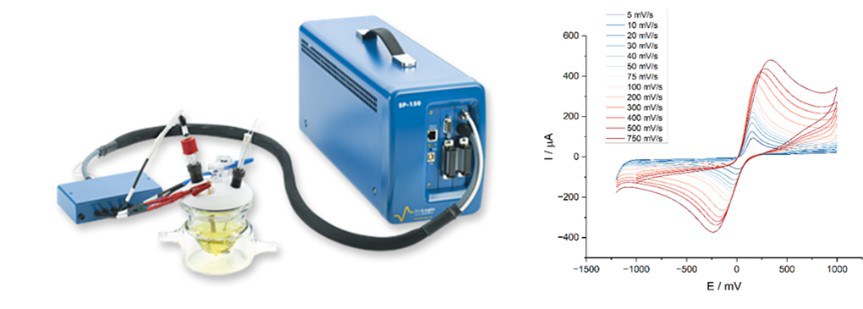
Potentiostat SP150 und Voltammogramm bei verschiedenen Scanraten an K4[Fe(CN6)]
Electrochemical methods such as cyclic voltammetry and differential pulse voltammetry allow for the determination of the oxidation and reduction behavior of the respective analytes, as well as the measurement of the concentration of redox-active compounds. Particularly in the context of measuring the imbalance of reactive oxygen species (ROS) during oxidative stress (OS)—as occurs in many pathologies—electrochemical analytical methods offer a rapid and relatively straightforward way to assess the antioxidant status of samples. Low-molecular-weight antioxidants, in particular, can be determined in this manner.
Spectroelectrochemical methods combine electrochemical control with spectroscopic detection, thereby offering unique insights into structure-function relationships during the oxidation or reduction of redox-active components. Particularly with complex biological samples, this approach—by coupling traditional spectroscopic methods with electrochemistry—enables better identification of the spectral components of redox-active compounds.
Modern biomodified electrodes also enable the highly sensitive detection of specific biomarkers.
Research Focus
Our scientific research focuses on the study of electron transfer mechanisms, particularly in proteins. The goal is to understand the fundamental principles of electron transfer (ET) at the molecular level and to develop innovative analytical and diagnostic applications in the School of Medicine based on these findings. The combination of state-of-the-art electrochemical and spectroelectrochemical methods allows us to investigate both the kinetic and structural aspects of these processes in detail.