
Oct 08, 2026
ZML seminar with Aleksi Sutinen: "Versatile approaches to studying macromolecular dynamics using time-resolved SAXS" 27th Oktober 2026 | 03:00pm | CRTD-Auditorium links
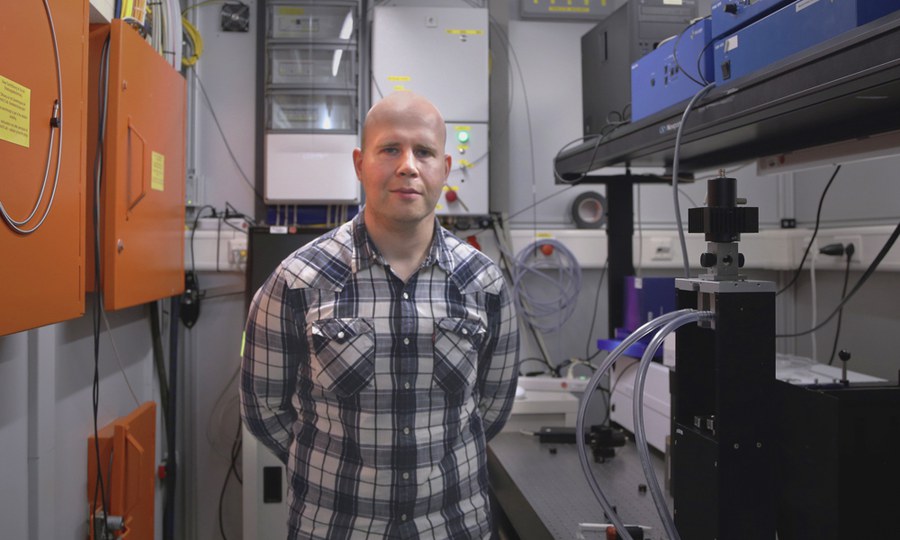
Volker Kiessling
Aleksi Sutinen: Time-resolved SAXS
On 27 October 2026, the ZML welcomes Aleksi Sutinen, Postdoctoral Fellow at EMBL Hamburg in the Clément Blanchet Group, for a guest lecture. His talk, entitled “Versatile approaches to studying macromolecular dynamics using time-resolved SAXS”, will take place at 3:00 p.m. in the CRTD Auditorium Left side and will be held in English.
Aleksi Sutinen’s focus includes BioSAXS, soft-matter SAXS and structural biology, with a particular focus on lipid nanoparticles, membrane proteins, photoactive biomolecules and microfluidics. In his talk, he will discuss the potential of time-resolved small-angle X-ray scattering (TR-SAXS) for investigating dynamic processes in biological macromolecules.
Abstract
Small-angle X-ray scattering (SAXS) is a versatile solution-based method for studying the structure, interactions, and assembly of biological macromolecules. At the EMBL P12 BioSAXS beamline at PETRA III, highly automated sample handling and data collection enable rapid characterization of a broad range of biological systems and experimental conditions, providing an efficient route from initial screening to more advanced SAXS experiments, or setting the stage for other techniques in structural biology. Beyond equilibrium measurements, SAXS can directly follow structural changes in solution as they occur. Time-resolved SAXS (TR-SAXS) at P12 extends BioSAXS towards the millisecond-to-second regime, enabling observation of processes such as conformational transitions, biomolecular interactions, folding, assembly and disassembly. Static SAXS characterization provides the essential basis for defining appropriate sample conditions, concentrations and timescales before moving to kinetic measurements. TR-SAXS capabilities at P12 include stopped-flow mixing, microfluidics and light-triggered experiments. Recent developments in sample environments, triggering, and complementary offline spectroscopy are discussed together with experimental examples, practical considerations, and current limitations.