
Jan 08, 2026
From Chaos to Order: Designing MXenes Surface with Record-high Conductivity
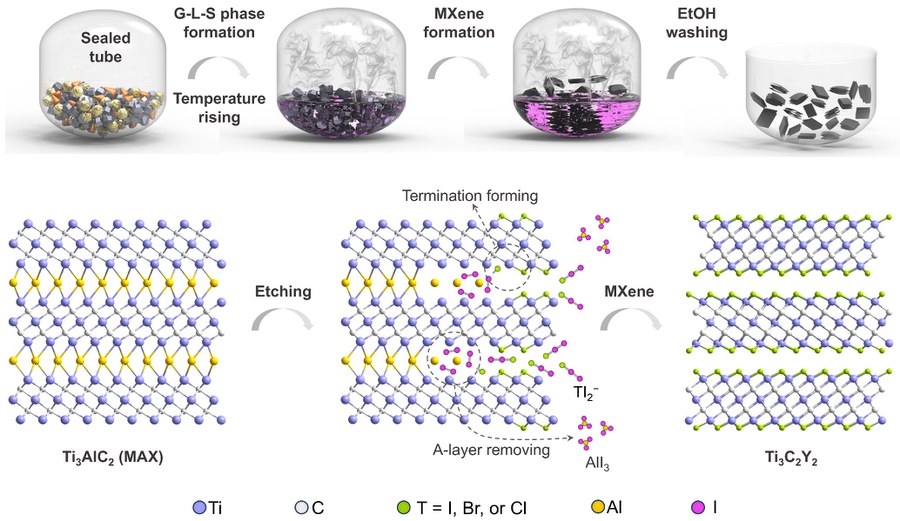
Schematics showing the GLS method and the evolution of the atomic structure during the synthesis of Ti3C2 MXene.
Triphasic Synthesis of MXenes with Uniform and Controlled Halogen Terminations
Two-dimensional transition metal carbides and nitrides, also termed as MXenes, have emerged as a large group of multifunctional materials, characterized by the chemical formula Mn+1XnTx (M: transition metal, X: carbon or nitrogen, Tx: surface terminations). A distinguishing feature of MXenes is their adjustable surface terminations, which cover the exposed metal atoms on the MXene surface. These surface terminations have been shown, both theoretically and experimentally, to determine the intrinsic intra-layer charge transport properties of MXenes by manipulating the electronic structure of the surface metal atoms. However, the currently reported MXenes often possess mixed and mostly randomly distributed terminations, leading to surface disordering that causes severe electron trapping and scattering, consequently compromising the intrinsic charge transport. Moreover, the lack of MXenes with uniform terminations poses a substantial obstacle to experimentally determining the impact of specific terminations on both intrinsic charge transport and inter-grain electron hopping. The random arrangement of terminations on MXenes stems from the intricate top-down etching synthesis process used to produce these materials from layered ternary metal carbides/nitrides (MAX phases). Typically, the synthesis process involves selectively removing the A-layers (for example Al or Si) of MAX using strong acidic etchants, which exposes the transition metal atom layers to the surface. Anionic species in the reaction environment tend to bond with the exposed transition metal atoms for charge balance, acting as terminations on the MXene surface. However, the reported approaches similarly result in MXenes characterized by mixed and randomly distributed terminations. It is highly desirable to develop synthesis methods that can be universally applied to diverse MXenes, while ensuring ordered and uniform terminations.
A recent article by researchers from the Max Planck Institute of Microstructure Physics and TU Dresden, published in Nature Synthesis, presents a “gas-liquid-solid” (GLS) triphasic etching strategy that employs iodine vapor, halide molten salts, and MAX phases to produce MXenes with pure and precisely tunable halogen terminations (Cl, Br, I, or their combinations). In this process, halide molten salts dissolve iodine via interhalogen anion formation while efficiently transporting etching by-products. The resulting MXenes retain excellent structural integrity, yielding uniformly ordered surfaces. As a representative example, Ti3C2Cl2 shows a 160-fold enhancement in macroscopic conductivity and a 13-fold enhancement in terahertz conductivity relative to conventional Cl/O-terminated Ti3C2, attributed to minimized electron trapping and scattering. Beyond single-halogen terminations, the GLS approach enables dual- and triple-halogen termination control, providing a general platform for tailoring MXene surface chemistry toward advanced (opto)electronic applications.
The paper entitled “Triphasic Synthesis of MXenes with Uniform and Controlled Halogen Terminations” by Dongqi Li, Wenhao Zheng, Mahdi Ghorbani-Asl, Juliane Scheiter, Kamil Sobczak, Silvan Kretschmer, Josef Polčák, Pranjali Hirasing Jadhao, Paweł P. Michałowski, Ruoling Yu, Jiaxu Zhang, Jinxin Liu, Jingwei Du, Quanquan Guo, Ehrenfried Zschech, Tomáš Šikola, Mischa Bonn, Nicolás Pérez, Kornelius Nielsch, Arkady V. Krasheninnikov, Hai I. Wang, Minghao Yu, Xinliang Feng can be found at: https://doi.org/10.1038/s44160-025-00970-w