
Nov 23, 2026
POCOCOP Meeting: International Research Group Discusses the Complexity of Constraint Satisfaction Problems
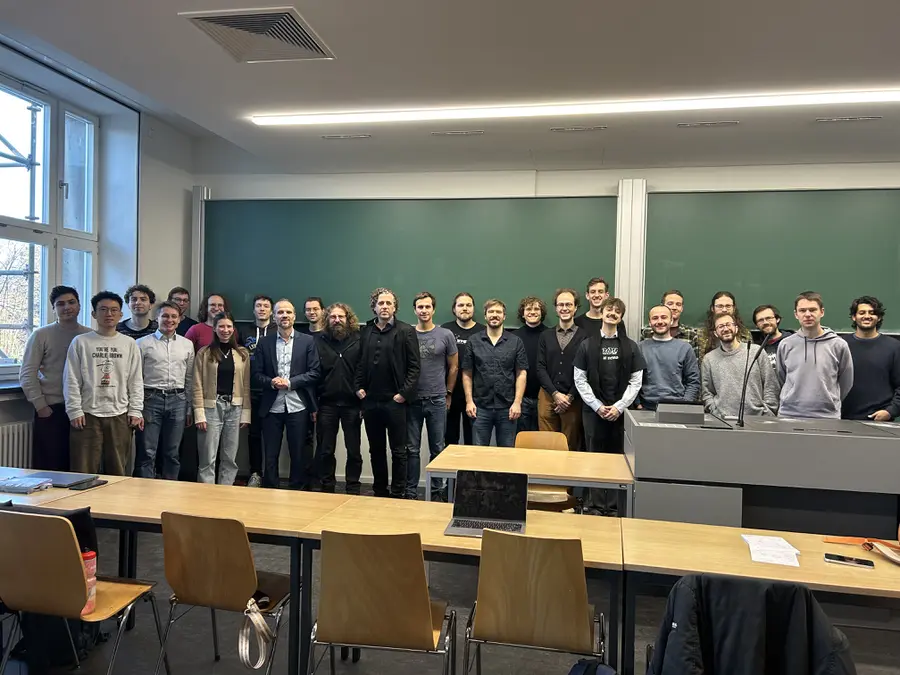
From November 23 to 25, 2026, the Institute of Algebra at TU Dresden welcomed approximately 25 researchers from Charles University in Prague, TU Vienna, and TU Dresden to the fall meeting of the European research project POCOCOP. The international group, which collaborates within the framework of an ERC Synergy Grant, gathered at the Willersbau. There, current results were presented, and participants worked on open problems in collaborative working groups.
POCOCOP is dedicated to fundamental questions regarding the algorithmic complexity of constraint satisfaction problems (CSPs)—a central class of problems in theoretical computer science with connections to combinatorics, logic, and universal algebra.
During the three-day event, seven researchers presented findings on key issues of the project. Libor Barto spoke about the algebraic properties of nilpotent groups in the context of Kompatscher theory, while Christoph Spiess introduced Hrushovski constructions—a tool with powerful capabilities in model theory that has helped explore the limits of complexity classification in constraint satisfaction theory. Sebastian Meyer presented his new dichotomy theorem for approximate graph coloring. Johanna Brunar gave a tutorial on LP/AIP relaxations and block-symmetric polymorphisms; Maximilian Hadek discussed FO reductions and L-hardness; and Neng Huang presented progress on the coloring of 3-colorable graphs. Finally, Leopold Karl spoke about automatic continuity for projective clone homomorphisms.
Between the talks, participants worked in so-called “task forces”: small, assembled in a targeted manner groups dedicated to specific open problems. This combination of individual presentations and collaborative small-group work is a tried-and-true format of the POCOCOP meetings, which fosters intensive discussions and progress on current research questions.
The Dresden meeting was organized by Paul Winkler from the Institute of Algebra at TU Dresden.